


Comparison of the in vitro efficacies of moxifloxacin and amoxicillin against Listeria monocytogenes
- PMID: 18299415
- PMCID: PMC2346626
- DOI: 10.1128/AAC.01211-07
Comparison of the in vitro efficacies of moxifloxacin and amoxicillin against Listeria monocytogenes
Abstract
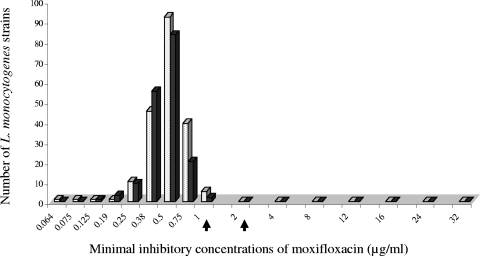
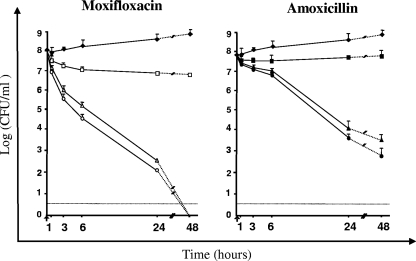
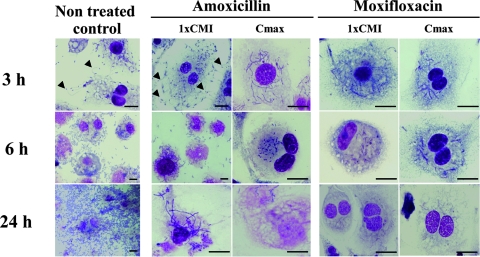
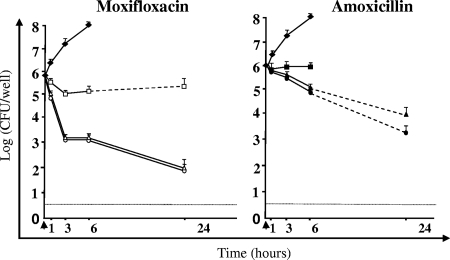
Listeria monocytogenes is a facultative intracellular bacterium that causes severe infections associated with a high mortality rate. Moxifloxacin presents extended activity against gram-positive bacteria and has recently been suggested to be a potential alternative in the treatment of listeriosis. We evaluated the in vitro efficacy of moxifloxacin against L. monocytogenes using a combination of epidemiological and experimental approaches. The median MIC of moxifloxacin for a large collection of L. monocytogenes strains of various origins (human, food, and environment) was 0.5 microg/ml (MIC range, 0.064 to 1 microg/ml). No differences were observed, irrespective of the origin of the strains. Moreover, no cross-resistance with fluoroquinolones was detected in strains that have been reported to be resistant to ciprofloxacin. The in vitro activities of moxifloxacin and amoxicillin were compared by time-kill curve and inhibition of intracellular growth experiments by using a model of bone marrow-derived mouse macrophages infected by L. monocytogenes EGDe. Both moxifloxacin and amoxicillin were bactericidal in broth against extracellular forms of L. monocytogenes. However, moxifloxacin acted much more rapidly, beginning to exert its effects in the first 3 h and achieving complete broth sterilization within 24 h of incubation. Moxifloxacin has a rapid bactericidal effect against intracellular reservoirs of bacteria, whereas amoxicillin is only bacteriostatic and appears to prevent cellular lysis and the subsequent bacterial spreading to adjacent cells. No resistant bacteria were selected during the in vitro experiments. Taken together, our results suggest that moxifloxacin is an interesting alternative to the reference treatment, combining rapid and bactericidal activity, even against intracellular bacteria.
Figures
References
-
- Carryn, S., H. Chanteux, C. Seral, M. P. Mingeot-Leclercq, F. Van Bambeke, and P. M. Tulkens. 2003. Intracellular pharmacodynamics of antibiotics. Infect. Dis. Clin. N. Am. 17:615-634. - PubMed
-
- Carryn, S., F. Van Bambeke, M. P. Mingeot-Leclercq, and P. M. Tulkens. 2002. Comparative intracellular (THP-1 macrophage) and extracellular activities of beta-lactams, azithromycin, gentamicin, and fluoroquinolones against Listeria monocytogenes at clinically relevant concentrations. Antimicrob. Agents Chemother. 46:2095-2103. - PMC - PubMed
-
- Charpentier, E., G. Gerbaud, C. Jacquet, J. Rocourt, and P. Courvalin. 1995. Incidence of antibiotic resistance in Listeria species. J. Infect. Dis. 172:277-281. - PubMed
-
- Clinical and Laboratory Standards Institute. 2006. Methods for antimicrobial dilution and disk susceptibility testing of infrequently isolated or fastidious bacteria. Approved standard M45-A. Clinical and Laboratory Standards Institute, Wayne, PA. - PubMed
Publication types
MeSH terms
Substances
LinkOut - more resources
Full Text Sources
