A comparison of blood pressure measurement over a sleeved arm versus a bare arm
- PMID: 18299548
- PMCID: PMC2244664
- DOI: 10.1503/cmaj.070975
A comparison of blood pressure measurement over a sleeved arm versus a bare arm
Abstract
Background: The measurement of blood pressure is a common clinical exam with important health consequences. We sought to determine whether the measurement of blood pressure over a sleeved arm varies from that taken on a bare arm.
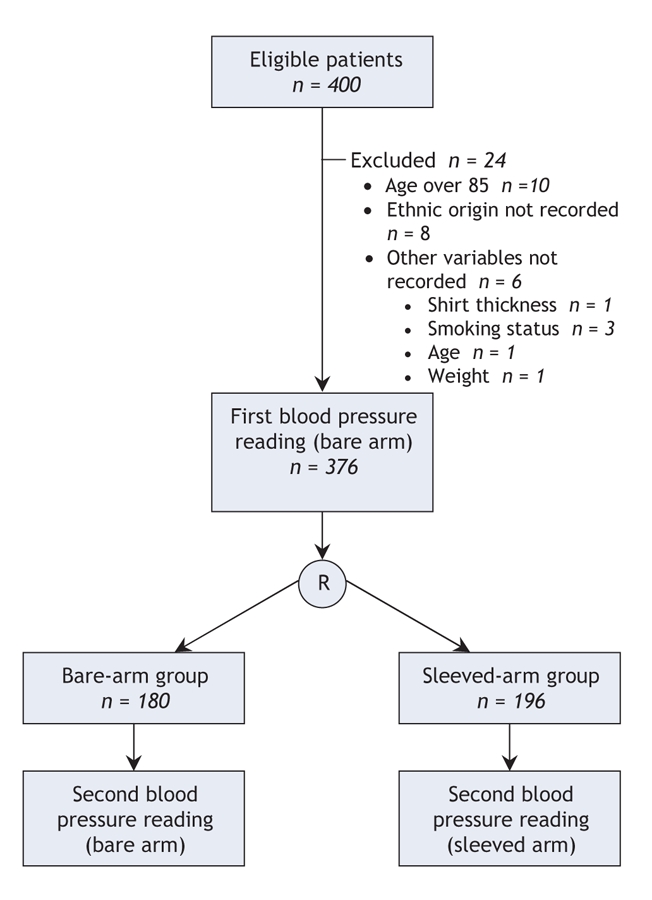
Methods: We recruited 376 patients between 18 and 85 years of age from a family medicine clinic between September 2004 and November 2006. They all had their blood pressure recorded using the same automatic oscillometric device, with the cuff placed over their bare arms for the first reading. Each patient was then randomly assigned to either the bare-arm group, for which the second blood pressure reading was also taken on a bare arm, or the sleeved-arm group, for which the second reading was taken with the cuff placed over the patient's sleeve.
Results: The mean age of the 376 participants was 61.6 years (standard deviation 15.0), 61% of the participants were male, 41% had hypertension and 11.7% had diabetes. We found no clinically important differences between the bare-arm group (n = 180) and the sleeved-arm group (n = 196) in age, sex or body mass index. The mean differences between the first and second readings for patients in the bare-arm group were 4.1 mm Hg (95% confidence interval [CI] 2.8 to 5.5) for systolic blood pressure and 0.1 mm Hg (95% CI -0.7 to 0.9) for diastolic blood pressure. The mean differences between the first and second readings for patients in the sleeved-arm group were 3.4 mm Hg (95% CI 2.1 to 4.7) for systolic blood pressure and 0.4 mm Hg (95% CI -0.4 to 1.3) for diastolic blood pressure. The between-group differences in these values was 0.76 mm Hg (95% CI -1.13 to 2.65) for systolic and -0.31 mm Hg (95% CI -1.48 to 0.86) for diastolic blood pressure; neither of these differences was clinically important or statistically significant.
Interpretation: We found that there was no significant difference in blood pressure recorded over a sleeve or on a bare arm. For practical purposes, the decision to measure blood pressure on a bare arm or over a sleeved arm should be left to the judgment of the health care professional taking the blood pressure.
Figures
Comment in
-
Measuring blood pressure: a call to bare arms?CMAJ. 2008 Feb 26;178(5):591-3. doi: 10.1503/cmaj.071787. CMAJ. 2008. PMID: 18299549 Free PMC article. No abstract available.
References
-
- Chobanian AV, Bakris GL, Black HR, et al. The seventh report of the Joint National Committee on Prevention, Detection, Evaluation, and Treatment of High Blood Pressure: the JNC 7 report. JAMA 2003;289:2560-72. - PubMed
-
- Guidelines Subcommittee. 1999 World Health Organization–International Society of Hypertension guidelines for the management of hypertension. J Hypertens 1999;17:151-83. - PubMed
-
- Holleman DR Jr, Westman EC, McCrory DC, et al. The effect of sleeved arms on oscillometric blood pressure measurement. J Gen Intern Med 1993;8:325-6. - PubMed
-
- Kahan E, Yaphe J, Knaani-Levinz H, et al. of blood pressure measurements on the bare arm, below a rolled-up sleeve, or over a sleeve. Fam Pract 2003;20:730-2. - PubMed
-
- Liebl M, Holzgreve H, Schulz M, et al. The effect of clothes on sphygmomanometric and oscillometric blood pressure measurement. Blood Press 2004;13:279-82. - PubMed
Publication types
MeSH terms
LinkOut - more resources
Full Text Sources
Other Literature Sources
Medical