


Nuclear receptor coactivator/coregulator NCoA6(NRC) is a pleiotropic coregulator involved in transcription, cell survival, growth and development
- PMID: 18301782
- PMCID: PMC2254332
- DOI: 10.1621/nrs.06002
Nuclear receptor coactivator/coregulator NCoA6(NRC) is a pleiotropic coregulator involved in transcription, cell survival, growth and development
Abstract
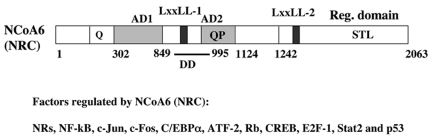
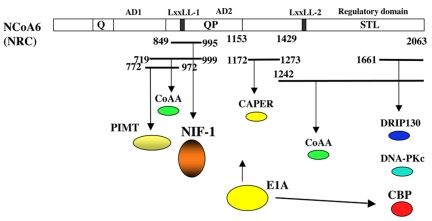
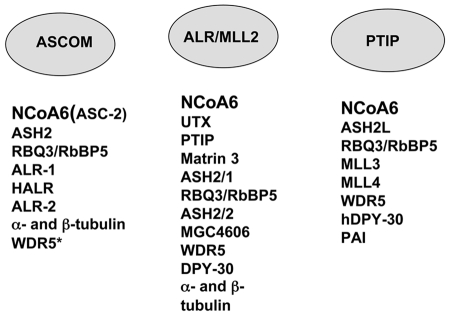
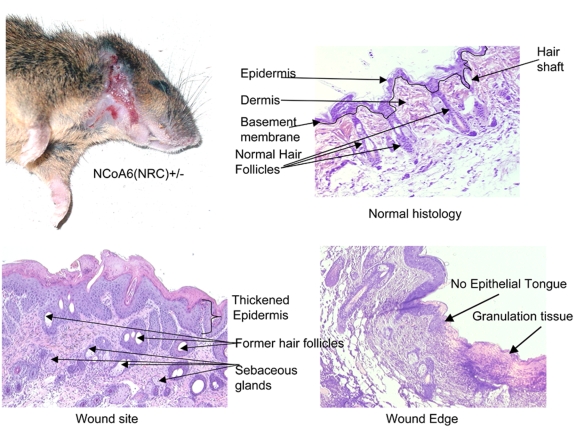
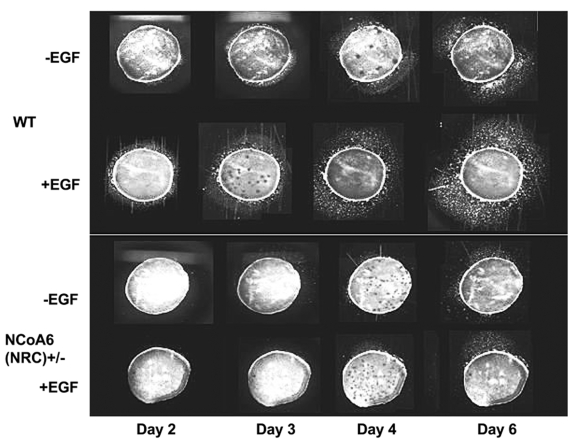
NCoA6 (also referred to as NRC, ASC-2, TRBP, PRIP and RAP250) was originally isolated as a ligand-dependent nuclear receptor interacting protein. However, NCoA6 is a multifunctional coregulator or coactivator necessary for transcriptional activation of a wide spectrum of target genes. The NCoA6 gene is amplified and overexpressed in breast, colon and lung cancers. NCoA6 is a 250 kDa protein which harbors a potent N-terminal activation domain, AD1; and a second, centrally-located activation domain, AD2, which is necessary for nuclear receptor signaling. The intrinsic activation potential of NCoA6 is regulated by its C-terminal STL regulatory domain. Near AD2 is an LxxLL-1 motif which interacts with a wide spectrum of ligand-bound NRs with high-affinity. A second LxxLL motif (LxxLL-2) located towards the C-terminal region is more restricted in its NR specificity. The potential role of NCoA6 as a co-integrator is suggested by its ability to enhance transcriptional activation of a wide variety of transcription factors and from its in vivo association with a number of known cofactors including CBP/p300. NCoA6 has been shown to associate with at least three distinct coactivator complexes containing Set methyltransferases as core polypeptides. The composition of these complexes suggests that NCoA6 may play a fundamental role in transcriptional activation by modulating chromatin structure through histone methylation. Knockout studies in mice suggest that NCoA6 is an essential coactivator. NCoA6-/- embryos die between 8.5-12.5 dpc from general growth retardation coupled with developmental defects in the heart, liver, brain and placenta. NCoA6-/- MEFs grow at a reduced rate compared to WT MEFs and spontaneously undergo apoptosis, indicating the importance of NCoA6 as a prosurvival and anti-apoptotic gene. Studies with NCoA6+/- and conditional knockout mice suggest that NCoA6 is a pleiotropic coregulator involved in growth, development, wound healing and maintenance of energy homeostasis.
Figures
References
-
- Angel P., Szabowski A., Schorpp-Kistner M. Function and regulation of AP-1 subunits in skin physiology and pathology. Oncogene. 2001;20:2413–23. - PubMed
-
- Anghel S. I., Wahli W. Fat poetry: a kingdom for PPARgamma. Cell Res. 2007;17:486–511. - PubMed
-
- Antonson P., Al-Beidh F., Matthews J., Gustafsson J. A. The human RAP250 gene: genomic structure and promoter analysis. Gene. 2004;327:233–8. - PubMed
-
- Anzick S. L., Kononen J., Walker R. L., Azorsa D. O., Tanner M. M., Guan X. Y., Sauter G., Kallioniemi O. P., Trent J. M., Meltzer P. S. AIB1, a steroid receptor coactivator amplified in breast and ovarian cancer. Science. 1997;277:965–8. - PubMed
Publication types
MeSH terms
Substances
Grants and funding
LinkOut - more resources
Full Text Sources
Miscellaneous
