


Longitudinal trends in use of bone mass measurement among older americans, 1999-2005
- PMID: 18302495
- PMCID: PMC2497454
- DOI: 10.1359/jbmr.080232
Longitudinal trends in use of bone mass measurement among older americans, 1999-2005
Abstract
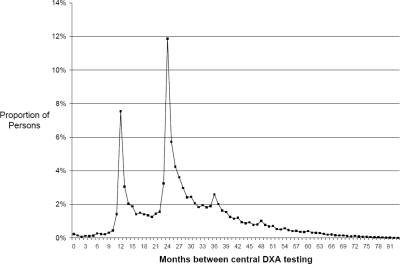
Bone mass measurement (BMM) is useful to identify persons with low bone mass who are at increased risk for fracture. Given the increased emphasis that is being placed on preventive services such as screening for osteoporosis, we evaluated trends in BMM among Medicare beneficiaries. We studied a 5% sample of Medicare beneficiaries >or=65 yr of age in 1999-2005. We identified claims for BMM tests performed in both facility and nonfacility settings, evaluated temporal trends in use of these tests, and described the proportion of tests attributable to each specialty of physicians submitting claims. We also assessed patterns of serial testing among individuals who were tested more than once. Claims data from all years were pooled to describe the proportion of persons in the population ever tested. From 1999 to 2005, use of central DXA increased by approximately 50%, and use of peripheral DXA declined. The greatest increases in central DXA occurred among internists, family practitioners, and gynecologists. In 1999, the proportion of 65-yr-old women tested was 8.4%; this increased to 12.9% in 2005. Corresponding proportions for men were 0.6% and 1.7%, respectively. Between 40% and 73% of persons receiving central DXA were retested, most at approximately 2-yr intervals. Aggregating data across all years for whites and blacks, 30.0% of women and 4.4% of men underwent central DXA at least once. We conclude that, although use of DXA steadily increased from 1999 to 2005, only approximately 30% of women and 4% of men at least 65 yr old had a central DXA study. Given the importance of central DXA to assess the risk of osteoporotic fractures, strategies to increase central DXA use to test at-risk persons are warranted.
Figures
References
-
- Siris ES, Miller PD, Barrett-Connor E, Faulkner KG, Wehren LE, Abbott TA, Berger ML, Santora AC, Sherwood LM. Identification and fracture outcomes of undiagnosed low bone mineral density in postmenopausal women: Results from the National Osteoporosis Risk Assessment. JAMA. 2001;286:2815–2822. - PubMed
-
- Nelson HD, Helfand M, Woolf SH, Allan JD. Screening for postmenopausal osteoporosis: A review of the evidence for the U.S. Preventive Services Task Force. Ann Intern Med. 2002;137:529–541. - PubMed
-
- International Society for Clinical Densitometry. Position statement: Executive summary. The Writing Group for the International Society for Clinical Densitometry (ISCD) Position Development Conference. J Clin Densitom. 2004;7:7–12. - PubMed
-
- National Osteoporosis Foundation. Belle, Mead, NJ, USA: Excerpta Medica; 1998. Physician's Guide to Prevention and Treatment of Osteoporosis.
-
- Cadarette SM, Gignac MA, Jaglal SB, Beaton DE, Hawker GA. Access to osteoporosis treatment is critically linked to access to dual-energy x-ray absorptiometry testing. Med Care. 2007;45:896–901. - PubMed
MeSH terms
Grants and funding
LinkOut - more resources
Full Text Sources
Medical
