


Increased plasma osteoprotegerin concentrations are associated with indices of bone strength of the hip
- PMID: 18303076
- PMCID: PMC2386280
- DOI: 10.1210/jc.2007-2492
Increased plasma osteoprotegerin concentrations are associated with indices of bone strength of the hip
Abstract
Objective: Osteoprotegerin (OPG) is an important regulator of bone turnover through its effects on osteoclastogenesis, yet findings from previous studies of circulating OPG and commonly measured bone indices in humans have been conflicting. We conducted a cross-sectional study to evaluate the association between plasma OPG and femoral neck (FN) bone density (BMD) and geometry in a large cohort of women and men.
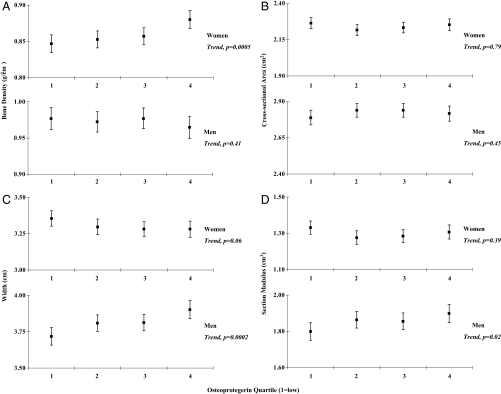
Design: Participants included 1379 postmenopausal women and 1165 men, aged 50-89 yr (mean, 64 yr), in the Framingham Offspring Study. Dual x-ray absorptiometry was used to evaluate FN BMD and geometry (bone width, section modulus, and cross-sectional area at the narrow neck region). Plasma OPG concentrations were measured by ELISA. Sex-specific analysis of covariance was used to calculate means and assess linear trend in BMD and geometry values across OPG quartiles, adjusted for confounders.
Results: OPG concentrations were greater in women than men, increased with age, and were greater in smokers and those with diabetes and heart disease. Multivariable-adjusted mean FN BMD in women increased from the lowest to the highest OPG quartile (trend, P < 0.01). However, no linear trend between FN BMD and OPG was observed in men (trend, P = 0.34). Section modulus and bone width increased with OPG in men (trend, P < 0.01), whereas no association between hip geometry indices and OPG was observed in women.
Conclusion: Higher OPG concentration may indicate greater skeletal strength in women and men, possibly through reducing bone loss in women and increasing periosteal apposition in men.
Figures
References
-
- Lacey DL, Timms E, Tan HL, Kelley MJ, Dunstan CR, Burgess T, Elliott R, Colombero A, Elliott G, Scully S, Hsu H, Sullivan J, Hawkins N, Davy E, Capparelli C, Eli A, Qian YX, Kaufman S, Sarosi I, Shalhoub V, Senaldi G, Guo J, Delaney J, Boyle WJ 1998 Osteoprotegerin ligand is a cytokine that regulates osteoclast differentiation and activation. Cell 93:165–176 - PubMed
-
- Simonet WS, Lacey DL, Dunstan CR, Kelley M, Chang MS, Luthy R, Nguyen HQ, Wooden S, Bennett L, Boone T, Shimamoto G, DeRose M, Elliott R, Colombero A, Tan HL, Trail G, Sullivan J, Davy E, Bucay E, Renshaw-Gegg L, Hughes TM, Hill D, Pattison W, Campbell P, Boyle WJ 1997 Osteoprotegerin: a novel secreted protein involved in the regulation of bone density. Cell 89:309–319 - PubMed
-
- Mizuno A, Amizuka N, Irie K, Murakami A, Fujise N, Kanno T, Sato Y, Nakagawa N, Yasuda H, Mochizuki S, Gomibuchi T, Yano K, Shima N, Washida N, Tsuda E, Morinaga T, Higashio K, Ozawa H 1998 Severe osteoporosis in mice lacking osteoclastogenesis inhibitory factor/osteoprotegerin. Biochem Biophys Res Commun 247:610–615 - PubMed
-
- Kong YY, Feige U, Sarosi I, Bolon B, Tafuri A, Morony S, Capparelli C, Li J, Elliott R, McCabe S, Wong T, Campagnuolo G, Moran E, Bogoch ER, Van G, Nguyen LT, Ohashi PS, Lacey DL, Fish E, Boyle WJ, Penninger JM 1999 Activated T cells regulate bone loss and joint destruction in adjuvant arthritis through osteoprotegerin ligand. Nature 402:304–309 - PubMed
Publication types
MeSH terms
Substances
Grants and funding
- K01 AR053118/AR/NIAMS NIH HHS/United States
- R01 HL076784/HL/NHLBI NIH HHS/United States
- R01 AR/AG 41398/AG/NIA NIH HHS/United States
- R01 AR041398/AR/NIAMS NIH HHS/United States
- R01 AG 028321/AG/NIA NIH HHS/United States
- N01 HC 25195/HC/NHLBI NIH HHS/United States
- R01 AR 050066/AR/NIAMS NIH HHS/United States
- K01 AR 053118/AR/NIAMS NIH HHS/United States
- R01 HL 076784/HL/NHLBI NIH HHS/United States
- N01 HC025195/HL/NHLBI NIH HHS/United States
- R01 AR050066/AR/NIAMS NIH HHS/United States
- R01 AG028321/AG/NIA NIH HHS/United States
LinkOut - more resources
Full Text Sources
Medical
Miscellaneous
