. 2008 Mar 27;452(7186):487-91.
doi: 10.1038/nature06608. Epub 2008 Feb 27.

SLAC1 is required for plant guard cell S-type anion channel function in stomatal signalling

Affiliations

SLAC1 is required for plant guard cell S-type anion channel function in stomatal signalling

Triin Vahisalu et al. Nature. .

Abstract

Stomatal pores, formed by two surrounding guard cells in the epidermis of plant leaves, allow influx of atmospheric carbon dioxide in exchange for transpirational water loss. Stomata also restrict the entry of ozone--an important air pollutant that has an increasingly negative impact on crop yields, and thus global carbon fixation and climate change. The aperture of stomatal pores is regulated by the transport of osmotically active ions and metabolites across guard cell membranes. Despite the vital role of guard cells in controlling plant water loss, ozone sensitivity and CO2 supply, the genes encoding some of the main regulators of stomatal movements remain unknown. It has been proposed that guard cell anion channels function as important regulators of stomatal closure and are essential in mediating stomatal responses to physiological and stress stimuli. However, the genes encoding membrane proteins that mediate guard cell anion efflux have not yet been identified. Here we report the mapping and characterization of an ozone-sensitive Arabidopsis thaliana mutant, slac1. We show that SLAC1 (SLOW ANION CHANNEL-ASSOCIATED 1) is preferentially expressed in guard cells and encodes a distant homologue of fungal and bacterial dicarboxylate/malic acid transport proteins. The plasma membrane protein SLAC1 is essential for stomatal closure in response to CO2, abscisic acid, ozone, light/dark transitions, humidity change, calcium ions, hydrogen peroxide and nitric oxide. Mutations in SLAC1 impair slow (S-type) anion channel currents that are activated by cytosolic Ca2+ and abscisic acid, but do not affect rapid (R-type) anion channel currents or Ca2+ channel function. A low homology of SLAC1 to bacterial and fungal organic acid transport proteins, and the permeability of S-type anion channels to malate suggest a vital role for SLAC1 in the function of S-type anion channels.


Figures
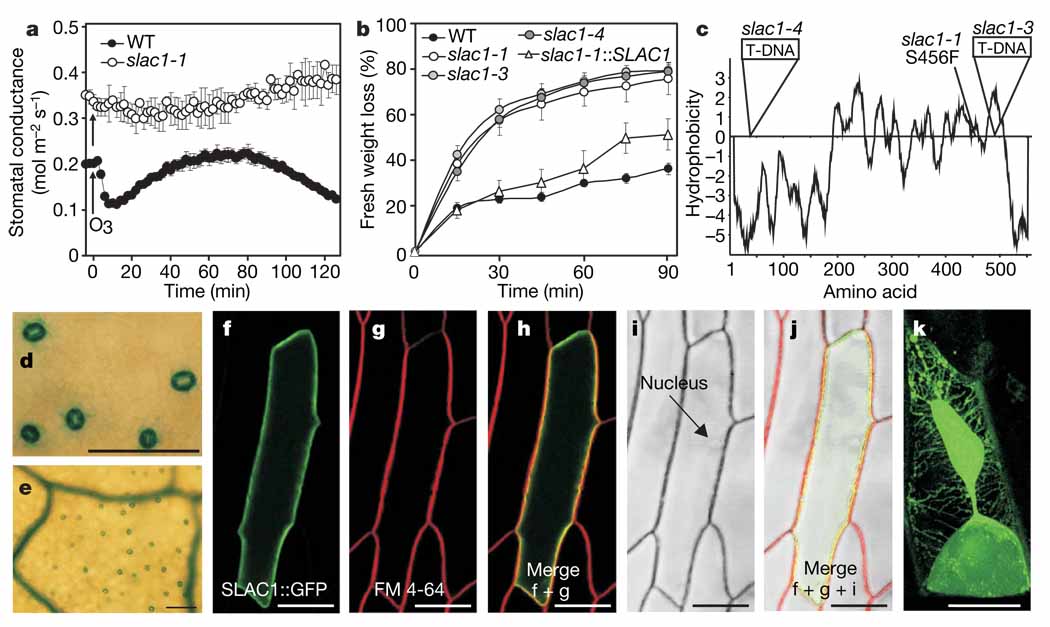
Figure 1
Figure 1. Membrane protein SLAC1 controls leaf ozone and water-loss responses
a, Stomatal conductance (n = 10,±s.e.m.) of slac1-1 and wild-type plants after onset of 200 p.p.b. ozone, indicated by arrows. b, Weight loss from detached leaves of wild type (WT), slac1 alleles and slac1-1 complemented with the SLAC1 gene (n = 5,±s.e.m.). c, Membrane spanning hydrophobic regions in SLAC1 protein and the location of mutant alleles. d, e, GUS activity in SLAC1 promoter uidA reporter lines. f, SLAC1::GFP translational fusion expressed in onion epidermal cells. g, Area as in f, membranes stained with FM4-64. h, Overlay of f and g. i, Light micrograph of h. j, Overlay of h, and i. k, SLAC1::GFP translational fusion in plasmolysed onion epidermal cells renders the Hechtian strands attaching the plasma membrane to the cell wall visible. Scale bars: d–j, 100 µm; k, 50 µm.
Figure 2
Figure 2. Mutations in SLAC1 impair stomatal responses to changes in environment
a, Diurnal dark/light stomatal conductance response in slac1 and wild-type plants with±s.e.m. (n = 3). b, Time courses of stomatal responses to changes in light intensity. c, Time courses of stomatal response to changes in airhumidity. d, Time courses of stomatal response to changes in CO2 concentration. Stomatal responses were monitored with an Arabidopsis whole-rosette gas-exchange system, and values in b–d were normalized to conductances at 0 min and represent averages (±s.e.m.) of four rosettes.
Figure 3
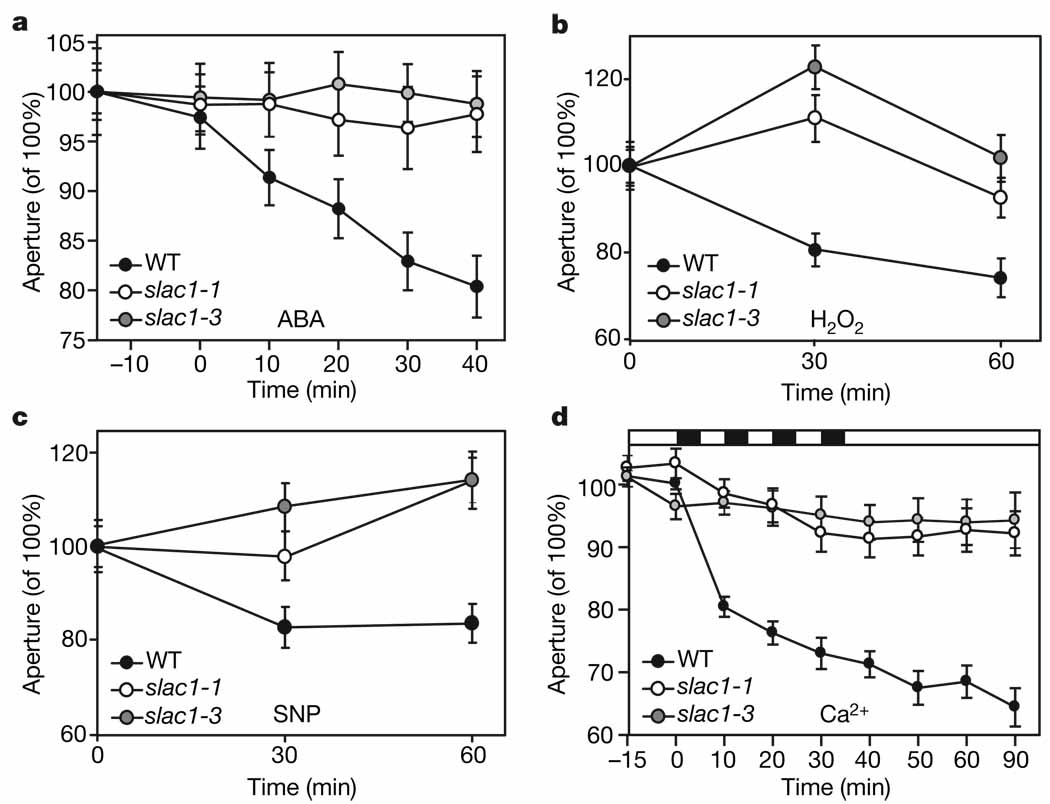
Figure 3. Impaired stomatal responses to ABA, H2O2, NO and Ca2+ in slac1
a, Time-course experiments of ABA-induced stomatal closure. ABA (1 µM) was added at time = 0 (n = 3 experiments, 28, 23 and 57 stomata for slac1-1, slac1-3 and wild type, respectively). Stomatal apertures at time = 0 (100%) corresponded to average stomatal apertures of 2.82±0.16 µm (wild type), 2.88±0.12 µm in slac1-1 and 3.23±0.08 µm in slac1-3. b, c, Time course of stomatal closure induced by H2O2 (100 µM) (b) and NO (derived from 50 µM SNP) (c). n = 3–5 independent experiments, 20 stomata per experiment. d, Impairment in stomatal closure in response to four transient 5-min extracellular applications of 1 mM CaCl2 and 1 mM KCl (black strips at top; n = 3 experiments, 48, 24 and 32 stomata for wild type, slac1-1 and slac1-3, respectively). Imposed intracellular Ca2+ transients (see Supplementary Fig. 7) were followed by 5-min exposures to a depolarizing solution containing 0 mM CaCl2 and 50 mM KCl (white strips at top) as previously described. Stomatal apertures at time = 0 (100%) corresponded to average stomatal apertures of 3.56±0.10 µm, 3.93±0.14 µm and 3.56±0.10 µm in wild type, slac1-1 and slac1-3, respectively. Error bars depict means±s.e.m.
Figure 4
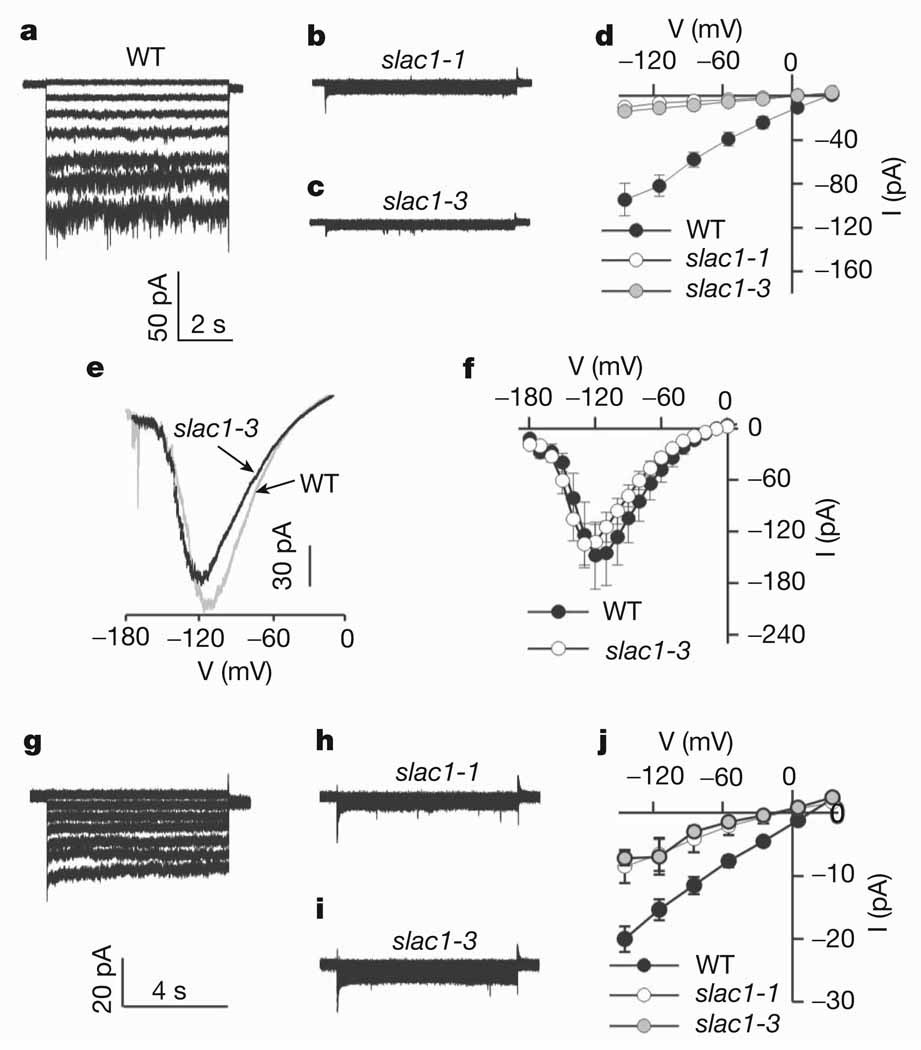
Figure 4. Ca2+ and ABA activations of S-type anion channels are impaired in slac1 guard cells
a–d, Ca2+ activation of S-type anion channels. a–c, Whole-cell recordings of S-type anion currents in wild type (a), slac1-1 (b) and slac1-3 (c). d, Average current–voltage curves of S-type anion channel currents recorded in wild type (n = 7), slac1-1 (n = 12) and slac1-3 (n = 10). e, f, Typical R-type anion channel recordings (e), and average current–voltage curves in wild type (n = 3) and slac1-3 (n = 6) (f). g–j, ABA activation of S-type anion channels. g–i, Typical recordings in wild type (g), slac1-1 (h) and slac1-3 (i). j, Average current–voltage curves recorded in wild type (n = 10), slac1-1 (n = 8) and slac1-3 (n = 8). Error bars depict means±s.e.m.

References

    1. Hopkin M. Carbon sinks threatened by increasing ozone. Nature. 2007;448:396–397. - PubMed
    1. Sitch S, Cox PM, Collins WJ, Huntingford C. Indirect radiative forcing of climate change through ozone effects on the land-carbon sink. Nature. 2007;448:791–794. - PubMed
    1. MacRobbie EAC. Signal transduction and ion channels in guard cells. Phil. Trans. R. Soc. Lond. B. 1998;353:1475–1488. - PMC - PubMed
    1. Hetherington AM, Woodward FI. The role of stomata in sensing and driving environmental change. Nature. 2003;424:901–908. - PubMed
    1. Webb AAR, Hetherington A. Convergence of the abscisic acid, CO2, and extracellular calcium signal transduction pathways in stomatal guard cells. Plant Physiol. 1997;114:1557–1560. - PMC - PubMed

Publication types

MeSH terms