. 2008;18(6):575-83.
doi: 10.1002/hipo.20417.

New semantic learning in patients with large medial temporal lobe lesions

Affiliations

New semantic learning in patients with large medial temporal lobe lesions

P J Bayley et al. Hippocampus. 2008.

Abstract

Two patients with large lesions of the medial temporal lobe were given four tests of semantic knowledge that could only have been acquired after the onset of their amnesia. In contrast to previous studies of postmorbid semantic learning, correct answers could be based on a simple, nonspecific sense of familiarity about single words, faces, or objects. According to recent computational models (for example, Norman and O'Reilly (2003) Psychol Rev 110:611-646), this characteristic should be optimal for detecting the kind of semantic learning that might be supported directly by the neocortex. Both patients exhibited some capacity for new learning, albeit at a level substantially below control performances. Notably, the correct answers appeared to reflect declarative memory. It was not the case that the correct answers simply popped out in some automatic way in the absence of any additional knowledge about the items. Rather, the few correct choices made by the patients tended to be accompanied by additional information about the chosen items, and the available knowledge appeared to be similar qualitatively to the kind of factual knowledge that healthy individuals gradually acquire over the years. The results are consistent with the idea that neocortical structures outside the medial temporal lobe are able to support some semantic learning, albeit to a very limited extent. Alternatively, the small amount of learning detected in the present study could depend on tissue within the posterior medial temporal lobe that remains intact in both patients.


Figures

FIGURE 1
FIGURE 1
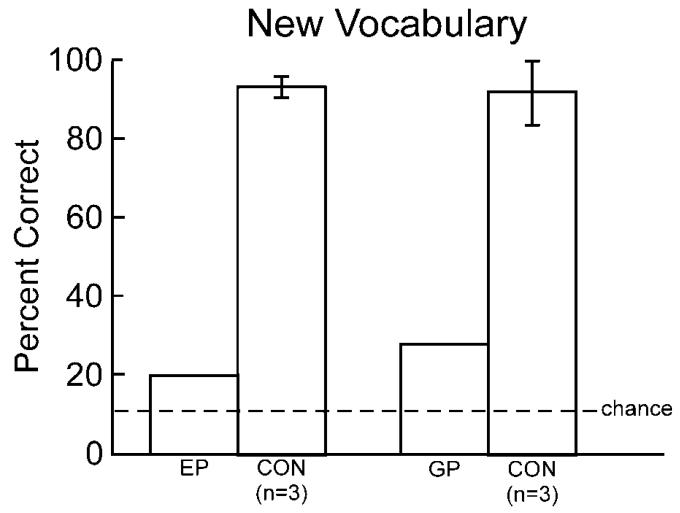
New vocabulary. Performance of patients E.P., G.P., and controls (CON) on 25 multiple-choice questions about vocabulary words that could only have been learned after the onset of amnesia. Each test item contained one target word (e.g., Prozac) and eight foil words (e.g., Flozac, Prozam, Grodaz, etc). Brackets show standard error of the mean, and the dashed line indicates chance performance (11.1%).
FIGURE 2
FIGURE 2
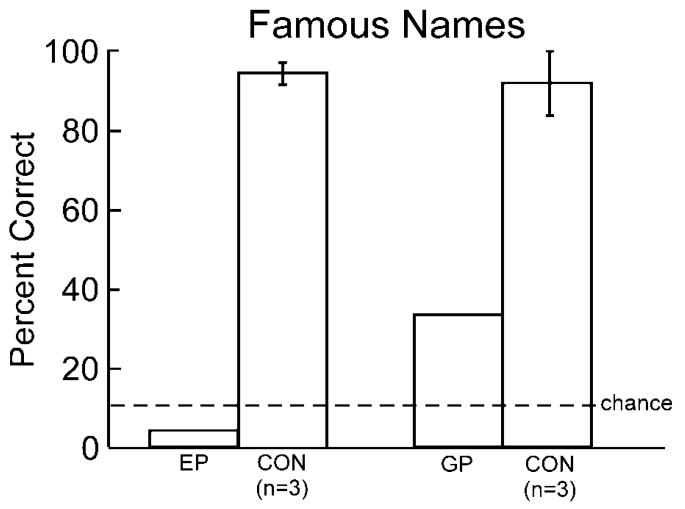
Famous names. Performance of patients E.P., G.P., and controls (CON) on 24 multiple-choice questions about people who had become well-known after the onset of amnesia (e.g., Colin Powell). Each test item contained one target name and eight foil names (e.g., Ralph Penfield, Peter Bergey, John Musser, etc.). Brackets show standard error of the mean, and the dashed line indicates chance performance (11.1%).
FIGURE 3
FIGURE 3
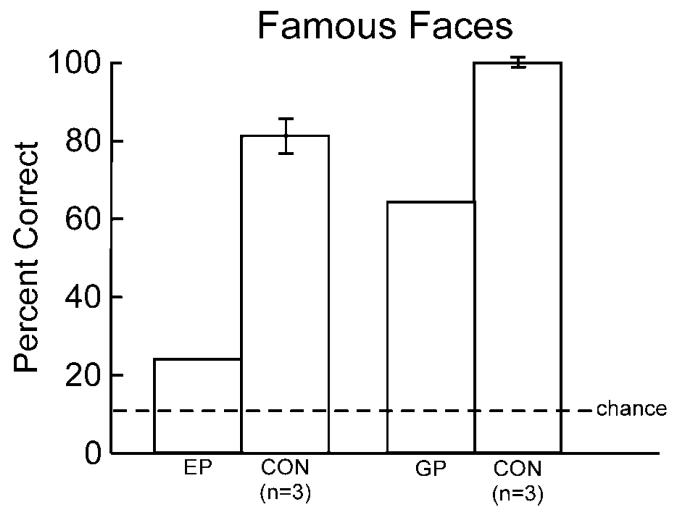
Famous faces. Performance of patients E.P., G.P., and controls (CON) on 25 multiple-choice questions about people who had become famous after the onset of amnesia. Each test item contained a photograph of a famous person (e.g., President George W. Bush) and eight nonfamous persons who matched the target photograph with respect to age, gender and the style of the photograph. Brackets show standard error of the mean, and the dashed line indicates chance performance (11.1%).
FIGURE 4
FIGURE 4
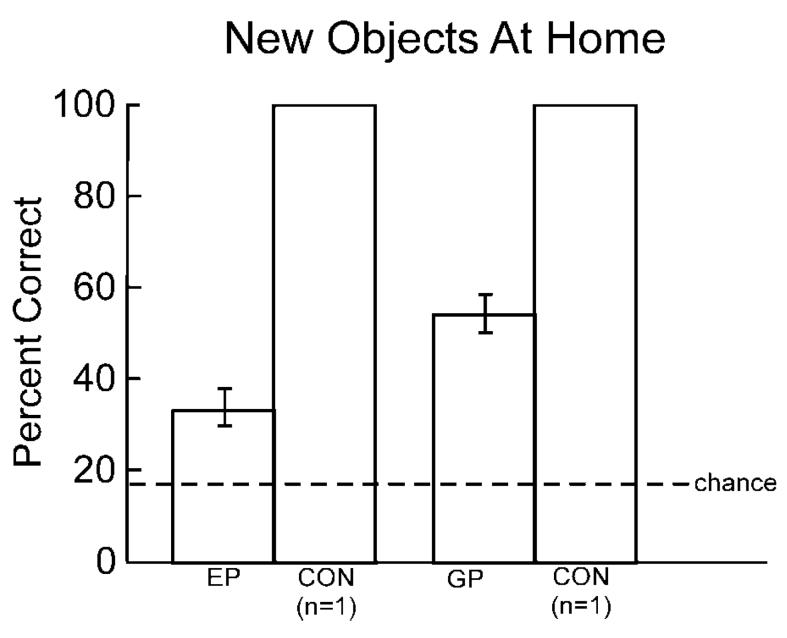
New objects at home. Performance of patients E.P., G.P., and controls (CON) on eight multiple-choice questions about objects that were acquired by the patient's household after the onset of amnesia (e.g., car, lamp, table). Each test item consisted of a photograph of the target object and five photographs of different exemplars of the same object (e.g., a different lamp). The patients' spouses served as controls. Brackets show standard error of the mean, and the dashed line indicates chance performance (16.7%).
FIGURE 5
FIGURE 5
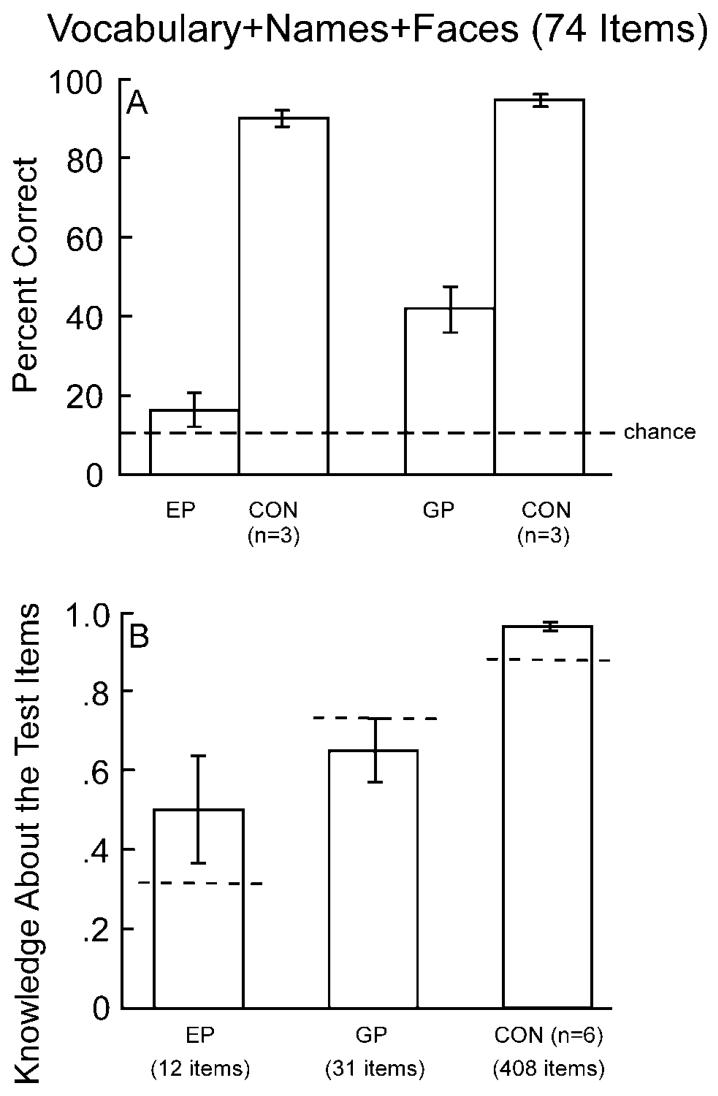
Summary of performance on the tests of new vocabulary, famous names, and famous faces. (A) Mean percent correct. Brackets show standard error of the mean, and the dashed line indicates chance performance (11.1%). (B) Declarative knowledge available to participants about their correct answers. After each response, participants were asked to provide any information they could about the selected item. (0 = no knowledge, 1 = some knowledge about the item). An “expected” score was also calculated (dashed line). The expected score is the score that would have been obtained if participants had guessed the correct answer 11.1% of the time and had some declarative knowledge about their other correct answers.
FIGURE 6
FIGURE 6
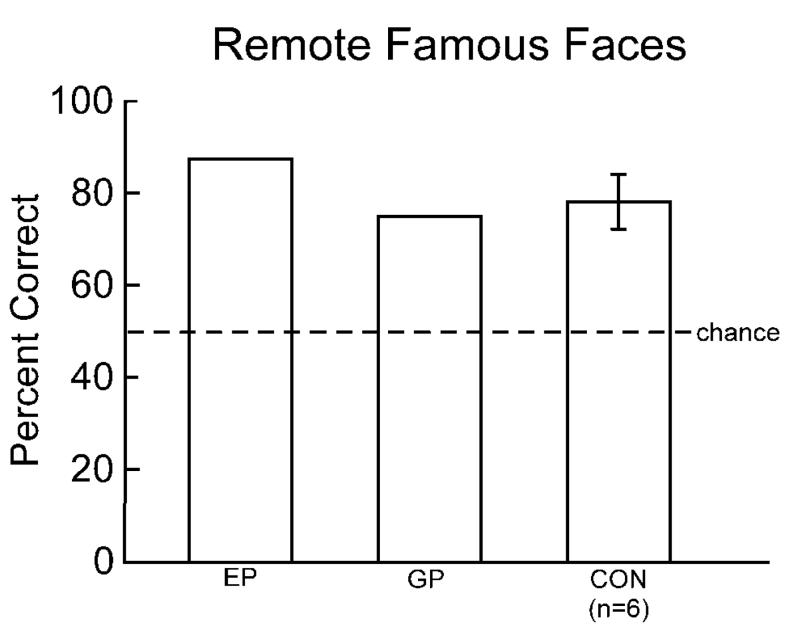
Remote famous faces. Performance of patients E.P., G.P., and controls (CON) on 16 yes/no questions about persons who were well known by 1940. Participants saw 16 photographs one at a time (eight photographs of people famous during the patients early life, long before the onset of amnesia [e.g., Abraham Lincoln, Judy Garland, Adolf Hitler] and eight photographs of nonfamous persons). Brackets show standard error of the mean, and the dashed line indicates chance performance (50%).

References

    1. Amaral DG, Insausti R. Hippocampal formation. In: Paxinos G, editor. The human nervous system. Academic Press; San Diego: 1990. pp. 711–755.
    1. Bayley PJ, Squire LR. Medial temporal lobe amnesia: gradual acquisition of factual information by nondeclarative memory. J Neurosci. 2002;22:5741–5748. - PMC - PubMed
    1. Bayley PJ, Squire LR. Failure to acquire new semantic knowledge in patients with large medial temporal lobe lesions. Hippocampus. 2005;15:273–280. - PMC - PubMed
    1. Bayley PJ, Frascino JC, Squire LR. Robust habit learning in the absence of awareness and independent of the medial temporal lobe. Nature. 2005;436:550–553. - PMC - PubMed
    1. Bayley PJ, Hopkins RO, Squire LR. The fate of old memories after medial temporal lobe damage. J Neurosci. 2006;26:13311–13317. - PMC - PubMed

Publication types

MeSH terms