. 2008 Feb 28:3:3.
doi: 10.1186/1750-9378-3-3.

Prevalence of high-risk human papillomavirus types in Mexican women with cervical intraepithelial neoplasia and invasive carcinoma

Affiliations

Prevalence of high-risk human papillomavirus types in Mexican women with cervical intraepithelial neoplasia and invasive carcinoma

Rubén López-Revilla et al. Infect Agent Cancer. .

Abstract

Background: Prevalence of high risk (HR) human papillomavirus (HPV) types in the states of San Luis Potosí (SLP) and Guanajuato (Gto), Mexico, was determined by restriction fragment length-polymorphism (RFLP) analysis on the E6 ~250 bp (E6-250) HR-HPV products amplified from cervical scrapings of 442 women with cervical intraepithelial neoplasia and invasive carcinoma (280 from SLP and 192 from Gto). Fresh cervical scrapings for HPV detection and typing were obtained from all of them and cytological and/or histological diagnoses were performed on 383.

Results: Low grade intraepithelial squamous lesions (LSIL) were diagnosed in 280 cases (73.1%), high grade intraepithelial squamous lesions (HSIL) in 64 cases (16.7%) and invasive carcinoma in 39 cases (10.2%). In the 437 cervical scrapings containing amplifiable DNA, only four (0.9%) were not infected by HPV, whereas 402 (92.0%) were infected HR-HPV and 31 (7.1%) by low-risk HPV. RFLP analysis of the amplifiable samples identified infections by one HR-HPV type in 71.4%, by two types in 25.9% and by three types in 2.7%. The overall prevalence of HR-HPV types was, in descending order: 16 (53.4%) > 31 (15.6%) > 18 (8.9%) > 35 (5.6) > 52 (5.4%) > 33 (1.2%) > 58 (0.7%) = unidentified types (0.7%); in double infections (type 58 absent in Gto) it was 16 (88.5%) > 31 (57.7%) > 35 (19.2%) > 18 (16.3%) = 52 (16.3%) > 33 (2.8%) = 58 (2.8%) > unidentified types (1.0%); in triple infections (types 33 and 58 absent in both states) it was 16 (100.0%) > 35 (54.5%) > 31 (45.5%) = 52 (45.5%) > 18 (27.3%). Overall frequency of cervical lesions was LSIL (73.1%) > HSIL (16.7%) > invasive cancer (10.2%). The ratio of single to multiple infections was inversely proportional to the severity of the lesions: 2.46 for LSIL, 2.37 for HSIL and 2.15 for invasive cancer. The frequency of HR-HPV types in HSIL and invasive cancer lesions was 16 (55.0%) > 31 (18.6%) > 35 (7.9%) > 52 (7.1%) > 18 (4.3%) > unidentified types (3.6%) > 33 (2.9%) > 58 (0.7%).

Conclusion: Ninety percent of the women included in this study were infected by HR-HPV, with a prevalence 1.14 higher in Gto. All seven HR-HPV types identifiable with the PCR-RFLP method used circulate in SLP and Gto, and were diagnosed in 99.3% of the cases. Seventy-one percent of HR-HPV infections were due to a single type, 25.9% were double and 2.7% were triple. Overall frequency of lesions was LSIL (73.1%) > HSIL (16.7%) > invasive cancer (10.2%), and the ratio of single to multiple infections was inversely proportional to severity of the lesions: 2.46 for LSIL, 2.37 for HSIL and 2.15 for invasive cancer. The frequency of HR-HPV types found in HSIL and invasive cancer was 16 (55.0%) > 31 (18.6%) > 35 (7.9%) > 52 (7.1%) > 18 (4.3%) > unidentified types (3.6%) > 33 (2.9%) > 58 (0.7%). Since the three predominant types (16, 31 and 18) cause 77.9% of the HR-HPV infections and immunization against type 16 prevents type 31 infections, in this region the efficacy of the prophylactic vaccine against types 16 and 18 would be close to 80%.


Figures
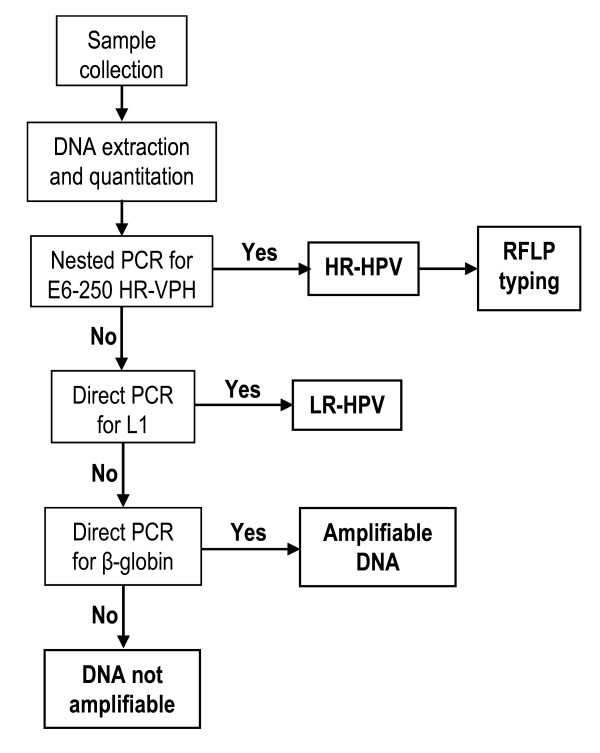
Figure 1
Figure 1
Algorithm for high-risk HPV detection in cervical scrapings from women with dysplastic and neoplastic lesions. It checks first for the presence of HPV DNA through nested PCR (expected to be positive in most samples) and then for the amplificability of β-globin DNA in HPV-negative samples (expected to be rare).
Figure 2
Figure 2
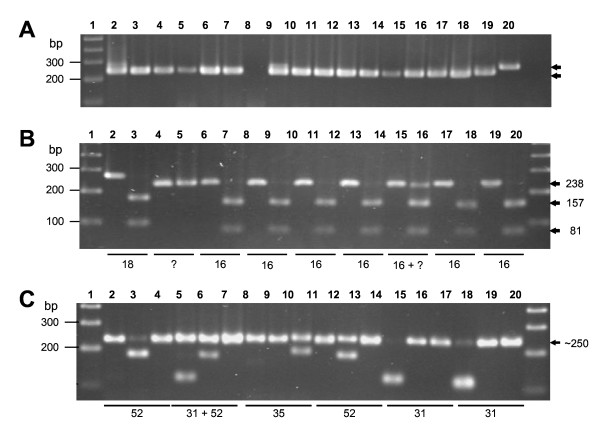
HR-HPV DNA detection and typing. Examples of agarose gels used for detection of the E-250 products amplified by nested PCR, for the first stage of HR-HPV typing with Ava II, and for the second stage with Rsa I, Bgl II, Ava I and Acc I endonucleases. Numbers to the left indicate the size of the DNA markers; arrows to the right indicate the size of the products amplified or the restriction fragments obtained. (A) HR-HPV DNA detection. Lane 1, 100 bp ladder. Lanes 2–18, DNA from different patients. Lane 19, Positive control (HeLa cell DNA). Lane 20, Negative control (no DNA). The expected E6-250 band appeared in the positive control and all problem samples except that of lane 8; Note the doublets in lanes 2 and 9 suggestive of double infection. (B) Identification of HPV types 16 and 18 by restriction with Ava II. Lanes 1 and 20, 100 bp ladder. Lanes 2 and 3, Positive control: E6-250 product from HeLa cell DNA intact (lane 2) and treated with Ava II (lane 3). Lanes 4–19: neighboring lanes containing E6-250 products either intact or treated with Ava II. Lanes 4 and 5, Patient 322. Lanes 6 and 7, Patient 323. Lanes 8 and 9, Patient 324. Lanes 10 and 11, Patient 325. Lanes 12 and 13, Patient 326. Lanes 14 and 15, Patient 328. Lanes 16 and 17, Patient 329. Lanes 18 and 19, Patient 306. Note the slightly larger size of HPV18 product and fragments, as well as total and partial resistance to Ava II by samples from patients 322 (lane 5) and 328 (lane 15). (C) Identification of HPV types 31, 52 and 35. Groups of three neighboring lanes contained E6-250 products in mixtures incubated separately with Rsa I, Bgl II and Ava I endonucleases from each sample. Lanes 1 and 20, 100 bp ladder. Lanes 2–4, Patient 191. Lanes 5–7, Patient 197. Lanes 8–10, Patient 203. Lanes 11–13, Patient 209. Lanes 14–16, Patient 211. Lanes 17–19, Patient 246. Note that infections by one and two HPV types are clearly distinguished.
Figure 3
Figure 3
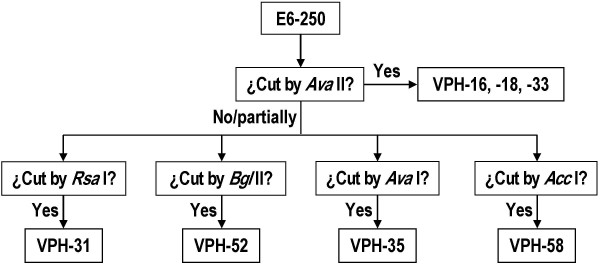
Algorithm for HR-HPV typing. The PCR-RFLP method used identifies seven HR-HPV types by the size of the restriction fragments of the E6-250 products generated by specific cuts with five enzymes. Ava II is used first because it helps recognize types 16, 18 and 33 (16 and 18 are known to be the most prevalent globally). PCR products not restricted by Ava II are incubated separately with each of the four remaining enzymes to identify the other five HR-HPV types.
Figure 4
Figure 4
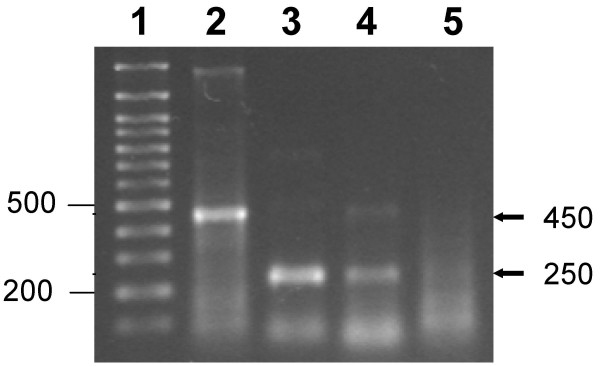
Inhibition of L1-450 and E6-250 segment amplification in duplex PCR mixtures with primer sets MY 09/11 and pU 1M/2R. Mixtures contained 50 ng DNA from Patient 1 as well as primer set MY 09/11, pU 1M/2R, or both. Arrows to the left indicate positions of the bands expected. Lane 1, 100 bp ladder. Lane 2, Uniplex 1 mixture (set MY 09/11). Lane 3, Uniplex mixture 2 (set pU 1M/2R). Lane 4, Duplex mixture (sets MY 09/11 and pU 1M/2R). Lane 5, Negative control (without DNA). Major bands expected in uniplex and duplex mixtures: ~450 bp with set MY 09/11 (Lanes 2 and 4) and ~250 bp with set pU 1M/2R (Lanes 3 and 4). Note the decrease in the intensity of bands in the duplex mixture (lane 4), especially ~450 bp.

References

    1. Pisani P, Parkin DM, Bray F, Ferlay J. Estimates of the worldwide mortality from 25 cancers in 1990. Int J Cancer. 1999;83:18–29. doi: 10.1002/(SICI)1097-0215(19990924)83:1<18::AID-IJC5>3.0.CO;2-M. - DOI - PubMed
    1. Pisani P, Bray F, Parkin DM. Estimates of the world-wide prevalence of cancer for 25 sites in the adult population. Int J Cancer. 2002;97:72–81. doi: 10.1002/ijc.1571. - DOI - PubMed
    1. Arrossi S, Sankaranarayanan R, Parkin DM. Incidence and mortality of cervical cancer in Latin America. Salud Publica Mex. 2003;45 Suppl 3:S306–14. - PubMed
    1. Reeves WC, Brinton LA, Garcia M, Brenes MM, Herrero R, Gaitan E, Tenorio F, de Britton RC, Rawls WE. Human papillomavirus infection and cervical cancer in Latin America. N Engl J Med. 1989;320:1437–1441. - PubMed
    1. Soe MM. Screening for cervical cancer in developing countries. Bmj. 1992;304:983–984. - PMC - PubMed

LinkOut - more resources