. 2008 Feb 29:7:41.
doi: 10.1186/1475-2875-7-41.

Cytokine-associated neutrophil extracellular traps and antinuclear antibodies in Plasmodium falciparum infected children under six years of age

Affiliations

Cytokine-associated neutrophil extracellular traps and antinuclear antibodies in Plasmodium falciparum infected children under six years of age

Virginia S Baker et al. Malar J. .

Abstract

Background: In Plasmodium falciparum-infected children, the relationships between blood cell histopathology, blood plasma components, development of immunocompetence and disease severity remain poorly understood. Blood from Nigerian children with uncomplicated malaria was analysed to gain insight into these relationships. This investigation presents evidence for circulating neutrophil extracellular traps (NETs) and antinuclear IgG antibodies (ANA). The presence of NETs and ANA to double-stranded DNA along with the cytokine profiles found suggests autoimmune mechanisms that could produce pathogenesis in children, but immunoprotection in adults.

Methods: Peripheral blood smear slides and blood samples obtained from 21 Nigerian children under six years of age, presenting with uncomplicated malaria before and seven days after initiation of sulphadoxine-pyrimethamine (SP) treatment were analysed. The slides were stained with Giemsa and with DAPI. Levels of the pro-inflammatory cytokines IFN-gamma, IL-2, TNF, CRP, and IL-6, select anti-inflammatory cytokines TGF-beta and IL-10, and ANA were determined by immunoassay.

Results: The children exhibited circulating NETs with adherent parasites and erythrocytes, elevated ANA levels, a Th2 dominated cytokine profile, and left-shifted leukocyte differential counts. Nonspecific ANA levels were significant in 86% of the children pretreatment and in 100% of the children seven days after SP treatment, but in only 33% of age-matched control samples collected during the season of low parasite transmission. Levels of ANA specific for dsDNA were significant in 81% of the children both pre-treatment and post treatment.

Conclusion: The results of this investigation suggest that NET formation and ANA to dsDNA may induce pathology in falciparum-infected children, but activate a protective mechanism against falciparum malaria in adults. The significance of in vivo circulating chromatin in NETs and dsDNA ANA as a causative factor in the hyporesponsiveness of CpG oligonucleotide-based malaria vaccines is discussed.


Figures
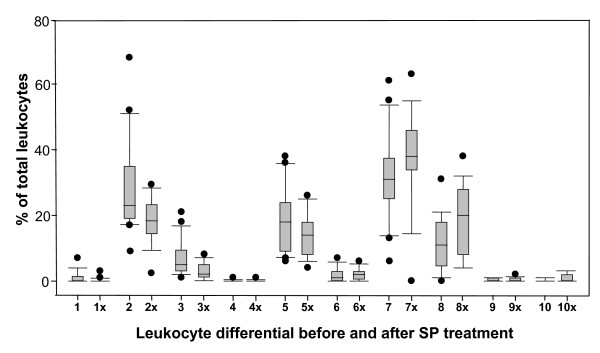
Figure 1
Figure 1
Leukocyte differential counts before and seven days after SP treatment. One hundred leukocytes on fingerprick peripheral blood smear slides for each child made before and seven days after SP treatment (x) were classified into one of ten groups. The percentage of each group was calculated. Box plots indicating the 25th, 50th, and 75th percentile (solid lines from bottom to top of box, respectively), the 90th and 10th percentile values (high and low error bars respectively), and high and low outlier points are shown for each of the following leukocyte classes: 1) metamyelocytes, 2) segmented neutrophils, 3) bands, 4) hypersegmented neutrophils, 5) NETs, 6) monocytes, 7) lymphocytes, 8) smudge forms, 9) eosinophils, and 10) basophils.
Figure 2
Figure 2
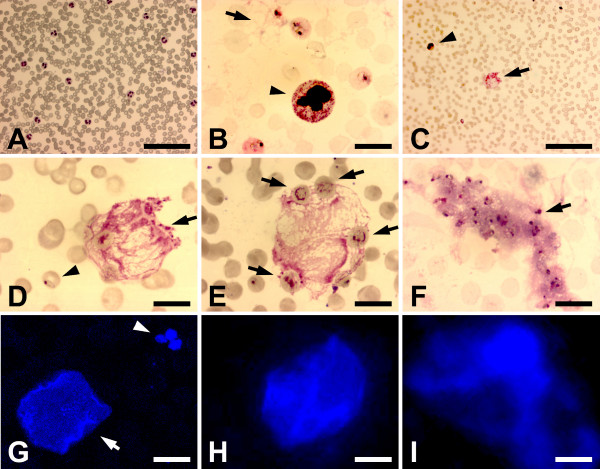
Giemsa- and DAPI-stained peripheral fingerprick blood smears from children 5 years old and younger presenting with uncomplicated malaria. (A) low magnification field of a control smear from a child presenting with fever but no detectable P. falciparum; (B) field showing neutrophil exhibiting toxic granulation and lack of a distinct nuclear membrane (arrowhead)and fibrous material (arrow); (C) field showing NET (arrow) and P. falciparum-infected erythrocyte with a young trophozoite (arrowhead); (D) higher magnification image of field from (C); (E) Fibrous aggregate interpreted to be a NET containing parasitized erythrocytes (arrows); (F) Fibrous aggregate interpreted to be a NET sequestering parasitized erythrocytes; (G) DAPI-stained aggregate resembling fibrous structures in D and E (arrowhead) and normal neutrophil (arrow); (H) DAPI-stained aggregate resembling fibrous structures in D and E; and (I) DAPI-stained aggregate resembling fibrous structure in F. Bars: A, C 100 μm; B, D-F, 10 μm.
Figure 3
Figure 3
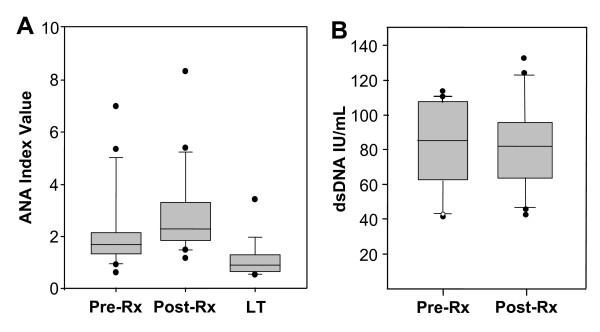
Anti-nuclear antibody (ANA) and anti-dsDNA levels in 21 falciparum-infected children before and seven days after SP treatment and in age-matched uninfected children. Samples from the infected children (A and B, Pre-Rx and Post-Rx) were collected during the season of high transmission. The Pre-Rx samples in (A) and (B) were collected before SP treatment. The Post-Rx samples in (A) and (B) were collected seven days after SP treatment. Samples from children exhibiting no evidence of falciparum infection were collected during a season of low transmission (A, LT). ANA Index values were calculated according to assay kit instructions and interpreted as negative, ≤0.90; equivocal, 0.91-1.09; and positive, ≥1.10. Anti-dsDNA levels were calculated according to assay kit instructions and interpreted as negative <25 IU/ml, borderline positive: 25-30 IU/ml, positive: 60-200 IU/ml, and high positive: >200 IU/ml.
Figure 4
Figure 4
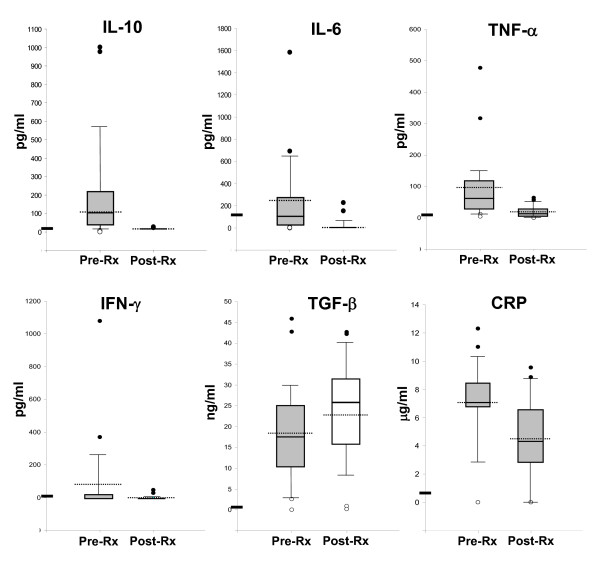
Levels of IL-10, IL-6, TNF, IFN-γ, TGF-β, and CRP in plasma or serum drawn from 21 children ≤ 5 years old infected with P. falciparum before (Pre-Rx) and 7 days after treatment with SP (Rx). Individual values (n = 21) are represented as box plots indicating the 25th, 50th, and 75th percentile (solid lines from bottom to top of box), the 90th and 10th percentile values (high and low error bars respectively), and the mean value (dotted line). Closed circles represent the two highest values (above 90th percentile). Open circles represent the two lowest values (below 10th percentile; two open circles are superimposed in the plots where only one open circle is apparent). Horizontal bars on x-axes represent the upper limit of the range for normal healthy individuals determined with each assay kit by the manufacturer.
Figure 5
Figure 5
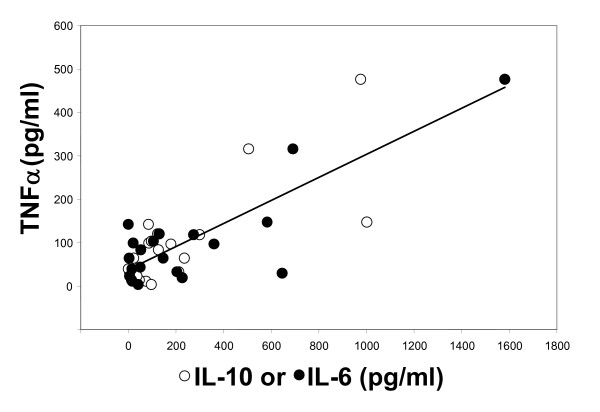
Triad relationship of TNF, IL-10, and IL-6 levels. Relationships of TNF with IL-10 (open circles) and with IL-6 (closed circles) are plotted for each of the 21 patients. The additive combinatorial effect of elevated IL-6 and IL-10 cytokine levels on TNF is significant (without random sampling error). Line, multivariate regression line (r2 = 0.726).
Figure 6
Figure 6
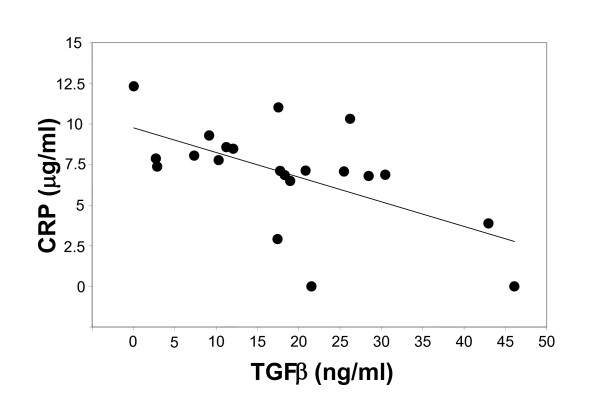
Relationship of CRP and TGF-β levels in 21 falciparum-infected children before SP treatment. CRP levels exhibits a modest inverse relationship with TGF-β levels. Line, regression line (r2 = 0.353).
Figure 7
Figure 7
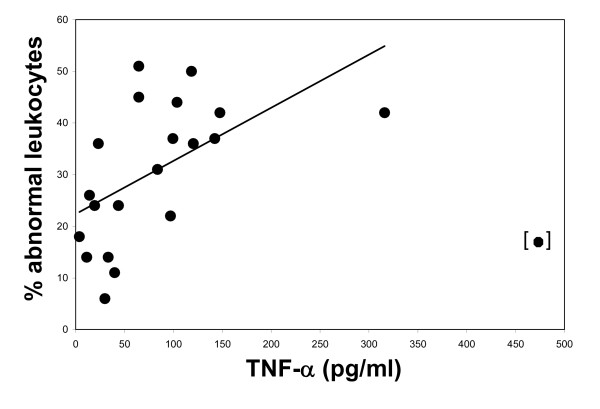
Relationship between the presence of NETs and elevated TNF levels. Levels of abnormal leukocytes exhibit a positive relationship with elevated TNF levels. Line, regression line (r2 = 0.512).

References

    1. Good MF, Xu H, Wykes M, Engwerda CR. Development and regulation of cell-mediated immune responses to the blood stages of malaria: implications for vaccine research. Annu Rev Immunol. 2005;23:69–99. doi: 10.1146/annurev.immunol.23.021704.115638. - DOI - PubMed
    1. Malaguarnera L, Musumeci S. The immune response to Plasmodium falciparum malaria. Lancet Infect Dis. 2002;2:472–478. doi: 10.1016/S1473-3099(02)00344-4. - DOI - PubMed
    1. Stevenson MM, Riley EM. Innate immunity to malaria. Nat Rev Immunol. 2004;4:169–180. doi: 10.1038/nri1311. - DOI - PubMed
    1. Millington OR, Di Lorenzo C, Phillips RS, Garside P, Brewer JM. Suppression of adaptive immunity to heterologous antigens during Plasmodium infection through hemozoin-induced failure of dendritic cell function. J Biol. 2006;5:5. doi: 10.1186/jbiol34. - DOI - PMC - PubMed
    1. Nussenblatt V, Mukasa G, Metzger A, Ndeezi G, Garrett E, Semba RD. Anemia and interleukin-10, tumor necrosis factor alpha, and erythropoietin levels among children with acute, uncomplicated Plasmodium falciparum malaria. Clin Diagn Lab Immunol. 2001;8:1164–1170. doi: 10.1128/CDLI.8.6.1164-1170.2001. - DOI - PMC - PubMed

Publication types