


Applying a conceptual model for examining health-related quality of life in long-term breast cancer survivors: CALGB study 79804
- PMID: 18314912
- PMCID: PMC3930158
- DOI: 10.1002/pon.1329
Applying a conceptual model for examining health-related quality of life in long-term breast cancer survivors: CALGB study 79804
Abstract
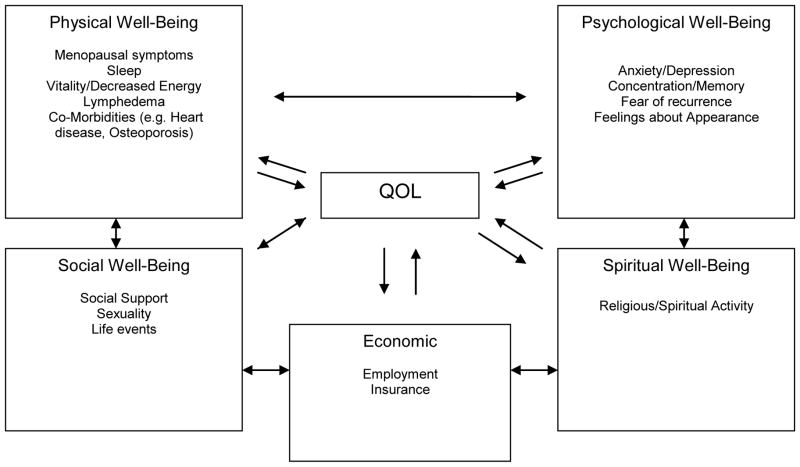
Objectives: The Survivor's Health and Reaction study used a quality-of-life model adapted for cancer survivors by Dow and colleagues to identify factors related to global health-related quality of life (HRQL) and to document the prevalence of problems and health-oriented behaviors in a follow-up study of breast cancer patients who participated in CALGB 8541.
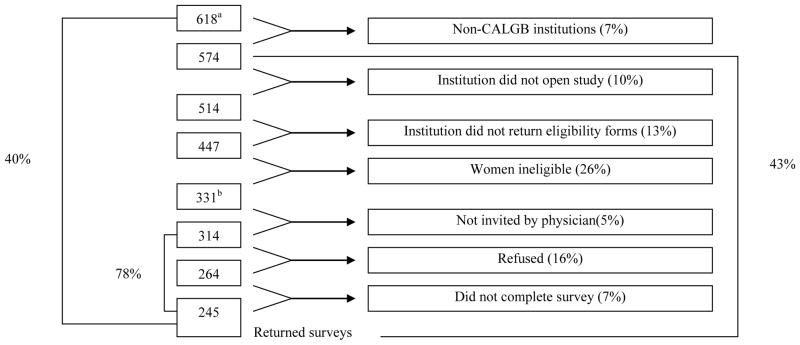
Methods: A total of 245 survivors (78% of those invited) who were 9.4-16.5 years post-diagnosis completed surveys that inquired about current HRQL, economic, spiritual, physical and psychosocial concerns, and health-oriented behaviors (e.g. smoking, exercise, and supplement use). A regression model was developed to examine factors related to global HRQL across all domains.
Results: The regression model revealed that decreased energy levels (odds ratio (OR)=1.05, 95% confidence interval (CI): 1.03, 1.07), having heart disease (OR=5.01, 95% CI: 1.39, 18.1), having two or more co-morbidities (OR=2.39, 95% CI: 1.10, 5.19), and lower social support (OR=1.03, 95% CI: 1.02, 1.05) were associated with lower global HRQL. Factors related to psychological, spiritual, and economic domains were not predictive of global HRQL. Regarding lifestyle changes, some women reported engaging in health-oriented behaviors since their cancer diagnosis, such as improving eating habits (54%), increasing exercise (32%), and reducing/quitting smoking (20%). The most prevalent problems reported by women at follow-up were menopausal symptoms (64%), such as hot flashes and vaginal dryness, osteoporosis (25%), and lymphedema (23%).
Conclusion: Suggestions are provided to target interventions, such as provider-based strategies, in order to improve HRQL in long-term breast cancer survivors.
(c) 2008 John Wiley & Sons, Ltd.
Figures
References
-
- Smigel K. Breast cancer death rates decline for white women. J Natl Cancer Inst. 1995;87(3):173. - PubMed
-
- Nasseri K. Secular trends in the incidence of female breast cancer in the United States, 1973–1998. Breast J. 2004;10:129–35. - PubMed
-
- Jemal A, Siegel R, Ward E, Murray T, Xu J, Smigal C, et al. Cancer statistics, 2006 CA Cancer J Clin. 2006;56(2):106–30. - PubMed
-
- Partridge AH, Winer EP, Burstein HJ. Follow-up care of breast cancer survivors. Semin Oncol. 2003;30:817–25. - PubMed
-
- Partridge AH, Winer EP. Long-term complications of adjuvant chemotherapy for early stage breast cancer. Breast Dis. 2004;21:55–64. - PubMed
Publication types
MeSH terms
Grants and funding
- U10 CA032291/CA/NCI NIH HHS/United States
- CA33601/CA/NCI NIH HHS/United States
- U10 CA077658/CA/NCI NIH HHS/United States
- CA32291/CA/NCI NIH HHS/United States
- CA41287/CA/NCI NIH HHS/United States
- U10 CA033601/CA/NCI NIH HHS/United States
- U10 CA180821/CA/NCI NIH HHS/United States
- CA45808/CA/NCI NIH HHS/United States
- U10 CA045418/CA/NCI NIH HHS/United States
- AG16602/AG/NIA NIH HHS/United States
- CA57707/CA/NCI NIH HHS/United States
- U10 CA041287/CA/NCI NIH HHS/United States
- U10 CA077651/CA/NCI NIH HHS/United States
- CA79883/CA/NCI NIH HHS/United States
- CA45418/CA/NCI NIH HHS/United States
- U10 CA003927/CA/NCI NIH HHS/United States
- U10 CA045808/CA/NCI NIH HHS/United States
- CA03927/CA/NCI NIH HHS/United States
- CA77651/CA/NCI NIH HHS/United States
- CA77658/CA/NCI NIH HHS/United States
- CA12449/CA/NCI NIH HHS/United States
LinkOut - more resources
Full Text Sources
Medical
