


Agrobacterium rhizogenes-transformed roots of coffee (Coffea arabica): conditions for long-term proliferation, and morphological and molecular characterization
- PMID: 18316320
- PMCID: PMC2710235
- DOI: 10.1093/aob/mcn027
Agrobacterium rhizogenes-transformed roots of coffee (Coffea arabica): conditions for long-term proliferation, and morphological and molecular characterization
Abstract
Background and aims: The aims of this study were to set up proliferation conditions for hairy roots of Coffea arabica regenerated after transformation by Agrobacterium rhizogenes strain A4-RS, and to carry out the morphological and molecular characterization of hairy root clones maintained over the long term.
Methods: Auxin supply, light conditions and sucrose concentration were modified with the aim of establishing efficient root proliferation conditions. The morphological variability among 62 established hairy root clones was phenotyped by scanning the roots and analysing the images using 'whinRHIZO' software procedures. PCR analysis of integration in transformed root cells of rol and aux oncogenes from the T-DNA of the Ri plasmid was used to study the molecular variability among clones.
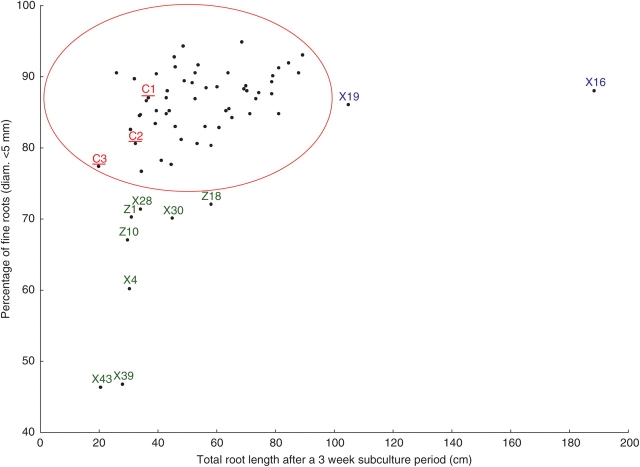
Key results: Auxin supply was necessary to obtain and stimulate growth and branching, and IBA applied at 0.5 microm was the most efficient auxin. Significant differences were shown among the 62 clones for total root length and for the percentage of fine roots. These variables were stable across subcultures and could hence be used for efficient characterization of hairy root clones. The majority of hairy root clones (86 %) exhibited non-significant phenotype differences with non-transformed roots. Eight clones were significantly different from the non-transformed controls in that they possessed a low proportion of fine roots. Two other hairy root clones grew significantly faster than the other clones. The PCR analysis revealed a low variability in the integration of rol and aux oncogenes in transformed root cells. The T(R)-DNA was never integrated as aux1 and aux2 genes were not found, although rolB and rolC genes from the T(L)-DNA were always present.
Conclusions: The discovery of low morphological variability among coffee hairy roots together with the identification of morphological variables allowing easy identification of phenotypically altered clones represent two important results. They make hairy roots a possible, and efficient, tool for functional-genomic studies of coffee root genes.
Figures
References
-
- Akasaka Y, Mii M, Daimon H. Morphological alterations and root nodule formation in Agrobacterium rhizogenes-mediated transgenic hairy roots of peanut (Arachis hypogaea L.) Annals of Botany. 1998;81:355–362.
-
- Alpizar E, Dechamp E, Espeout S, Lecouls AC, Nicole M, Bertrand B, Lashermes P, Etienne H. Efficient production of Agrobacterium rhizogenes-transformed roots and composite plants for studying gene expression in coffee roots. Plant Cell Reports. 2006;25:959–967. - PubMed
-
- Altamura MM. Agrobacterium rhizogenes rolB and rolD genes: regulation and involvement in plant development. Plant Cell Tissue and Organ Culture. 2004;77:89–101.
-
- Batra J, Dutta A, Singh D, Kumar S, Sen J. Growth and terpenoid indole alkaloid production in Catharanthus roseus hairy root clones in relation to left- and right-termini-linked Ri T-DNA gene intregration. Plant Cell Reports. 2004;23:148–154. - PubMed
