. 2008 Mar 1;22(5):615-26.
doi: 10.1101/gad.458008.

A cryptic unstable transcript mediates transcriptional trans-silencing of the Ty1 retrotransposon in S. cerevisiae

Affiliations

A cryptic unstable transcript mediates transcriptional trans-silencing of the Ty1 retrotransposon in S. cerevisiae

Julia Berretta et al. Genes Dev. .

Abstract

Cryptic unstable transcripts (CUTs) are synthesized from intra- and intergenic regions in Saccharomyces cerevisiae and are rapidly degraded by RNA surveillance pathways, but their function(s) remain(s) elusive. Here, we show that an antisense TY1 CUT, starting within the Ty1 retrotransposon and encompassing the promoter 5' long terminal repeat (LTR), mediates RNA-dependent gene silencing and represses Ty1 mobility. We show that the Ty1 regulatory RNA is synthesized by RNA polymerase II, polyadenylated, and destabilized by the cytoplasmic 5' RNA degradation pathway. Moreover, the Ty1 regulatory RNA represses Ty1 transcription and transposition in trans by acting on the de novo transcribed TY1 RNA. Consistent with a transcriptional regulation mechanism, we show that RNA polymerase II occupancy is reduced on the Ty1 chromatin upon silencing, although TBP binding remains unchanged. Furthermore, the Ty1 silencing is partially mediated by histone deacetylation and requires Set1-dependent histone methylation, pointing out an analogy with heterochromatin gene silencing. Our results show the first example of an RNA-dependent gene trans-silencing mediated by epigenetic marks in S. cerevisiae.


Figures
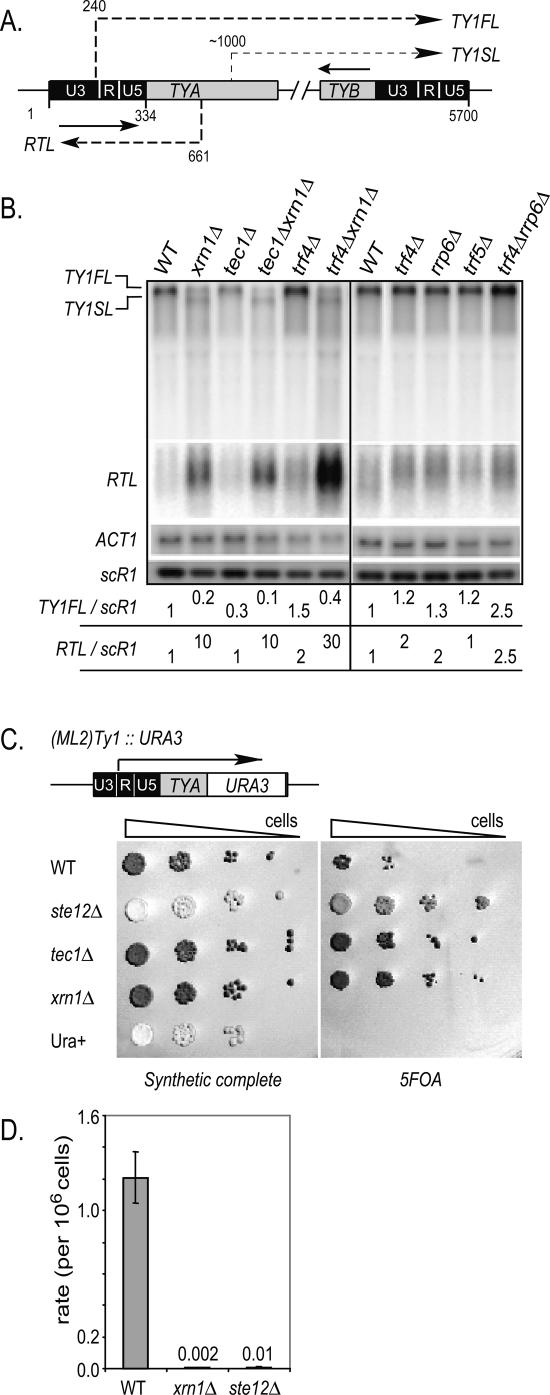
Figure 1.
Figure 1.
The 5′–3′ exoribonuclease Xrn1 prevents Ty1 antisense RNA accumulation and maintains Ty1 expression and transposition. (A) Schematization of different Ty1 transcripts (dashed lines/arrows), with their respective coordinates. Positions of riboprobes specific to the RTL, TY1FL, and TY1SL RNAs are represented by solid line/arrows. Note that the probe in the TYB region hybridizes the TY1SL and TY1FL RNAs. (B) Northern analysis of Ty1 full-length (TY1FL), Ty1 5′ short-length (TY1SL), and 5′-LTR antisense TY1 RNA (RTL). scR1 and ACT1 were used as loading controls. Numbers represent TY1FL/scR1 and RTL/scR1 RNA ratios. Strains are YAM92 (WT W303), YAM591 (tec1Δ), YAM460 (tec1Δxrn1Δ), YAM97 (xrn1Δ), YAM456 (trf4Δ), and YAM458 (xrn1Δtrf4Δ). YAM118 (WT BY4741), YAM125 (trf4Δ), YAM123 (rrp6Δ), YAM126 (trf5Δ), and YAM128 (rrp6Δtrf4Δ). (C) Growth assay of strains bearing TY1(ML2)∷URA3 on plates containing complete synthetic media and +5FOA. The strains are YAM698 (WT), YAM700 (xrn1Δ), YAM783 (tec1Δ), YAM784 (ste12Δ), and YAM166 (ura+). (D) Transposition rate of TY1HIS3AI-containing strains, expressed as a rate of HIS+ cells per total number of cells (see Materials and Methods). Strains are YAM359 (WT), YAM641 (xrn1Δ), and YAM601 (ste12Δ). The transposition rate represents the mean of three independent experiments with standard deviations.
Figure 2.
Figure 2.
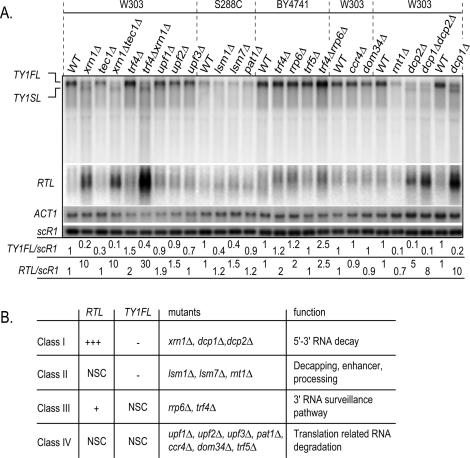
Effect of different RNA degradation pathways on Ty1 RNAs. (A) Extended Northern analysis of transcript levels in strains bearing mutations in different RNA surveillance pathways. The membrane is identical as in Figure 1B, but mutants have been separated for presentation convenience. The probes are the same as in Figure 1B. In the left panel, the W303 strains are YAM92 (WT W303), YAM591 (tec1Δ), YAM97 (xrn1Δ), YAM460 (tec1Δxrn1Δ), YAM456 (trf4Δ), YAM458 (xrn1Δtrf4Δ), YAM93 (upf1Δ), YAM94 (upf2Δ), and YAM95 (upf3Δ). W303 strains in the right panel are YAM92 (WT W303), YAM584 (ccr4Δ), YAM586 (dom34Δ), YAM115 (WT W303), (YAM119), YAM141 (dcp2Δ), YAM142 (dcp1Δdcp2Δ), YAM92 (WT W303), and YAM96 (dcp1Δ). The S288C strains are YAM31 (WT S288C), YAM34 (lsm1Δ), YAM33 (lsm7Δ), and YAM32 (pat1Δ). The BY4741 background strains are YAM118 (WT BY4741), YAM125 (trf4Δ), YAM123 (rrp6Δ), YAM126 (trf5Δ), and YAM128 (rrp6Δtrf4Δ). (B) Table summarizing the effects of the four classes of mutants on Ty1 RNA accumulation. RTL and TY1FL RNA changes were classified by the following rule: (+++) more than fivefold increase; (+) between twofold and fivefold increase; (−) more than twofold decrease; (NSC) no significant change (less than twofold).
Figure 3.
Figure 3.
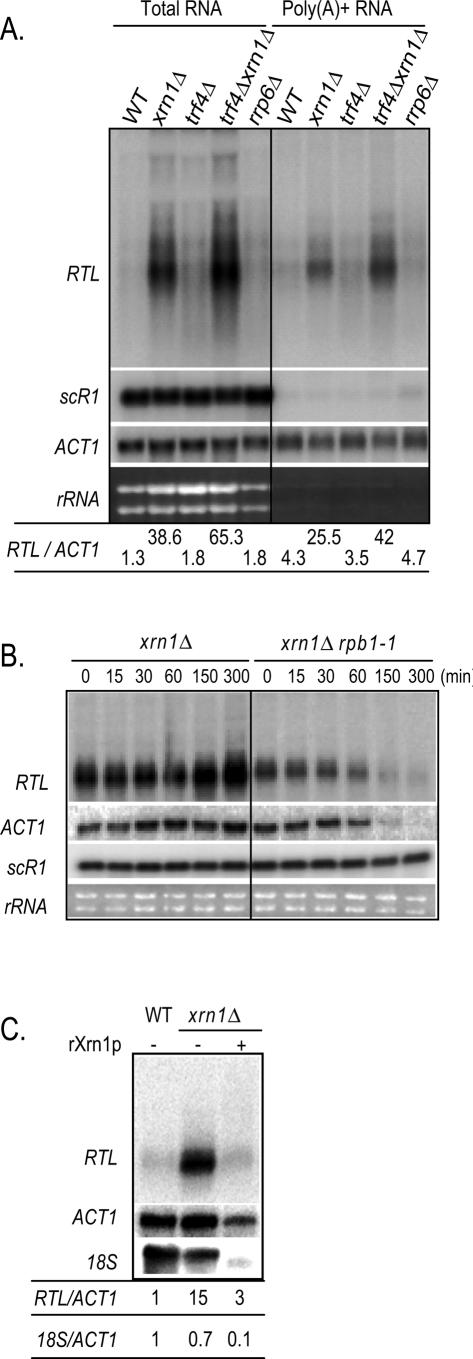
Characterization of the Ty1 antisense RNA. (A) Northern blot analysis of transcript levels in strains bearing mutations in the RNA surveillance pathways, purified on oligo(dT) beads [poly(A+) RNA, right panel] or not (total RNA, left panel). The probes are the same as in Figure 1B. The strains are YAM92 (WT), YAM97 (xrn1Δ), YAM456 (trf4Δ), YAM458 (xrn1Δtrf4Δ), and YAM587 (rrp6Δ). (B) Northern blot analysis of total RNA upon RNAPII inactivation. The time is in minutes after a 37°C heat shock. The probes are the same as in Figure 1B. The strains are YAM9 (xrn1Δ) and YAM538 (xrn1Δrpb1-1). (C) Northern blot analysis of 1 μg of total RNA treated (+) or not (−) with 0.3 μg of recombinant Xrn1p (rXrn1p). The probes are the same as in Figure 1B. The strains are YAM92 (WT) and YAM97 (xrn1Δ).
Figure 4.
Figure 4.
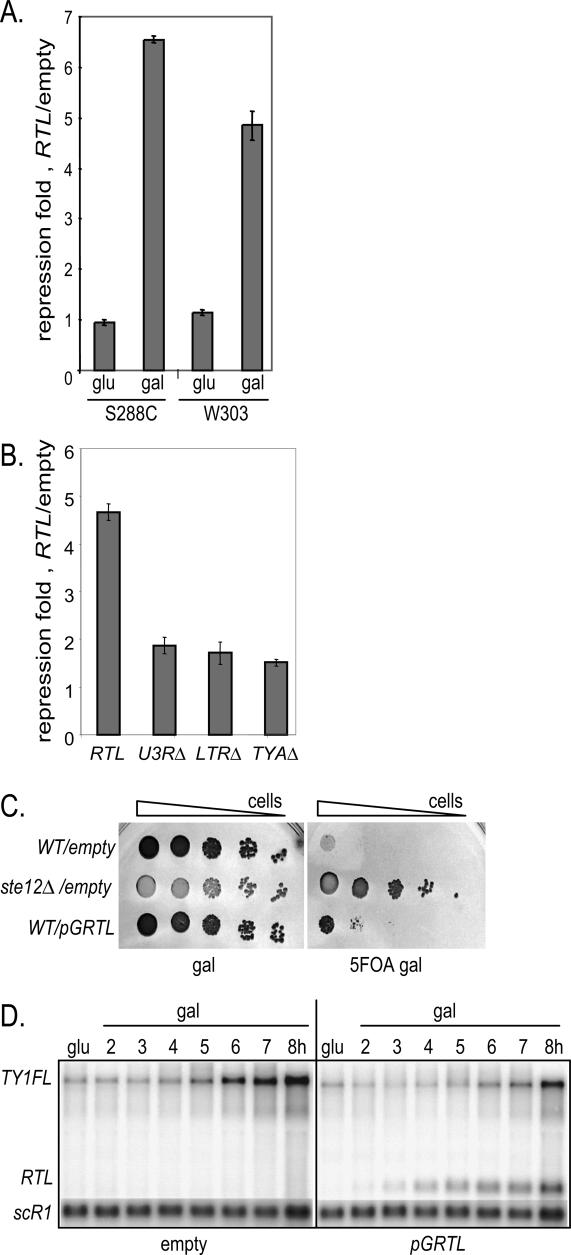
Trans-silencing of Ty1 expression in the presence of the Ty1 RTL RNA. (A) Transposition repression fold of TY1HIS3AI strains in the presence of pGRTL. The repression fold is expressed as a ratio between the transposition rate measured in a strain bearing pGRTL (pAM134) and a strain bearing an empty plasmid (pAM80) under the same growth conditions. The strains are YAM359 (S288C) and YAM358 (W303), grown in glucose (glu) or galactose (gal). The repression fold represents the mean of three independent experiments with standard deviations. (B) Transposition repression fold of TY1HIS3AI strains in the presence of truncated versions of RTL. The strains are the same as in A but with YAM359 (WT) grown in galactose and bearing pGRTL (RTL), pGRTLU3RΔ (U3RΔ), pGRTLLTRΔ (LTRΔ), or pGRTLTYAΔ (TYAΔ). (C) Growth ability of TY1(ML2)∷URA3 strains containing pGRTL (pAM167) or an empty plasmid (pAM20). Galactose plates contain complete synthetic media without leucine supplemented with 5FOA (5FOAgal) or not (gal). Cells were dropped after serial 10× dilutions. The strains are YAM698 (WT) and YAM784 (ste12Δ). (D) Northern blot analysis of total RNAs in a PGAL1ste12 strain (YAM799) bearing pGRTL (pAM134) or an empty plasmid (pAM80). The probes are the same as in Figure 1B. The time is in hours of growth in galactose.
Figure 5.
Figure 5.
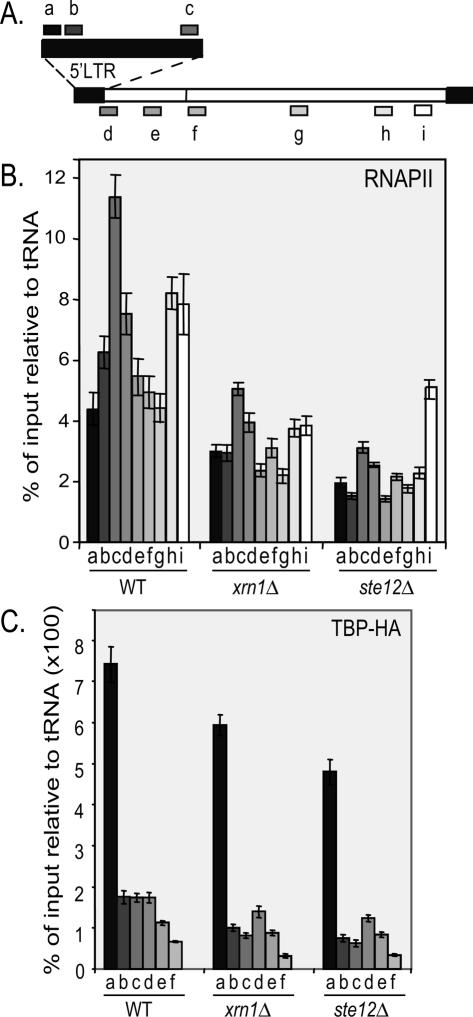
Xrn1 controls Ty1 transcription initiation at a post-TBP recruitment step. (A) Positions of different Ty1 amplicons on the Ty1 chromatin for real-time PCR analysis. (B) Real-time PCR quantification of RNAPII using primers over Ty1 chromatin. Percentage of immunoprecipitation signals relative to input, normalized with the tRNA region. The strains are YAM198 (WT), YAM775 (xrn1Δ), and YAM778 (ste12Δ). (C) Real-time PCR quantification of HA-TBP using primers over Ty1 chromatin. The same normalization as in B. The strains are YAM208 (WT), YAM238 (xrn1Δ), and YAM756 (ste12Δ).
Figure 6.
Figure 6.
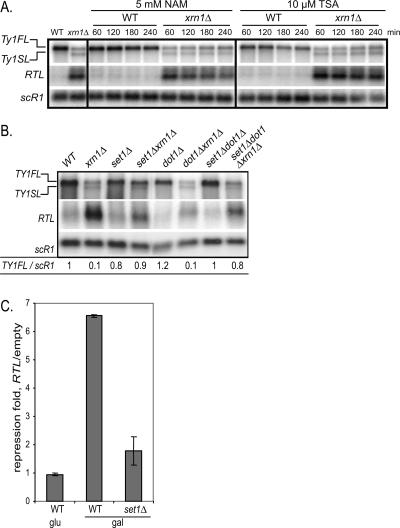
Histone deacetylation and HMT Set1 mediate Ty1 silencing. (A) Northern blot analysis of total RNAs in the presence of histone deacetylase inhibitors. The probes are the same as in Figure 1B. The strains YAM250 (WT) and YAM97 (xrn1Δ) were treated with 5 mM NAM or 10 μM TSA, and cells were collected at the indicated time points. (B) Northern analysis of total RNAs. The probes are the same as in Figure 1B. The strains are YAM250 (WT), YAM97 (xrn1Δ), YAM249 (set1Δ), YAM448 (set1Δxrn1Δ), YAM248 (dot1Δ), YAM449 (dot1Δxrn1Δ), YAM247 (set1Δdot1Δ), and YAM444 (set1Δdot1Δxrn1Δ). (C) Repression fold of transposition rates of TY1HIS3AI strains bearing the pGRTL and empty plasmids. The strains are YAM359 (WT) and YAM702 (set1Δ). The same conditions as in Figure 4A.
Figure 7.
Figure 7.
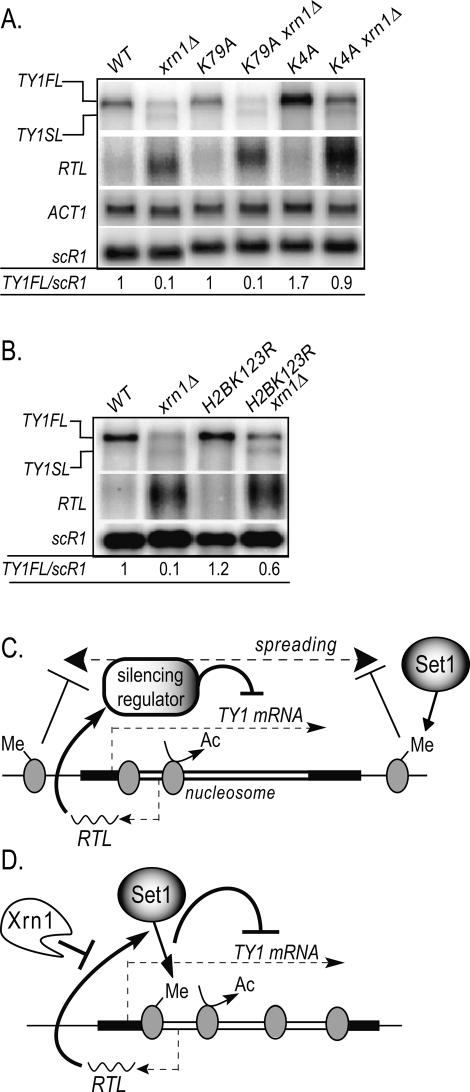
H3K4me controls Ty1 silencing. (A) Northern blot analysis of total RNAs. The probes are the same as in Figure 1B. The strains are YAM212 (WT), YAM762 (xrn1Δ), YAM216 (H3K4A), YAM764 (H3K4Axrn1Δ), YAM214 (H3K79A), and YAM673 (H3K79Axrn1Δ). (B) Northern blot analysis of total RNAs. The probes are the same as in Figure 1B. The strains are YAM166 (WT), YAM167 (xrn1Δ), YAM835 (H2BK123R), and YAM836 (H2BK123Rxrn1Δ). (C) Model of RNA-dependent Ty1 transcriptional gene silencing indirectly controlled by Set1. If not destabilized by the cytoplasmic exonuclease Xrn1, the RTL RNA targets an unknown silencing factor that inhibits Ty1 transcription through histone deacetylation. Furthermore, the silencing factor is restricted on Ty1 chromatin by Set1-dependent histone methylation, as suggested for heterochromatic domains. In the absence of Set1, the silencing factor spreads on adjacent chromatin, allowing Ty1 transcription to be derepressed. (D) Model of RNA-dependent Ty1 transcriptional gene silencing directly controlled by Set1. Same as in C but the RTL RNA activates Set1-dependent histone methylation on Ty1 embedded nucleosomes. Histone methylation is then recognized by a putative silencing factor that represses Ty1 transcription through histone deacetylation.

References

    1. Aravind L., Watanabe H., Lipman D.J., Koonin E.V. Lineage-specific loss and divergence of functionally linked genes in eukaryotes. Proc. Natl. Acad. Sci. 2000;97:11319–11324. - PMC - PubMed
    1. Baur M., Esch R.K., Errede B. Cooperative binding interactions required for function of the Ty1 sterile responsive element. Mol. Cell. Biol. 1997;17:4330–4337. - PMC - PubMed
    1. Beliakova-Bethell N., Beckham C., Giddings T.H., Winey M., Parker R., Sandmeyer S. Virus-like particles of the Ty3 retrotransposon assemble in association with P-body components. RNA. 2006;12:94–101. - PMC - PubMed
    1. Bernstein B.E., Tong J.K., Schreiber S.L. Genomewide studies of histone deacetylase function in yeast. Proc. Natl. Acad. Sci. 2000;97:13708–13713. - PMC - PubMed
    1. Bitterman K.J., Anderson R.M., Cohen H.Y., Latorre-Esteves M., Sinclair D.A. Inhibition of silencing and accelerated aging by nicotinamide, a putative negative regulator of yeast sir2 and human SIRT1. J. Biol. Chem. 2002;277:45099–45107. - PubMed

Publication types

MeSH terms

LinkOut - more resources