. 2008 May;52(5):1820-8.
doi: 10.1128/AAC.01181-07. Epub 2008 Mar 3.

Iminosugars in combination with interferon and ribavirin permanently eradicate noncytopathic bovine viral diarrhea virus from persistently infected cells

Affiliations

Iminosugars in combination with interferon and ribavirin permanently eradicate noncytopathic bovine viral diarrhea virus from persistently infected cells

Stephen D Woodhouse et al. Antimicrob Agents Chemother. 2008 May.

Abstract

We evaluated interferon (IFN) and ribavirin (RBV) as dual therapy and as part of triple-combination therapies with the iminosugars N-butyl-deoxynojirimycin (NB-DNJ), N-nonyl-deoxynojirimycin, and N-7-oxanonyl-6-deoxymethyl-galactonojirimycin. The ability of these compounds to clear bovine viral diarrhea virus (BVDV), a surrogate model for hepatitis C virus (HCV), from a persistently infected Madin-Darby bovine kidney cells cell line was determined by monitoring the secretion of viral RNA and the infectivity of secreted virions. In the BVDV system, after treatment with IFN-RBV alone, viral rebound was observed immediately after removal of the drugs. In contrast, we demonstrate that a triple drug combination of IFN, RBV, and an iminosugar eradicated the BVDV infection in a time- and a dose-dependent manner, leading to sustained viral clearance. Importantly, in the case of NB-DNJ, the sustained viral clearance was achieved by using physiologically relevant and tolerated drug concentrations. Therefore, the use of a triple-combination therapy that includes an iminosugar may prove to be of greater therapeutic value for the treatment of HCV infection than the use of IFN-RBV alone.


Figures
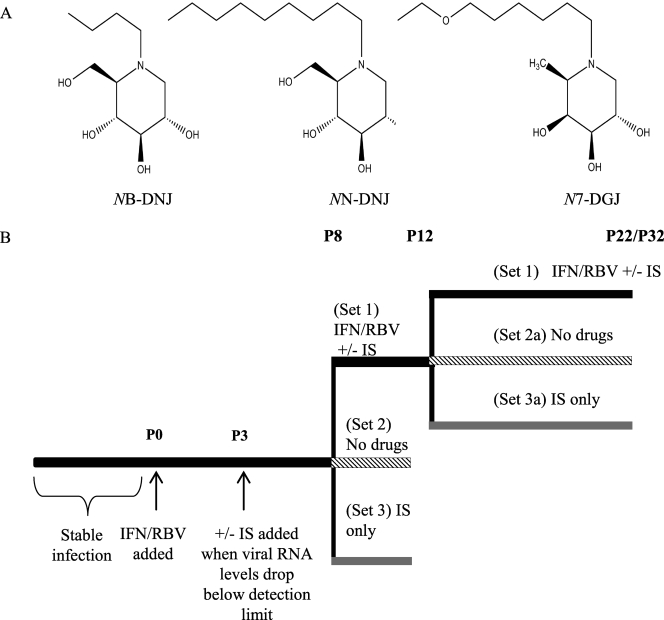
FIG. 1.
FIG. 1.
(A) Chemical structures of the iminosugar (IS) derivatives used in the study. (B) Experimental outline. After a stable infection was established, the cells were cultured for three passages (9 days) in the presence of 1,000 IU/ml IFN and 1 μM RBV. At P3, after the viral RNA levels dropped below the detection limit, the medium was supplemented with one of the iminosugar derivatives. At the end of P8, the samples were split into three sets: set 1 (black line), all drug regimens remained the same; set 2 (cross-hatched line), all drugs were removed; set 3 (gray line), only iminosugars were continued. After P12, samples from set 1, which had been cultured for nine passages in the presence of IFN-RBV and an iminosugar, were split into sample sets 1, 2a, and 3a and treated in the same manner as described above.
FIG. 2.
FIG. 2.
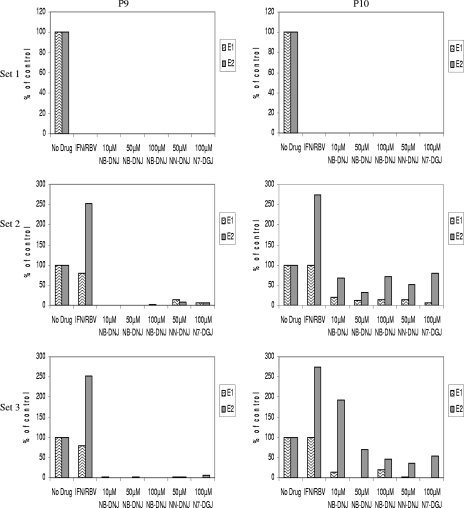
After eight passages of the various drug treatments, all drugs were either left on (set 1) or removed (set 2) or cells continued to be cultured in the presence of an iminosugar only for a further two passages (set 3). In all cases, for those columns denoted with an iminosugar concentration, the cells had been treated with a triple combination of IFN-RBV and an iminosugar of that concentration for five passages. The numbers of viral RNA copies from supernatants harvested at P9 (left column) and P10 (right column) were measured by real-time RT-PCR and are shown as a percentage of the numbers of copies for the non-drug-treated BVDV-infected control. The data presented are from two independent experiments (experiments E1 and E2). At P9 and P10, the supernatants from the no-drug control in experiment E1 contained 8.71 × 10⁶ and 5.05 ×10⁶ RNA copies/ml, respectively; and at P9 and P10 in experiment E2, the supernatants contained 5.1 ×10⁶ and 5.5 × 10⁶ RNA copies/ml, respectively.
FIG. 3.
FIG. 3.
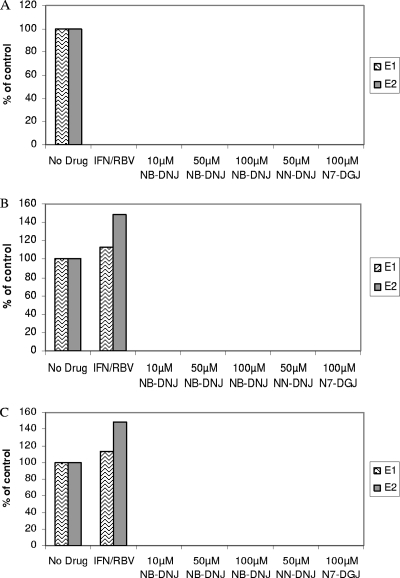
After 12 passages of the various drug treatments, all drugs were either left on (A) or removed (B) or cells continued to be cultured in the presence of an iminosugar only for a further 10 passages (30 days) (C). The numbers of viral RNA copies at P22 were measured by real-time RT-PCR and are shown as a percentage of the numbers of copies for the non-drug-treated BVDV-infected control. The data presented are from two independent experiments (experiments E1 and E2) in which the no-drug control contained 1.13 × 10⁷ and 4.6 ×10⁶ RNA copies/ml, respectively.
FIG. 4.
FIG. 4.
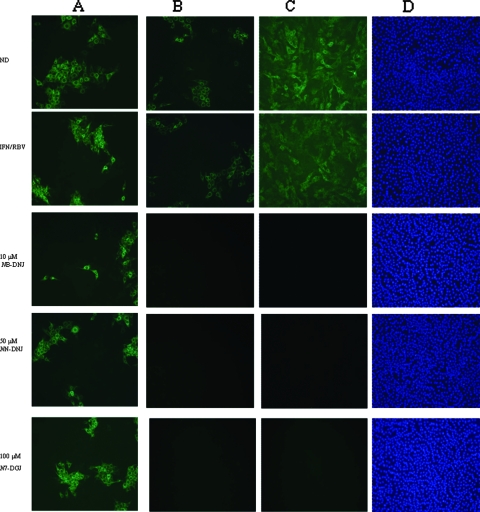
IF analysis of naïve MDBK cells incubated with supernatants from treated BVDV-infected cells (set 2) at P10 (A) and P22 (B) and of long-term-treated BVDV-infected MDBK cells (set 2) at P22 (C). The cells were fixed and probed with a monoclonal antibody against the BVDV NS2 and NS3 proteins, followed by incubation with an anti-mouse FITC-conjugated secondary antibody (green). Cell nuclei were stained with DAPI (D). ND, no drug.
FIG. 5.
FIG. 5.
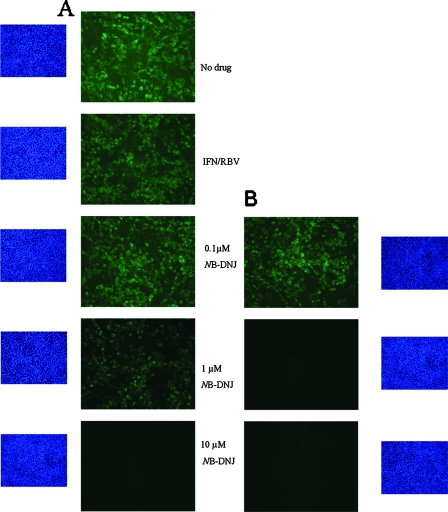
IF analysis of treated BVDV-infected MDBK cells at P32. At 20 passages (60 days) after the removal of all drugs (A) or after the removal IFN-RBV (iminosugar maintenance) (B), cells were fixed and probed with a monoclonal antibody against the BVDV NS2 and NS3 proteins, followed by incubation with an anti-mouse FITC-conjugated secondary antibody (green). Cell nuclei were stained with DAPI (blue).

References

    1. Basso, M., F. Torre, A. Grasso, G. Percario, E. Azzola, S. Artioli, S. Blanchi, N. Pelli, and A. Picciotto. 2007. Pegylated interferon and ribavirin in re-treatment of responder-relapser HCV patients. Dig. Liver Dis. 39:47-51. - PubMed
    1. Branza-Nichita, N., D. Durantel, S. Carrouee-Durantel, R. A. Dwek, and N. Zitzmann. 2001. Antiviral effect of N-butyldeoxynojirimycin against bovine viral diarrhea virus correlates with misfolding of E2 envelope proteins and impairment of their association into E1-E2 heterodimers. J. Virol. 75:3527-3536. - PMC - PubMed
    1. Chapel, C., C. Garcia, B. Bartosch, P. Roingeard, N. Zitzmann, F. L. Cosset, J. Dubuisson, R. A. Dwek, C. Trepo, F. Zoulim, and D. Durantel. 2007. Reduction of the infectivity of hepatitis C virus pseudoparticles by incorporation of misfolded glycoproteins induced by glucosidase inhibitors. J. Gen. Virol. 88:1133-1143. - PubMed
    1. Courcambeck, J., M. Bouzidi, R. Perbost, B. Jouirou, N. Amrani, P. Cacoub, G. Pepe, J. M. Sabatier, and P. Halfon. 2006. Resistance of hepatitis C virus to NS3-4A protease inhibitors: mechanisms of drug resistance induced by R155Q, A156T, D168A and D168V mutations. Antivir. Ther. 11:847-855. - PubMed
    1. Cox, T., R. Lachmann, C. Hollak, J. Aerts, S. van Weely, M. Hrebicek, F. Platt, T. Butters, R. Dwek, C. Moyses, I. Gow, D. Elstein, and A. Zimran. 2000. Novel oral treatment of Gaucher's disease with N-butyldeoxynojirimycin (OGT 918) to decrease substrate biosynthesis. Lancet 355:1481-1485. - PubMed

Publication types

MeSH terms

LinkOut - more resources