


Review
doi: 10.1104/pp.107.113027.
Plant defense priming against herbivores: getting ready for a different battle
Affiliations
- PMID: 18316635
- PMCID: PMC2259053
- DOI: 10.1104/pp.107.113027
Item in Clipboard
Review
Plant defense priming against herbivores: getting ready for a different battle
Plant Physiol.
2008 Mar.
No abstract available
Figures
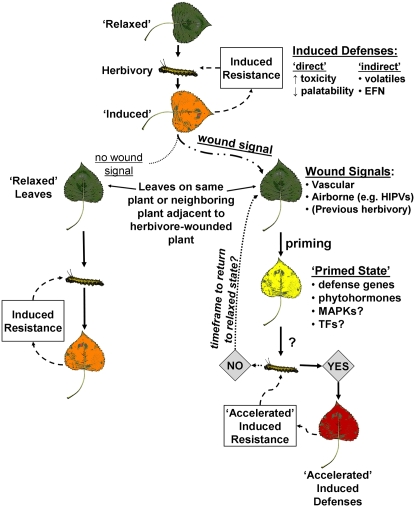
A conceptual model of defense priming in plant-herbivore interactions. The classic model of induced resistance is highlighted at the top of the flow chart, where a relaxed leaf is induced by herbivore feeding. Induced defenses include a suite of chemical changes that are plant and situation specific and may include direct defenses by synthesizing chemicals that are toxic or unpalatable to the herbivore. Induced defenses may also include indirect defenses such as the production of volatile compounds or EFN, both of which can attract natural enemies of the herbivores. Some of the chemical changes to the wounded leaf may act as wound signals to undamaged regions within the plant or to adjacent plants. The wound signals include internal signals such as JA or external signals such as volatiles. The recognition of these signals may initiate priming, which evidently comprises changes at the molecular level and leads to a so-called primed state in undamaged leaves. Leaves in a primed state are then able, by mechanisms that are poorly understood, to respond more quickly or vigorously to herbivore attack should such an attack occur. But, primed leaves theoretically pay fewer costs relative to a fully induced defense in the event that they do not actually experience herbivory. TFs, Transcription factors. See text for citations.
References
-
- Agrawal AA (2000) Communication between plants: this time it's real. Trends Ecol Evol 15 446 - PubMed
-
- Arimura G, Ozawa R, Shimoda T, Nishioka T, Boland W, Takabayashi J (2000) Herbivory-induced volatiles elicit defence genes in lima bean leaves. Nature 406 512–515 - PubMed
-
- Baldwin IT, Halitschke R, Paschold A, von Dahl CC, Preston CA (2006) Volatile signaling in plant-plant interactions: “talking trees” in the genomics era. Science 311 812–815 - PubMed
-
- Baldwin IT, Kessler A, Halitschke R (2002) Volatile signaling in plant-plant-herbivore interactions: what is real? Curr Opin Plant Biol 5 351–354 - PubMed
Publication types
MeSH terms
LinkOut - more resources
Full Text Sources
