


Rapid evolution of seed dispersal in an urban environment in the weed Crepis sancta
- PMID: 18316722
- PMCID: PMC2268839
- DOI: 10.1073/pnas.0708446105
Rapid evolution of seed dispersal in an urban environment in the weed Crepis sancta
Abstract
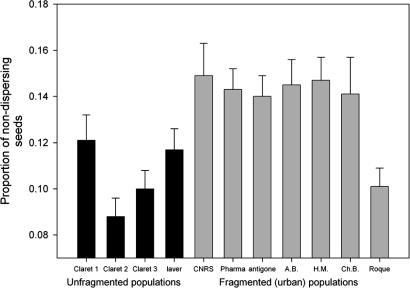
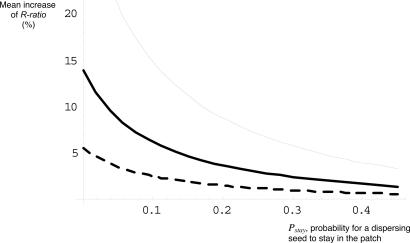
Dispersal is a ubiquitous trait in living organisms. Evolutionary theory postulates that the loss or death of propagules during dispersal episodes (cost of dispersal) should select against dispersal. The cost of dispersal is expected to be a strong selective force in fragmented habitats. We analyzed patchy populations of the weed Crepis sancta occupying small patches on sidewalks, around trees planted within the city of Montpellier (South of France), to investigate the recent evolutionary consequences of the cost of dispersal. C. sancta produces both dispersing and nondispersing seeds. First, we showed that, in urban patches, dispersing seeds have a 55% lower chance of settling in their patch compared with nondispersing seeds and, thus, fall on a concrete matrix unsuitable for germination. Second, we showed that the proportion of nondispersing seeds in urban patches measured in a common environment is significantly higher than in surrounding, unfragmented populations. Third, by using a quantitative genetic model, we estimated that the pattern is consistent with short-term evolution that occurs over approximately 5-12 generations of selection, which is generated by a high cost of dispersal in urban populations. This study shows that a high cost of dispersal after recent fragmentation causes rapid evolution toward lower dispersal.
Conflict of interest statement
The authors declare no conflict of interest.
Figures
References
-
- Levin SA, Muller-Landau HC, Nathan R, Chave J. The ecology and evolution of seed dispersal: a theoretical perspective. Annu Rev Ecol Syst. 2003;34:575–604.
-
- Clobert J, Danchin E, Dhondt AA, Nichols JD, editors. Dispersal. Oxford: Oxford Univ Press; 2001.
-
- Gandon S, Michalakis Y. In: Dispersal. Clobert J, Danchin E, Dhondt AA, Nichols JD, editors. Oxford: Oxford Univ Press; 2001. pp. 155–167.
-
- Hamilton WD, May RM. Dispersal in stable habitats. Nature. 1977;269:578–581.
-
- Motro U. Optimal rates of dispersal. I. Haploid populations. Theor Popul Biol. 1982;21:349–411.
MeSH terms
LinkOut - more resources
Full Text Sources
Other Literature Sources
