Nearly instantaneous brightness induction
- PMID: 18318641
- PMCID: PMC3188447
- DOI: 10.1167/8.2.15
Nearly instantaneous brightness induction
Abstract
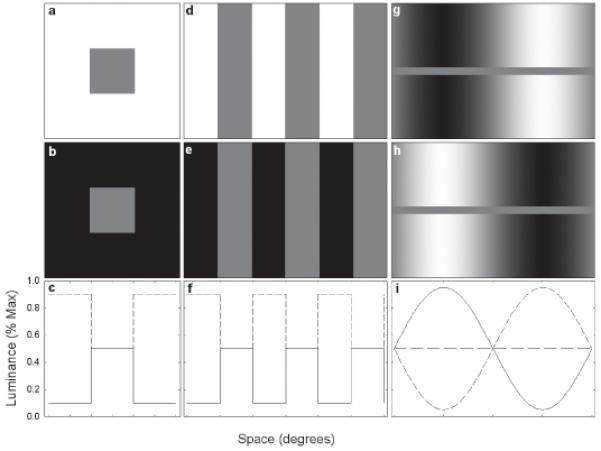
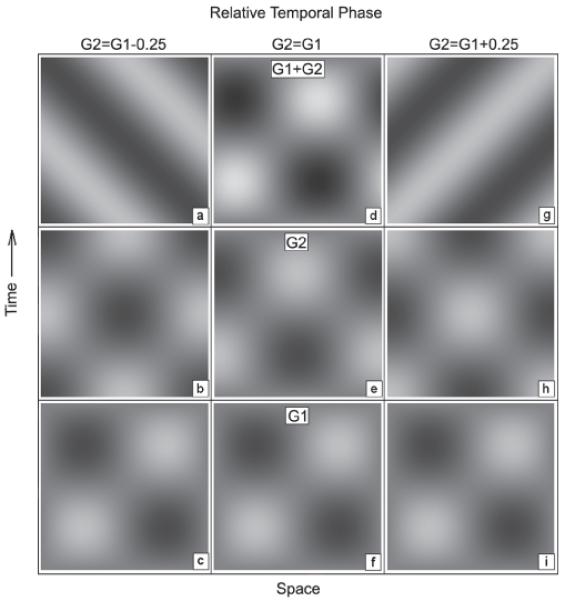
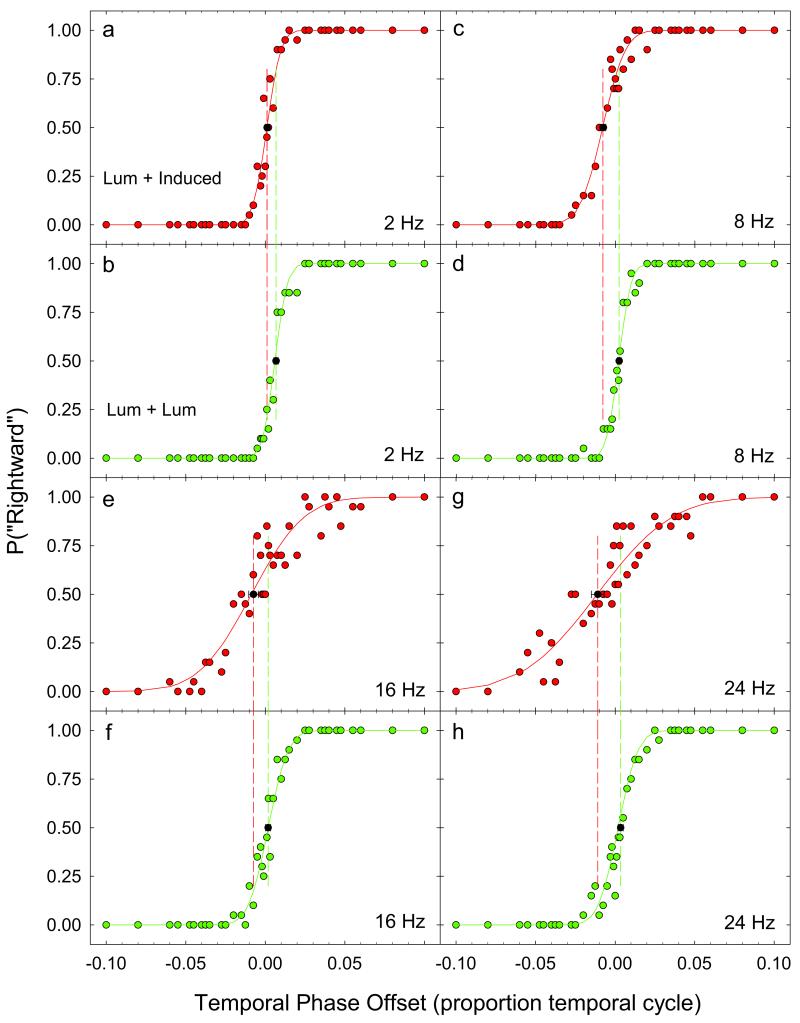
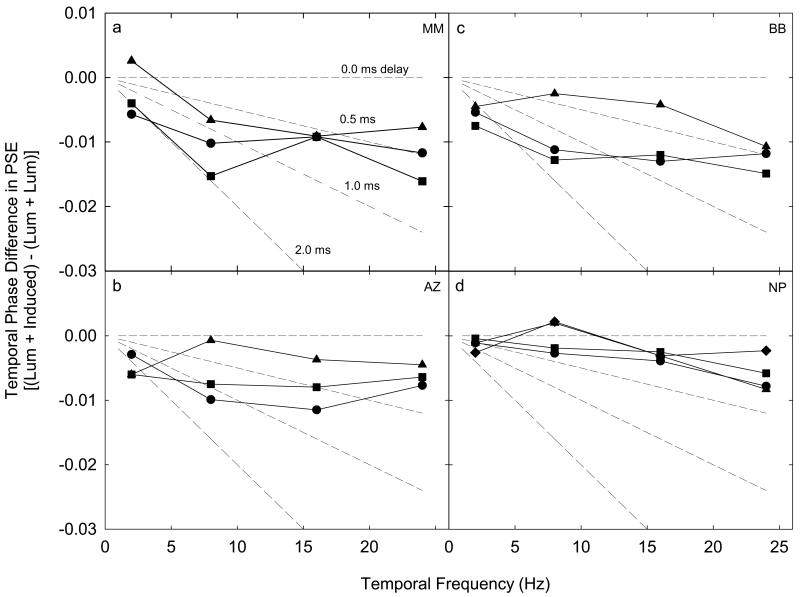
Brightness induction is the modulation of the perceived intensity of a region by the luminance of surrounding regions and reveals fundamental properties of neural organization in the visual system. Grating induction affords a unique opportunity to precisely measure the temporal properties of induction using a quadrature motion technique. Contrary to previous reports that induction is a sluggish process with temporal frequency cutoffs of 2-5 Hz (R. L. DeValois, M. A. Webster, K. K. DeValois, & B. Lingelbach, 1986; A. F. Rossi & M. A. Paradiso, 1996), we find that induction is nearly instantaneous. The temporal response of induced brightness differs from that of luminance gratings by a small time lag (<1 ms), or by a small temporal phase lag (<0.016 cycle), and remains relatively constant across wide variations in test field height. These data are not easily explained by an edge-dependent, homogeneous filling-in process (A. F. Rossi & M. A. Paradiso, 1996); however, they are consistent with an explanation of brightness induction based on spatial filtering by cortical simple cells (B. Blakeslee & M. E. McCourt, 1999).
Figures
References
-
- Albrecht DG, Geisler WS, Frazor RA, Crane AM. Visual cortex neurons of monkeys and cats: Temporal dynamics of the contrast response function. Journal of Neurophysiology. 2002;88:888–913. - PubMed
-
- Blakeslee B, McCourt ME. Similar mechanisms underlie simultaneous brightness contrast and grating induction. Vision Research. 1997;37:2849–2869. - PubMed
-
- Blakeslee B, McCourt ME. A multiscale spatial filtering account of the White effect, simultaneous brightness contrast and grating induction. Vision Research. 1999;39:4361–4377. - PubMed
-
- Blakeslee B, McCourt ME. A multiscale spatial filtering account of the Wertheimer-Benary effect and the corrugated Mondrian. Vision Research. 2001;41:2487–2502. - PubMed
-
- Blakeslee B, McCourt ME. A unified theory of brightness contrast and assimilation incorporating oriented multiscale spatial filtering and contrast normalization. Vision Research. 2004;44:2483–2503. - PubMed
Publication types
MeSH terms
Grants and funding
LinkOut - more resources
Full Text Sources