


Exploring action dynamics as an index of paired-associate learning
- PMID: 18320047
- PMCID: PMC2253184
- DOI: 10.1371/journal.pone.0001728
Exploring action dynamics as an index of paired-associate learning
Abstract
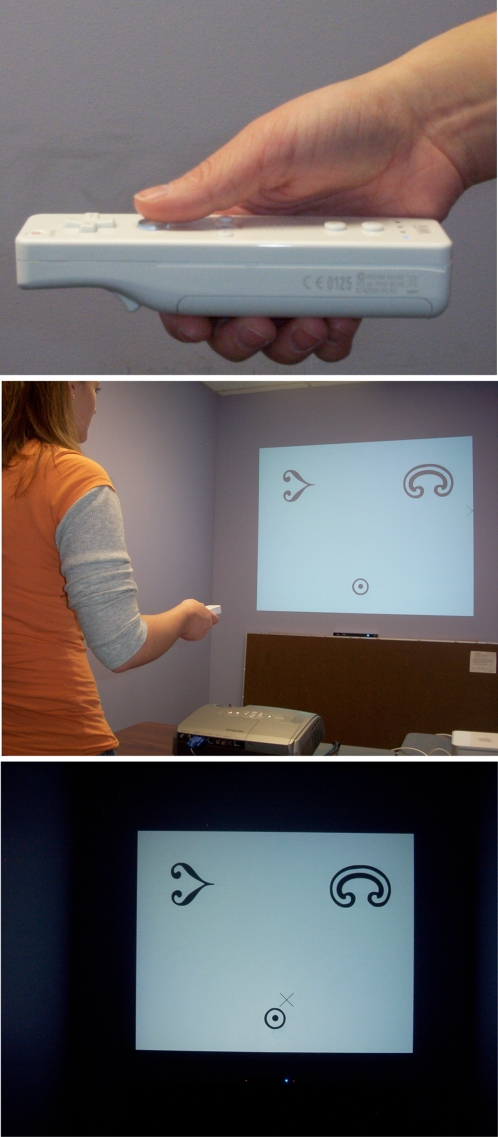
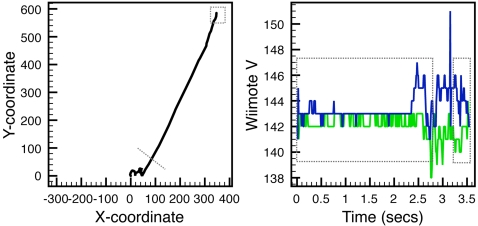
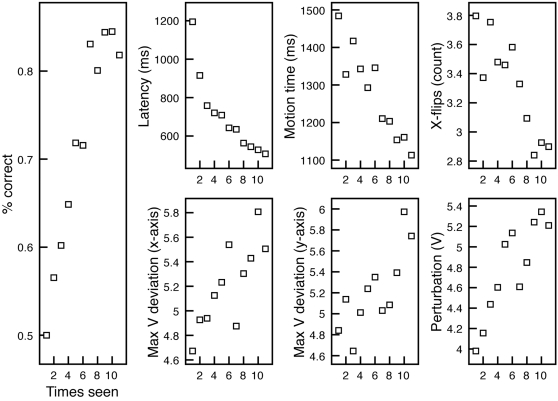
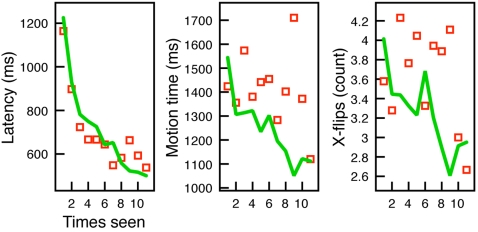
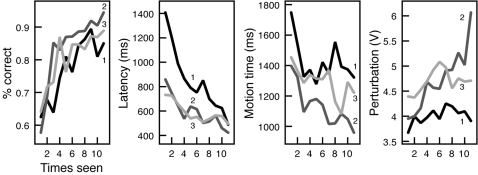
Much evidence exists supporting a richer interaction between cognition and action than commonly assumed. Such findings demonstrate that short-timescale processes, such as motor execution, may relate in systematic ways to longer-timescale cognitive processes, such as learning. We further substantiate one direction of this interaction: the flow of cognition into action systems. Two experiments explored match-to-sample paired-associate learning, in which participants learned randomized pairs of unfamiliar symbols. During the experiments, their hand movements were continuously tracked using the Nintendo Wiimote. Across learning, participant arm movements are initiated and completed more quickly, exhibit lower fluctuation, and exert more perturbation on the Wiimote during the button press. A second experiment demonstrated that action dynamics index novel learning scenarios, and not simply acclimatization to the Wiimote interface. Results support a graded and systematic covariation between cognition and action, and recommend ways in which this theoretical perspective may contribute to applied learning contexts.
Conflict of interest statement
Figures
References
-
- Wells P, Bull P. From politics to comedy: a comparative analysis of affiliative audience responses. J Lan Soc Psych, 2007;26:321–342.
-
- Ekman P, O'Sullivan M. Who can catch a liar. Am Psych, 1991;9:913–920. - PubMed
-
- Dale R, Kehoe C, Spivey MJ. Graded motor responses in the time course of categorizing atypical exemplars. Mem Cogn, 2007;35:15–28. - PubMed
-
- Balota D, Abrams R. Mental chronometry: beyond onset latencies in the lexical decision task. J Exp Psych: Learn Mem Cog, 1995;21:1289–1302. - PubMed
Publication types
MeSH terms
LinkOut - more resources
Full Text Sources
Other Literature Sources
