


Menstrual cycle phase at quit date predicts smoking status in an NRT treatment trial: a retrospective analysis
- PMID: 18321180
- PMCID: PMC2846509
- DOI: 10.1089/jwh.2007.0423
Menstrual cycle phase at quit date predicts smoking status in an NRT treatment trial: a retrospective analysis
Abstract
Background and objective: The deleterious health consequences of smoking are even more severe for women, yet ironically, they have more difficulty quitting than men. Identifying relapse predictors for women and implementing strategies to increase their chances of successfully quitting and remaining abstinent are important goals. Clinicians and researchers suggest that women could achieve greater success in smoking cessation interventions if the initial quit attempt coincided with the follicular phase (i.e., preovulatory phase) of their menstrual cycle (MC) rather than the luteal phase (i.e., premenstrual). However, no experimental data have been published to support this claim. Our objective was to determine whether MC phase affected smoking status in premenopausal female smokers participating in a smoking cessation treatment trial.
Methods: Data from 102 treatment-seeking smokers who participated in an 8-week nicotine replacement therapy (NRT) plus behavioral intervention smoking cessation study were examined retrospectively. NRT began the day subjects attempted to quit smoking (quit date). For analyses, smokers were grouped according to sex, and women were subdivided by MC phase at quit date into follicular (FF, days 1-14, n = 16) and luteal (LF, days 15-30, n = 21) groups.
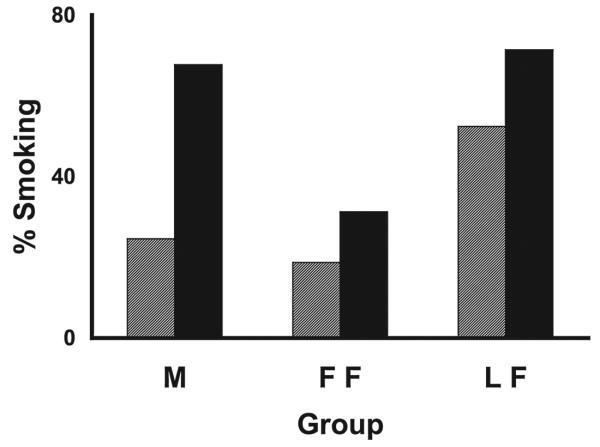
Results: Smoking status was examined on the third day after the quit date (day 3) and at 1 week posttreatment (week 9). On day 3, 52% of LFs reported smoking compared with 19% of FFs (p < 0.04), and at week 9, 71% of LFs reported smoking compared with 31% of FFs (p < 0.02). In a comparison group of men (n = 65), 25% were smoking at day 3 and 68% at week 9. Self-report at week 9 was verified by urine cotinine levels.
Conclusions: These data support the supposition that better treatment outcomes can be achieved by scheduling quit dates to coincide with the follicular phase of the MC in female smokers.
Figures
References
-
- Women and smoking: A report of the Surgeon General. United States Department of Health and Human Services; Washington, DC: 2001. Available at www.cdc.gov/tobacco/data_statistics/sgr/sgr_2001/index.htm#full.
-
- Van Keep PA, Lehert P. The premenstrual syndrome: An epidemiological and statistical exercise. In: Van Keep PA, Utian WH, editors. The premenstrual syndrome. MIT Press; Lancaster, England: 1981. p. 31.
-
- Endicott J, Amsterdam J, Eriksson E, et al. Is premenstrual dysphoric disorder a distinct clinical entity? J Womens Health Gend Based Med. 1999;8:663. - PubMed
-
- Ling FW. Recognizing and treating premenstrual dysphoric disorder in the obstetric, gynecologic, and primary care practices. J Clin Psych. 2000;61(Suppl 12):9. - PubMed
-
- Mello NK, Mendelson JH, Palmieri SL. Cigarette smoking by women: Interactions with alcohol use. Psychopharmacology. 1987;93:8. - PubMed
Publication types
MeSH terms
Substances
Grants and funding
LinkOut - more resources
Full Text Sources
Medical
