


Wall shear stress as measured in vivo: consequences for the design of the arterial system
- PMID: 18324431
- PMCID: PMC2441533
- DOI: 10.1007/s11517-008-0330-2
Wall shear stress as measured in vivo: consequences for the design of the arterial system
Abstract
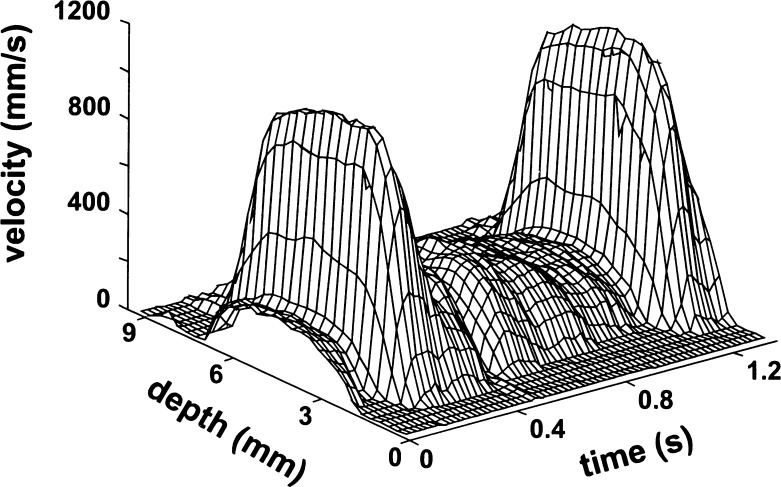
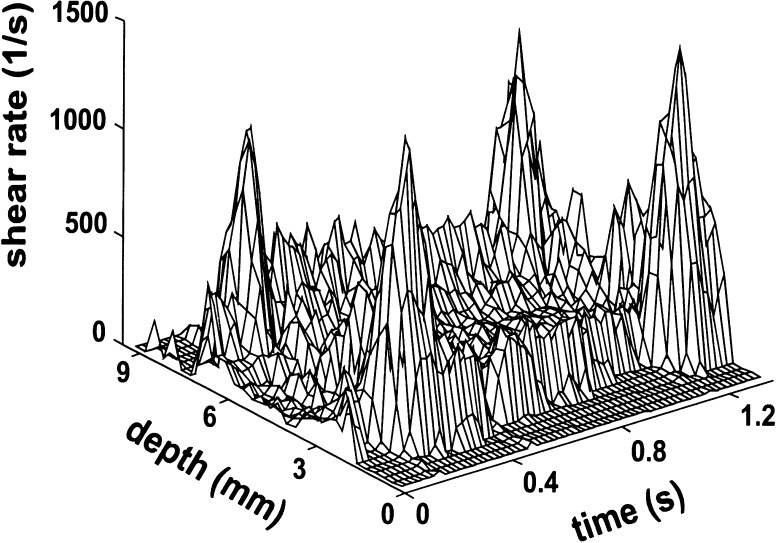
Based upon theory, wall shear stress (WSS), an important determinant of endothelial function and gene expression, has been assumed to be constant along the arterial tree and the same in a particular artery across species. In vivo measurements of WSS, however, have shown that these assumptions are far from valid. In this survey we will discuss the assessment of WSS in the arterial system in vivo and present the results obtained in large arteries and arterioles. In vivo WSS can be estimated from wall shear rate, as derived from non-invasively recorded velocity profiles, and whole blood viscosity in large arteries and plasma viscosity in arterioles, avoiding theoretical assumptions. In large arteries velocity profiles can be recorded by means of a specially designed ultrasound system and in arterioles via optical techniques using fluorescent flow velocity tracers. It is shown that in humans mean WSS is substantially higher in the carotid artery (1.1-1.3 Pa) than in the brachial (0.4-0.5 Pa) and femoral (0.3-0.5 Pa) arteries. Also in animals mean WSS varies substantially along the arterial tree. Mean WSS in arterioles varies between about 1.0 and 5.0 Pa in the various studies and is dependent on the site of measurement in these vessels. Across species mean WSS in a particular artery decreases linearly with body mass, e.g., in the infra-renal aorta from 8.8 Pa in mice to 0.5 Pa in humans. The observation that mean WSS is far from constant along the arterial tree implies that Murray's cube law on flow-diameter relations cannot be applied to the whole arterial system. Because blood flow velocity is not constant along the arterial tree either, a square law also does not hold. The exponent in the power law likely varies along the arterial system, probably from 2 in large arteries near the heart to 3 in arterioles. The in vivo findings also imply that in in vitro studies no average shear stress value can be taken to study effects on endothelial cells derived from different vascular areas or from the same artery in different species. The cells have to be studied under the shear stress conditions they are exposed to in real life.
Figures
References
-
- Arts T, Kruger RT, van Gerven W, Lambregts JA, Reneman RS. Propagation velocity and reflection of pressure waves in the canine coronary artery. Am J Physiol. 1979;237:H469–H474. - PubMed
MeSH terms
LinkOut - more resources
Full Text Sources
Other Literature Sources
Research Materials
