


Influenza-related hospitalisation and death in Australians aged 50 years and older
- PMID: 18325639
- PMCID: PMC7125633
- DOI: 10.1016/j.vaccine.2008.01.051
Influenza-related hospitalisation and death in Australians aged 50 years and older
Abstract
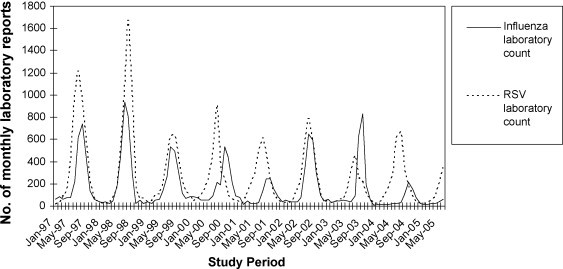
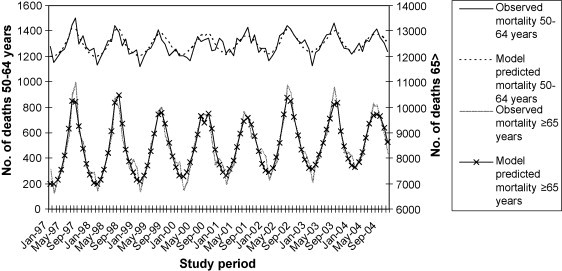
Estimating the true burden of influenza is problematic because relatively few hospitalisations or deaths are specifically coded as influenza related. Statistical regression techniques using influenza and respiratory syncytial virus surveillance data were used to estimate the number of excess hospitalisations and deaths attributable to influenza. Several International Classification of Diseases 10th Revision (ICD-10) groupings were used for both hospitalisation and mortality estimates, including influenza and pneumonia, other respiratory disorders, and circulatory disorders. For Australians aged 50-64 years, the annual excess hospitalisations attributable to influenza were 33.3 (95%CI: 23.2-43.4) per 100,000 for influenza and pneumonia and 57.6 (95%CI: 32.5-82.8) per 100,000 for other respiratory disorders. For Australians aged > or =65 years, the annual excess hospitalisations attributable to influenza were 157.4 (95%CI: 108.4-206.5) per 100,000 for influenza and pneumonia and 282.0 (95%CI: 183.7-380.3) per 100,000 for other respiratory disorders. The annual excess all-cause mortality attributable to influenza was 6.4 (95%CI: 2.6-10.2) per 100,000 and 116.4 (95%CI: 71.3-161.5) per 100,000, for Australians aged 50-64 years and those aged > or =65 years, respectively. In the age-group > or =65 years, a significant association was found between influenza activity and circulatory mortality. We conclude that influenza is responsible for a substantial amount of mortality and morbidity, over and above that which is directly diagnosed as influenza in Australians aged > or =50 years.
Figures
Comment in
-
Why young healthy adults should become a target group for the influenza vaccination: a cardiologist's point of view.Vaccine. 2008 Aug 18;26(35):4411-2. doi: 10.1016/j.vaccine.2008.06.078. Epub 2008 Jul 9. Vaccine. 2008. PMID: 18602956 No abstract available.
References
-
- De Ravin J.W., Gerrard P.N. The effect of influenza on Australian mortality. Ann Trans Aust Inst Act. 1984:471–479.
-
- Scagg R. Effect of influenza epidemics on Australian mortality. Med J Aust. 1985;142(2):98–102. - PubMed
-
- Fleming D.M. The contribution of influenza to combined acute respiratory infections, hospital admissions, and deaths in winter. Commun Dis Public Health. 2000;3(1):32–38. - PubMed
-
- Australian Institute of Health and Welfare. 2004 Adult vaccination survey: summary results. Canberra: AIHW & DoHA; 2005. Report No.: PHE 56.
Publication types
MeSH terms
LinkOut - more resources
Full Text Sources
Medical
