


Mass spectrometry identifies and quantifies 74 unique histone H4 isoforms in differentiating human embryonic stem cells
- PMID: 18326628
- PMCID: PMC2393763
- DOI: 10.1073/pnas.0710515105
Mass spectrometry identifies and quantifies 74 unique histone H4 isoforms in differentiating human embryonic stem cells
Abstract
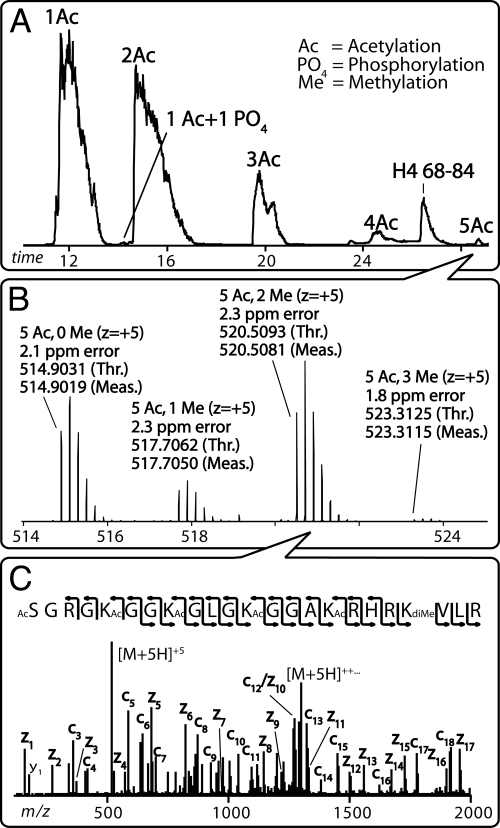
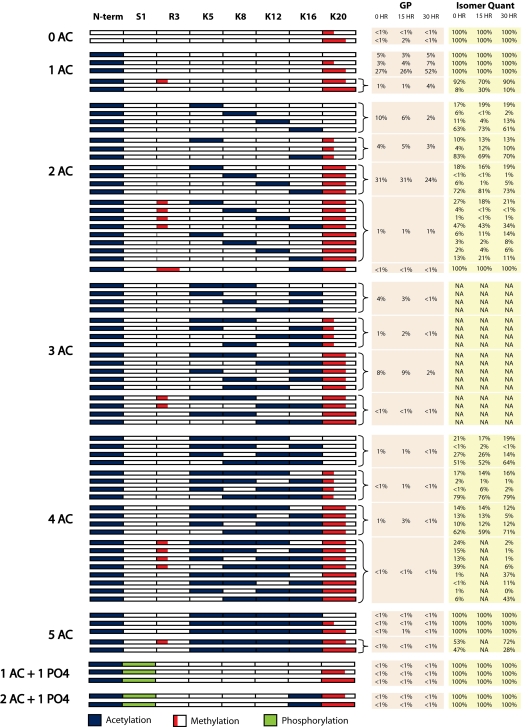
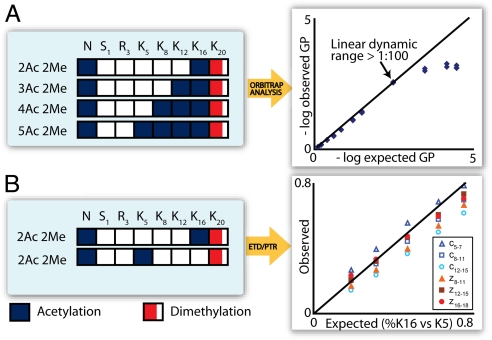
Epigenetic regulation through chromatin is thought to play a critical role in the establishment and maintenance of pluripotency. Traditionally, antibody-based technologies were used to probe for specific posttranslational modifications (PTMs) present on histone tails, but these methods do not generally reveal the presence of multiple modifications on a single-histone tail (combinatorial codes). Here, we describe technology for the discovery and quantification of histone combinatorial codes that is based on chromatography and mass spectrometry. We applied this methodology to decipher 74 discrete combinatorial codes on the tail of histone H4 from human embryonic stem (ES) cells. Finally, we quantified the abundances of these codes as human ES cells undergo differentiation to reveal striking changes in methylation and acetylation patterns. For example, H4R3 methylation was observed only in the presence of H4K20 dimethylation; such context-specific patterning exemplifies the power of this technique.
Conflict of interest statement
The authors declare no conflict of interest.
Figures
References
-
- Bernstein BE, et al. A bivalent chromatin structure marks key developmental genes in embryonic stem cells. Cell. 2006;125:315–326. - PubMed
-
- Pan G, et al. Whole-genome analysis of histone H3 lysine 4 and lysine 27 methylation in human embryonic stem cells. Cell Stem Cell. 2007;1:299–312. - PubMed
-
- Meshorer E, Misteli T. Opinion—Chromatin in pluripotent embryonic stem cells and differentiation. Nat Rev Mol Cell Biol. 2006;7:540–546. - PubMed
Publication types
MeSH terms
Substances
Grants and funding
LinkOut - more resources
Full Text Sources
Other Literature Sources
Miscellaneous
