


Comment
doi: 10.1016/j.ccr.2008.02.016.
A catalytic role for proangiogenic marrow-derived cells in tumor neovascularization
Affiliations
- PMID: 18328420
- PMCID: PMC2951026
- DOI: 10.1016/j.ccr.2008.02.016
Item in Clipboard
Comment
A catalytic role for proangiogenic marrow-derived cells in tumor neovascularization
Cancer Cell.
2008 Mar.
Abstract
Small numbers of proangiogenic bone marrow-derived cells (BMDCs) can play pivotal roles in tumor progression. In this issue of Cancer Cell, two papers, utilizing different tumor angiogenesis models, both find that activated MMP-9 delivered by BMDCs modulates neovessel remodeling, thereby promoting tumor growth. The changes in microvascular anatomy induced by MMP-9-expressing BMDCs are strikingly different between the preirradiated tumor vascular bed model employed by Ahn and Brown and the invasive glioblastoma model utilized by Du et al., likely mirroring the complexity of the real tumor microenvironment and the intricacy of roles of different BMDC populations in mediating tumor neoangiogenesis.
Figures
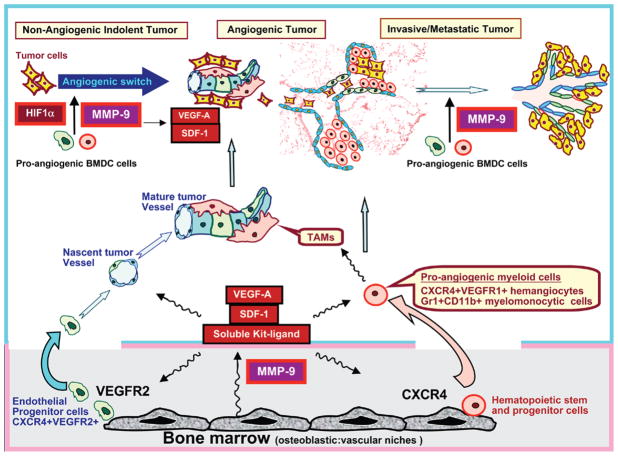
Activated MMP-9, through increasing the bioavailability of Kit-ligand, VEGF-A, and SDF-1, supports the mobilization of the proangiogenic bone marrow-derived cells (BMDCs), including tumor-associated monocytes/macrophages (TAMs), Gr1+CD11b+ myeloid precursors, CXCR4+VEGFR1+ hemangiocytes, and EPCs to the circulation. Irradiation-induced vascular injury or hypoxia-driven upregulation of HIF-1α enhances the release of SDF-1 and VEGF-A, thereby recruiting MMP-9-bearing BMDCs to the neoangiogenic niches, augmenting tumor vasculogenesis, angiogenesis, invasive potential, and metastasis. MMP-9 delivered by BMDCs amplifies tumor neoangiogenesis by increasing the bioavailability of VEGF-A and stem cell active chemocytokines, including SDF-1 and Kit-ligand.
Comment on
-
Matrix metalloproteinase-9 is required for tumor vasculogenesis but not for angiogenesis: role of bone marrow-derived myelomonocytic cells.Cancer Cell. 2008 Mar;13(3):193-205. doi: 10.1016/j.ccr.2007.11.032. Cancer Cell. 2008. PMID: 18328424 Free PMC article.
-
HIF1alpha induces the recruitment of bone marrow-derived vascular modulatory cells to regulate tumor angiogenesis and invasion.Cancer Cell. 2008 Mar;13(3):206-20. doi: 10.1016/j.ccr.2008.01.034. Cancer Cell. 2008. PMID: 18328425 Free PMC article.
References
Publication types
MeSH terms
Substances
Grants and funding
LinkOut - more resources
Full Text Sources
Other Literature Sources
Miscellaneous
