. 2008 May 16;369(4):1071-5.
doi: 10.1016/j.bbrc.2008.02.125. Epub 2008 Mar 6.

Isofagomine increases lysosomal delivery of exogenous glucocerebrosidase

Affiliations

Isofagomine increases lysosomal delivery of exogenous glucocerebrosidase

Jin-Song Shen et al. Biochem Biophys Res Commun. .

Abstract

Intravenous enzyme replacement therapy (ERT) with purified glucocerebrosidase (GLA) leads to significant improvement of the clinical manifestations in patients with Type 1 Gaucher disease. However, the high doses required, slow response and inability to recover most of the infused enzyme in the target tissues may be attributed to losses occurring during transit en route to the lysosome. Preincubation of GLA with isofagomine (IFG), a slow-binding inhibitor, significantly increased stability of the enzyme to heat, neutral pH and denaturing agents in vitro. Preincubation of GLA with isofagomine prior to uptake by cultured cells results in increased intracellular enzyme activity accompanied by an increase in enzyme protein suggesting that reduced denaturation of GLA in the presence of isofagomine leads to a decrease in the degradation of the enzyme after internalization. Preincubation of GLA with slow-binding inhibitors before infusion may improve the effectiveness of ERT for Gaucher disease.


Figures
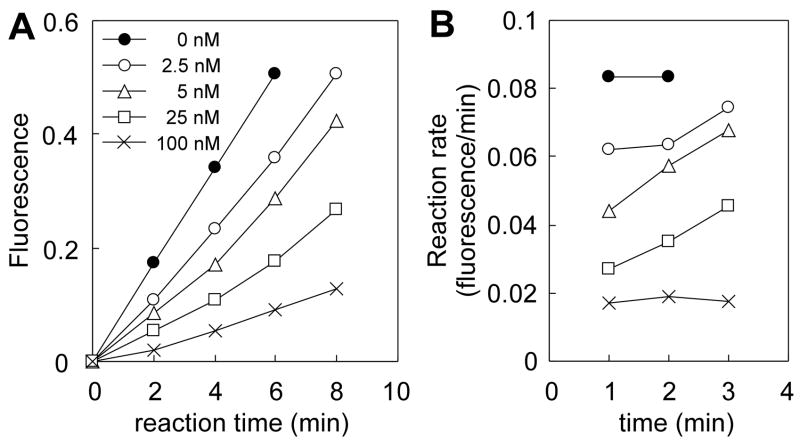
Figure 1
Figure 1
Slow release of IFG from enzyme-inhibitor complex upon dilution. (A) Progress curves for the hydrolysis of substrate. GLA was preincubated with 0 to 2 μM IFG, and then rapidly diluted 20x into substrate solution to achieve the final concentrations of IFG shown. (B) Reaction rates calculated from (A).
Figure 2
Figure 2
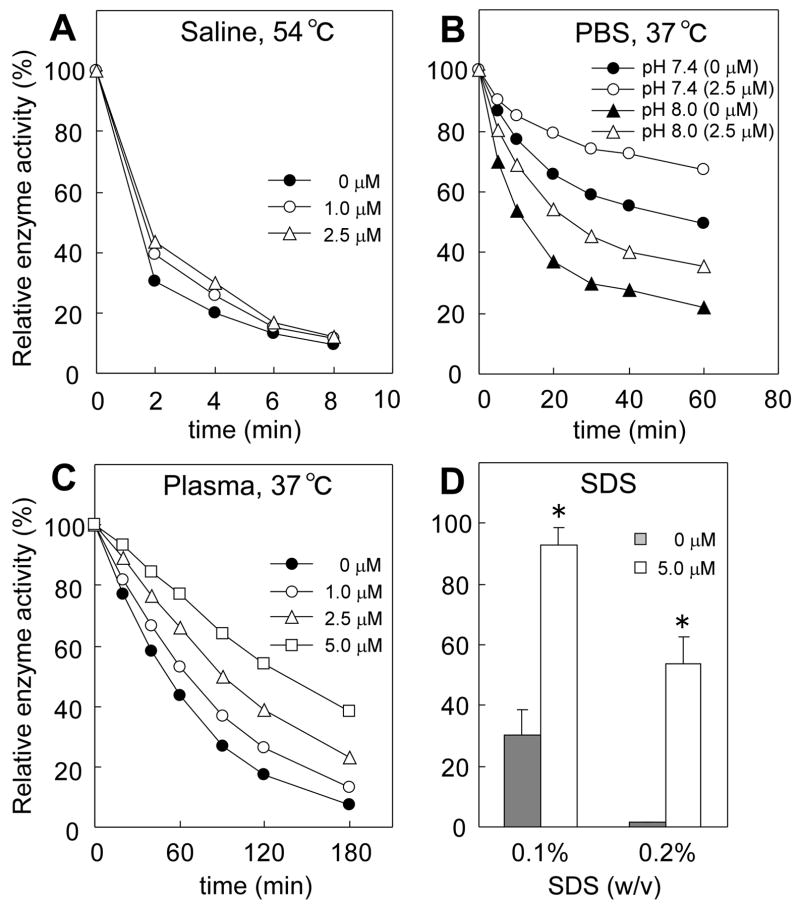
Stabilization of GLA by IFG-preincubation in vitro. GLA was preincubated with IFG at room temperature for 30 min. The EI complex was diluted 50-fold, incubated for indicated length of time at indicated temperature, and then assayed for activity. Concentrations indicated are final concentrations of IFG in EI complex. (A) EI complex was diluted in saline and was heated at 54°C. (B) EI complex was diluted with PBS (pH 7.4 and pH 8.0) and heated at 37°C. (C) EI complex was diluted in human plasma and was heated at 37°C. (D) EI complex was diluted in SDS solutions (0.1% and 0.2%) and incubated at room temperature for 30 min. Enzyme activity is expressed as relative activity to untreated enzyme. For (A–C), results are the mean of duplicate assays and are representative of two independent experiments. For (D), data are presented as mean ± SE (n = 3). *P<0.004, comparison of the enzyme with and without IFG preincubated, two-tailed Student’s t test.
Figure 3
Figure 3
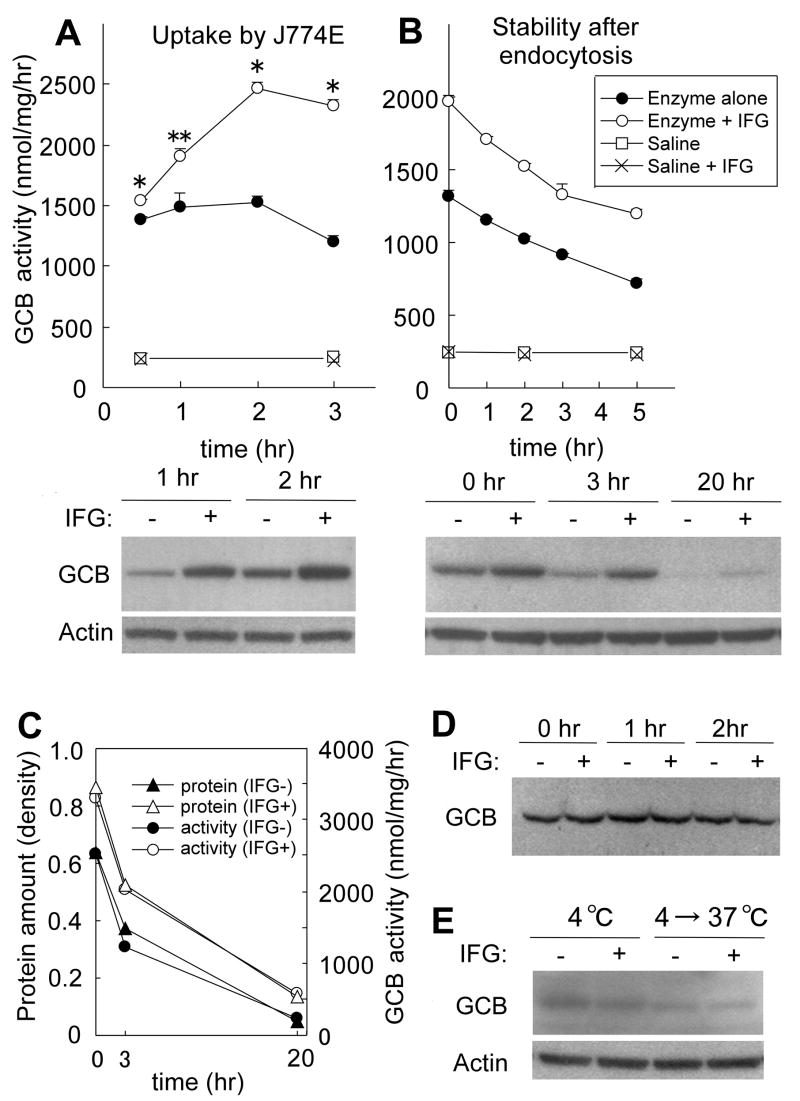
Effect of IFG on enzyme uptake by macrophages. (A) Uptake of GLA with or without IFG-preincubation. Intracellular enzyme was assessed by enzyme activity (upper) and Western blot analysis (lower). Data are presented as mean ± SE (n = 3). *P < 0.005, **P<0.05, activity of the cells loaded with IFG-preincubated enzyme compared to that with untreated enzyme, t test. (B) Stability of endocytosed GLA with or without IFG-preincubation. Intracellular enzyme was assessed by enzyme activity (upper) and Western blot analysis (lower). Data are presented as mean ± SE (n = 3). (C) Comparison of activity and protein level of endocytosed GLA through 20 hrs after removal of enzyme from medium. Protein level was quantified by densitometry. Enzyme activity was obtained by subtracting the endogenous GLA activity in control cells from the activity in enzyme-loaded cells. (D) Effect of IFG on stability of the enzyme in the culture medium. GLA with or without IFG-preincubation was incubated in the medium at 37°C, and the enzyme amount was assessed by Western blotting. (E) Effect of IFG on binding and internalization of the enzyme to the cells. Binding was conducted at 4°C for 2 hrs. To assess internalization of surface-bound protein, the cells were transferred to 37°C and incubated for 45 min.

References

    1. Brady RO, Kanfer JN, Shapiro D. Metabolism of Glucocerebrosides. Ii. Evidence of an Enzymatic Deficiency in Gaucher's Disease. Biochem Biophys Res Commun. 1965;18:221–5. - PubMed
    1. Beutler E, Grabowski GA. Gaucher disease. In: Scriver CR, Beaudet AL, Sly WS, Valle D, editors. The Metabolic and Molecular Bases of Inherited Diseases. McGraw-Hill; New York: 2001. pp. 3635–3668.
    1. Brady RO. Enzyme replacement for lysosomal diseases. Annu Rev Med. 2006;57:283–96. - PubMed
    1. Weinreb NJ, Charrow J, Andersson HC, Kaplan P, Kolodny EH, Mistry P, Pastores G, Rosenbloom BE, Scott CR, Wappner RS, Zimran A. Effectiveness of enzyme replacement therapy in 1028 patients with type 1 Gaucher disease after 2 to 5 years of treatment: a report from the Gaucher Registry. Am J Med. 2002;113:112–9. - PubMed
    1. Desnick RJ. Enzyme replacement and enhancement therapies for lysosomal diseases. J Inherit Metab Dis. 2004;27:385–410. - PubMed

MeSH terms