Review
. 2008 Jul;7(3):209-24.
doi: 10.1016/j.arr.2008.01.002. Epub 2008 Feb 7.

Caloric restriction: impact upon pituitary function and reproduction

Affiliations
Review

Caloric restriction: impact upon pituitary function and reproduction

Bronwen Martin et al. Ageing Res Rev. 2008 Jul.

Abstract

Reduced energy intake, or caloric restriction (CR), is known to extend life span and to retard age-related health decline in a number of different species, including worms, flies, fish, mice and rats. CR has been shown to reduce oxidative stress, improve insulin sensitivity, and alter neuroendocrine responses and central nervous system (CNS) function in animals. CR has particularly profound and complex actions upon reproductive health. At the reductionist level the most crucial physiological function of any organism is its capacity to reproduce. For a successful species to thrive, the balance between available energy (food) and the energy expenditure required for reproduction must be tightly linked. An ability to coordinate energy balance and fecundity involves complex interactions of hormones from both the periphery and the CNS and primarily centers upon the master endocrine gland, the anterior pituitary. In this review article we review the effects of CR on pituitary gonadotrope function and on the male and female reproductive axes. A better understanding of how dietary energy intake affects reproductive axis function and endocrine pulsatility could provide novel strategies for the prevention and management of reproductive dysfunction and its associated comorbidities.


Figures
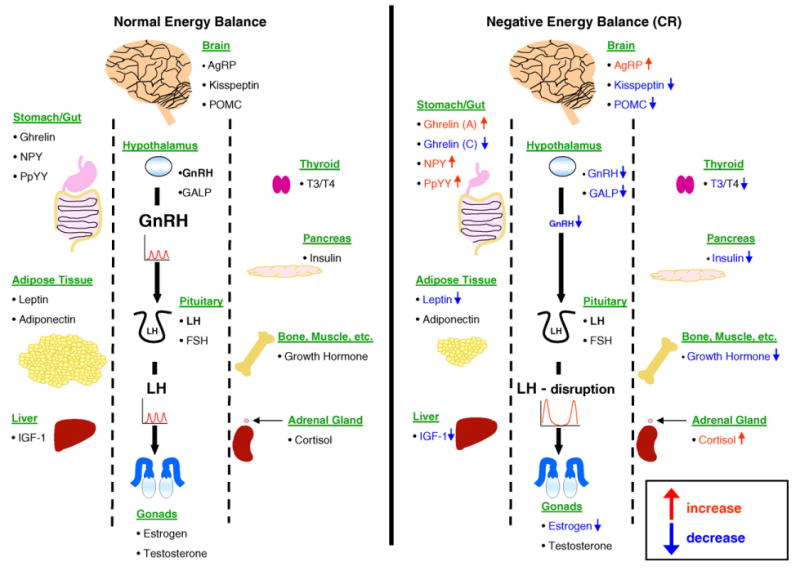
Fig. 1
Fig. 1
The effects of negative energy balance (caloric restriction)on pituitary function. The secretion of luteinizing hormone (LH) from the pituitary gonadotropes is controlled by gonadotropin-releasing hormone (GnRH) secreted from the hypothalamus. Under normal energy balance conditions, both are secreted in a pulsatile manner. The release patterns of GnRH and LH are themselves controlled by multiple feedback hormones (Ghrelin, NPY, polypeptide YY (PpYY), leptin, adiponectin, insulin-like growth factor 1 (IGF-1), agouti-related peptide (AgRP), kisspeptin, pro-opiomelanocortin (POMC), Galanin-like peptide (GALP), thyroid hormones 3 and 4 (T3/T4), insulin, growth hormone (GH), cortisol, estrogen and testosterone) that control the hypothalamic secretion of GnRH and the activity of gonadotropes in the anterior pituitary. In times of negative energy balance, i.e. caloric restriction, pulsatile GnRH secretion is reduced, resulting in a subsequent suppression of pulsatile LH release. A variety of metabolic hormones and neuropeptides important for energy homeostasis have been shown to influence the function of this hypothalamic-pituitary axis during caloric restriction. With reduction of visceral fat, the adipose-derived appetite hormone leptin is greatly reduced during CR. While leptin has little effect on the reproductive axis during normal energy conditions, during times of limited intake it appears to play a direct role in reduction of GnRH and thus LH secretion. While leptin levels are decreased with CR, both NPY and PpYY levels are reportedly increased, which also disrupts the GnRH/LH pulsatile release. Other peptide hormones that are altered by CR and appear to exert complex effects upon the pulsatile GnRH/LH secretion at the level of the hypothalamus and the pituitary itself are AgRP, kisspeptin, GALP and POMC. Insulin, produced in the pancreas, and IGF-1 produced in the liver, are also reduced in CR. Each has been shown to regulate hypothalamic GnRH secretion and therefore LH release, thus their reduction may be another mechanism through which these hormones are reduced during CR. Ghrelin, which is involved directly at the pituitary level, is differentially affected in CR, becoming increased with acute fasting (indicating hunger), and decreased with chronic fasting. Additionally, GH release disrupted by CR seems to control reproductive capacity as well. The thyroid hormones T3 and T4, which are involved with growth and the setting of the metabolic rate, seem to play a role in CR-mediated pituitary disruption, as abnormal levels of these hormones are associated with reproductive deficiency. In response to CR, T3 levels decrease while T4 levels remain unchanged. Caloric restriction is known to induce a mild stress response in the organism. Interestingly, GnRH pulsatile secretion (and thus LH secretion) is reduced by increased exposure to stress-related hormones such as corticotrophin-releasing hormone (CRH). One final effect that may lead to the reduction of LH pulsatile secretion during CR is the reported enhancement of negative feedback by estrogen and testosterone onto the pituitary during times of negative energy balance. Additional abbreviation: follicle-stimulating hormone (FSH).

References

    1. Adam CL, Findlay PA, Kyle CE, Young P, Mercer JG. Effect of chronic food restriction on pulsatile luteinizing hormone secretion and hypothalamic neuropeptide Y gene expression in castrated male sheep. J Endocrinol. 1997;152:329–337. - PubMed
    1. Ahima RS, Saper CB, Flier JS, Elmquist JK. Leptin regulation of neuroendocrine systems. Front Neuroendocrinol. 2000;21:263–307. - PubMed
    1. Allen YS, Adrian TE, Allen JM, Tatemoto K, Crow TJ, Bloom SR, Polak JM. Neuropeptide Y distribution in the rat brain. Science. 1983;221:877–879. - PubMed
    1. Aloi JA, Bergendahl M, Iranmanesh A, Veldhuis JD. Pulsatile intravenous gondaotropin-releasing hormone administration averts fasting-induced hypogonadotropism and hypoandrogenemia in healthy, normal weight men. J Clin Endocrinol Metab. 1997;82:1543–1548. - PubMed
    1. American Psychiatric Association. Diagnostic and Statistical Manual of Mental Disorders (DSM-IV) American Psychiatric Association; Washington, DC: 1994.

Publication types
