. 2008 Apr;12(4):136-43.
doi: 10.1016/j.tics.2008.01.006. Epub 2008 Mar 10.

A central circuit of the mind

Affiliations

A central circuit of the mind

John R Anderson et al. Trends Cogn Sci. 2008 Apr.

Abstract

The methodologies of cognitive architectures and functional magnetic resonance imaging can mutually inform each other. For example, four modules of the ACT-R (adaptive control of thought - rational) cognitive architecture have been associated with four brain regions that are active in complex tasks. Activity in a lateral inferior prefrontal region reflects retrieval of information in a declarative module; activity in a posterior parietal region reflects changes to problem representations in an imaginal module; activity in the anterior cingulate cortex reflects the updates of control information in a goal module; and activity in the caudate nucleus reflects execution of productions in a procedural module. Differential patterns of activation in such central regions can reveal the time course of different components of complex cognition.


Figures
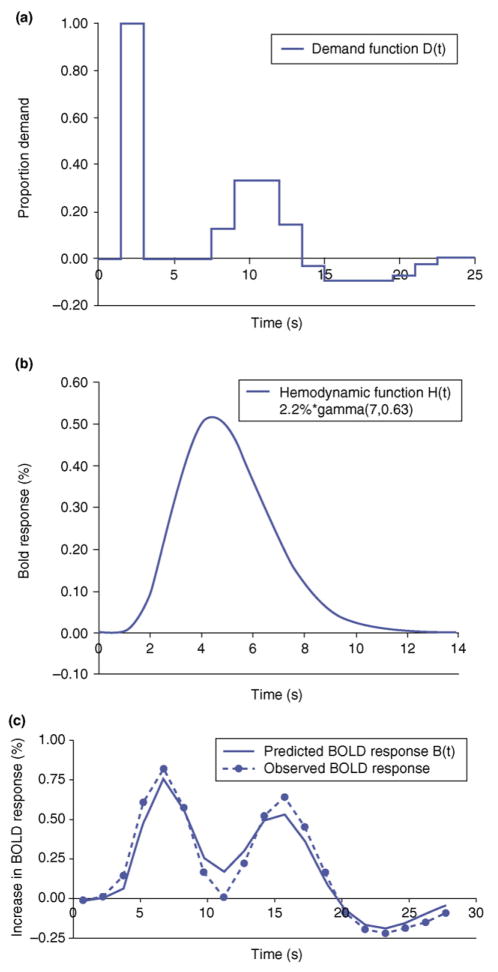
Figure I
Figure I
Illustration of the prediction of a BOLD response for the auditory cortex for the experiment in Ref. [3]: (a) shows the proportion of time that the aural module in ACT-R will be engaged during each 1.5 s scan in a trial; (b) illustrates the hemodynamic function estimate for this region; (c) shows the predicted response obtained by convolving the demand function in (a) with the hemodynamic function in (b) and compares it with the observed BOLD response.
Figure I
Figure I
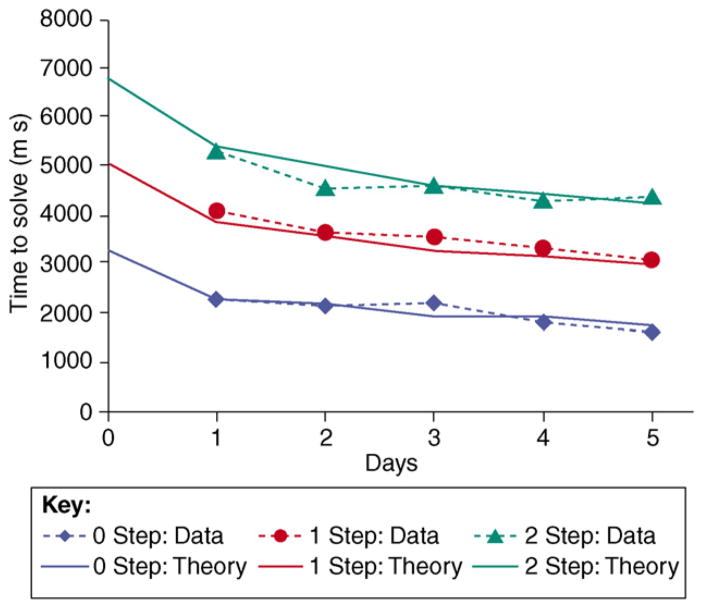
Mean solution times (and predictions of the ACT-R model) for the three types of equations as a function of delay. Although the data were not collected, the predicted times are presented for the practice session of the experiment (Day 0). Dashed lines connect the actual empirical points whereas the smooth lines show the predictions of an ACT-R model.
Figure II
Figure II
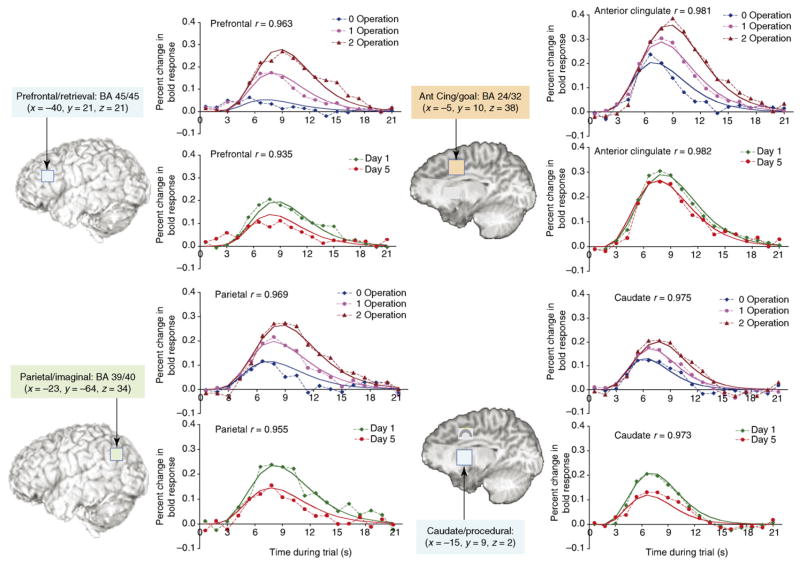
Effect of number of operations (collapsing over practice) and practice (collapsing over number of operations) on four regions in the central circuit. Dashed lines connect the actual empirical points whereas the solid lines show the predictions of an ACT-R mode.
Figure 1
Figure 1
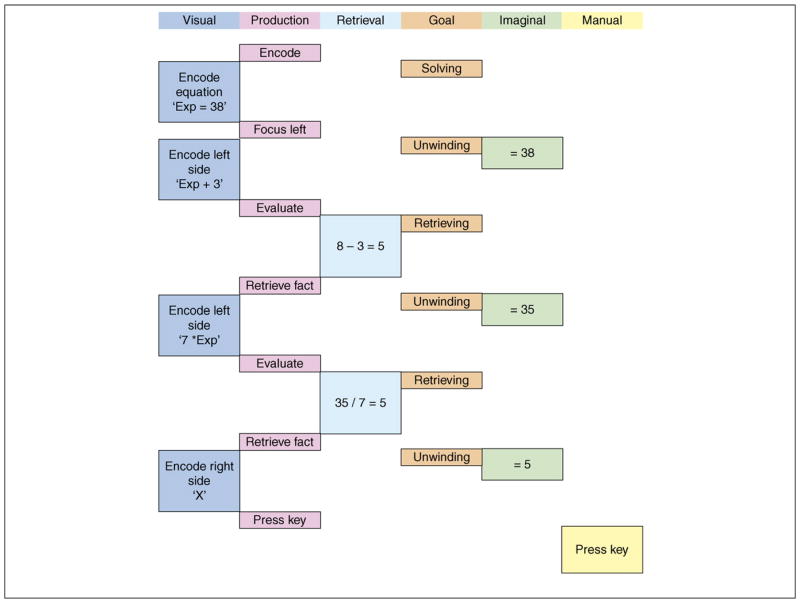
A representation of the basic module operations in ACT-R to implement the unwind strategy in ACT-R to solve the equation 7*x + 3 = 38. (i) The visual module encodes pieces of the visual display such as fragments of an equation, for example ‘+ 3’. (ii) The retrieval module holds retrieval cues such as ‘8 – 3’ to drive the retrieval of task-relevant facts. (iii) The imaginal module creates and transforms problem representations, such as intermediate answers in the equation solution. (iv) The goal module sets control states to direct the path of information processing, such as whether information is to be retrieved or the equation is to be transformed. (v) The manual module programs the output such as the keying of 5 as the final answer. (vi) The procedural module executes productions that recognize patterns of activity in other modules, selects appropriate actions and relays information to the other modules. The height of the boxes in Figure 1 represents the time a module is active in doing things such as retrieval or constructing an internal problem representation. While a module is engaged during one of these activities, it might be performing a great many computations in parallel to achieve its objectives, such as the retrieval module matching a pattern against declarative memory. It places the results of its computation in its buffer associated for access by other modules. Multiple modules can work in parallel, but the need to pass information among modules imposes some seriality on the overall processing.
Figure 2
Figure 2
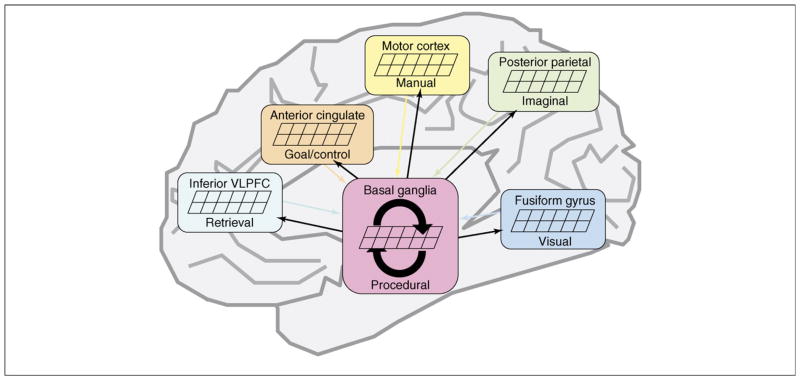
An illustration of how the various cortical modules of ACT-R are coordinated through the procedural module that is associated with the basal ganglia. VLPFC, ventrolateral prefrontal cortex.

References

    1. Anderson JR, et al. An integrated theory of mind. Psychol Rev. 2004;111:1036–1060. - PubMed
    1. Anderson JR. How Can the Human Mind Occur in the Physical Universe? Oxford University Press; 2007.
    1. Anderson JR, et al. Information-processing modules and their relative modality specificity. Cognit Psychol. 2007;54:185–217. - PubMed
    1. Cabeza R, et al. Attention-related activity during episodic memory retrieval: a crossfunction fMRI study. Neuropsychologia. 2003;41:390–399. - PubMed
    1. Dosenbach NUF, et al. A core system for the implementation of task sets. Neuron. 2006;50:799–812. - PMC - PubMed

Publication types