


Incidence and risk factors of recurrence after surgery for pathology-proven diverticular disease
- PMID: 18330623
- PMCID: PMC2480508
- DOI: 10.1007/s00268-008-9530-z
Incidence and risk factors of recurrence after surgery for pathology-proven diverticular disease
Abstract
Background: Diverticular disease is a common problem in Western countries. Rationale for elective surgery is to prevent recurrent complicated diverticulitis and to reduce emergency procedures. Recurrent diverticulitis occurs in about 10% after resection. The pathogenesis for recurrence is not completely understood. We studied the incidence and risk factors for recurrence and the overall morbidity and mortality of surgical therapy for diverticular disease.
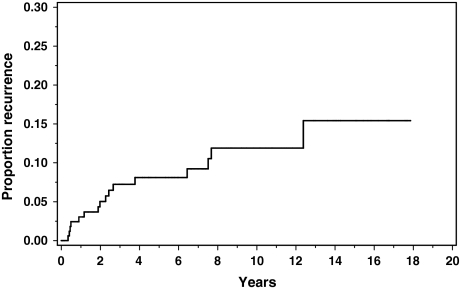
Methods: Medical records of 183 consecutive patients with pathology-proven diverticulitis were eligible for evaluation. Mean duration of follow-up was 7.2 years. Number of preoperative episodes, emergency or elective surgeries, type of operation, level of anastomosis, postoperative complications, persistent postoperative pain, complications associated with colostomy reversal, and recurrent diverticulitis were noted. The Kaplan-Meier method was used to calculate the cumulative probability of recurrence. Cox regression was used to identify possible risk factors for recurrence.
Results: The incidence of recurrence was 8.7%, with an estimated risk of recurrence over a 15-year period of 16%. Risk factors associated with recurrence were (younger) age (p < 0.02) and the persistence of postoperative pain (p < 0.005). Persistent abdominal pain after surgery was present in 22%. Eighty percent of patients who needed emergency surgery for acute diverticulitis had no manifestation of diverticular disease prior to surgery. In addition, recurrent diverticulitis was not associated with a higher percentage of emergency procedures.
Conclusion: Estimated risk of recurrence is high and abdominal complaints after surgical therapy for diverticulitis are frequent. Younger age and persistence of postoperative symptoms predict recurrent diverticulitis after resection. The clinical implication of these findings needs further investigation. The results of this study support the careful selection of patients for surgery for diverticulitis.
Figures
References
MeSH terms
LinkOut - more resources
Full Text Sources
Medical
