


Domestication of the donkey: timing, processes, and indicators
- PMID: 18332433
- PMCID: PMC2268817
- DOI: 10.1073/pnas.0709692105
Domestication of the donkey: timing, processes, and indicators
Abstract
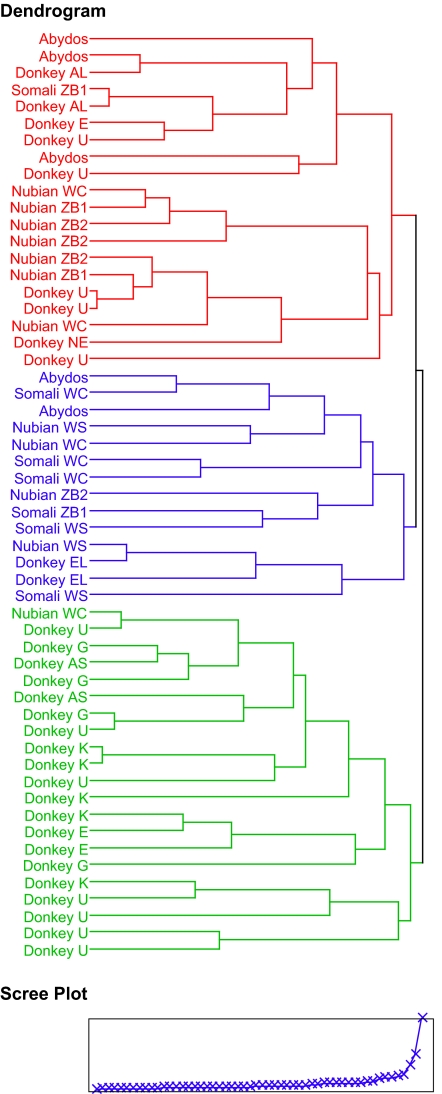
Domestication of the donkey from the African wild ass transformed ancient transport systems in Africa and Asia and the organization of early cities and pastoral societies. Genetic research suggests an African origin for the donkey, but pinpointing the timing and location of domestication has been challenging because donkeys are uncommon in the archaeological record and markers for early phases of animal domestication are hard to determine. We present previously undescribed evidence for the earliest transport use of the donkey and new paleopathological indicators for early phases of donkey domestication. Findings are based on skeletal data from 10 approximately 5,000-year-old ass skeletons recently discovered entombed in an early pharaonic mortuary complex at Abydos, Middle Egypt, and a concurrent study of 53 modern donkey and African wild ass skeletons. Morphometric studies showed that Abydos metacarpals were similar in overall proportions to those of wild ass, but individual measurements varied. Midshaft breadths resembled wild ass, but midshaft depths and distal breadths were intermediate between wild ass and domestic donkey. Despite this, all of the Abydos skeletons exhibited a range of osteopathologies consistent with load carrying. Morphological similarities to wild ass show that, despite their use as beasts of burden, donkeys were still undergoing considerable phenotypic change during the early Dynastic period in Egypt. This pattern is consistent with recent studies of other domestic animals that suggest that the process of domestication is slower and less linear than previously thought.
Conflict of interest statement
The authors declare no conflict of interest.
Figures


References
-
- Tanno K, Willcox G. Science. 2006;311:1886. - PubMed
-
- Peters J, von den Driesch A, Helmer D. In: The First Steps of Animal Domestication. Vigne JD, Peters J, Helmer D, editors. Oxford: Oxbow Books; 2005. pp. 96–124.
-
- Dobney K, Larson G. J Zool. 2006;269:261–271.
-
- Zeder MA, Emshwiller E, Smith BD, Bradley DG. Trends Genet. 2006;22:139–155. - PubMed
Publication types
MeSH terms
LinkOut - more resources
Full Text Sources
Medical
Molecular Biology Databases
Miscellaneous
