


Modeling targeted layered containment of an influenza pandemic in the United States
- PMID: 18332436
- PMCID: PMC2290797
- DOI: 10.1073/pnas.0706849105
Modeling targeted layered containment of an influenza pandemic in the United States
Abstract
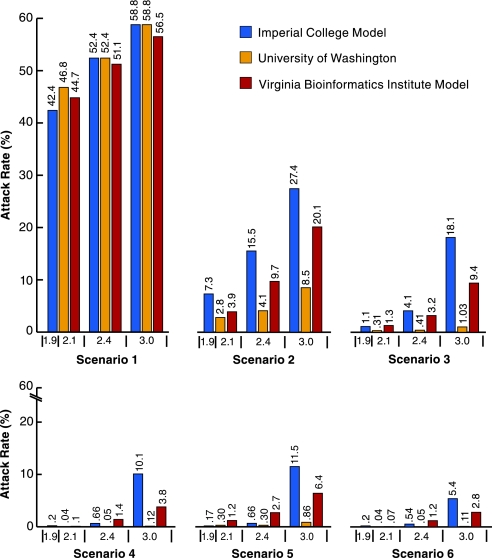
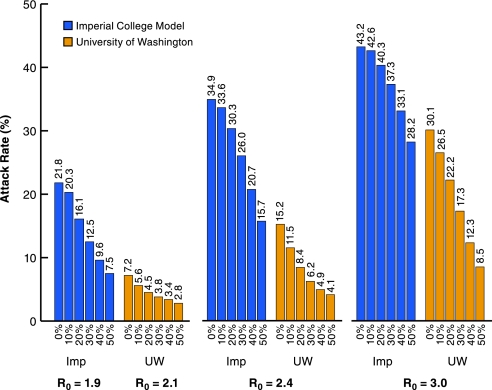
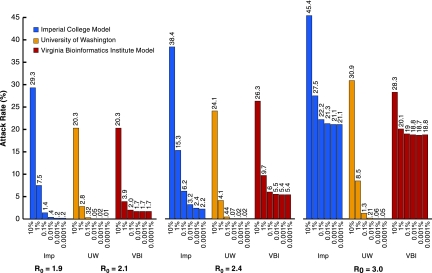
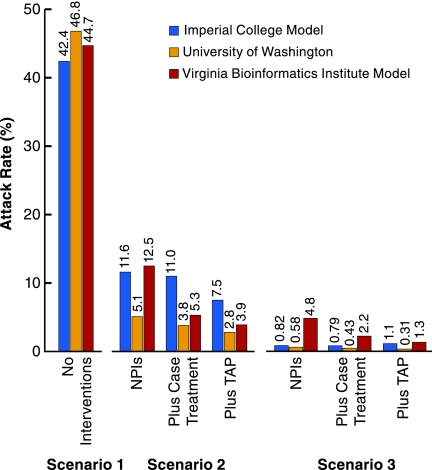
Planning a response to an outbreak of a pandemic strain of influenza is a high public health priority. Three research groups using different individual-based, stochastic simulation models have examined the consequences of intervention strategies chosen in consultation with U.S. public health workers. The first goal is to simulate the effectiveness of a set of potentially feasible intervention strategies. Combinations called targeted layered containment (TLC) of influenza antiviral treatment and prophylaxis and nonpharmaceutical interventions of quarantine, isolation, school closure, community social distancing, and workplace social distancing are considered. The second goal is to examine the robustness of the results to model assumptions. The comparisons focus on a pandemic outbreak in a population similar to that of Chicago, with approximately 8.6 million people. The simulations suggest that at the expected transmissibility of a pandemic strain, timely implementation of a combination of targeted household antiviral prophylaxis, and social distancing measures could substantially lower the illness attack rate before a highly efficacious vaccine could become available. Timely initiation of measures and school closure play important roles. Because of the current lack of data on which to base such models, further field research is recommended to learn more about the sources of transmission and the effectiveness of social distancing measures in reducing influenza transmission.
Conflict of interest statement
The authors declare no conflict of interest.
Figures
References
-
- Markel H, Stern AM, Navarro A, Michalsen JR, Monto AS, DiGiovanni C., Jr [Last accessed January 31, 2007];Emerg Infect Dis 12. 2006 Available at http://www.cdc.gov/ncidod/EID/vol12no12/06–0506.htm. - PMC - PubMed
-
- Rvachev LA, Longini IM. Math Biosci. 1985;75:3–22.
Publication types
MeSH terms
Grants and funding
LinkOut - more resources
Full Text Sources
Other Literature Sources
Medical
Molecular Biology Databases
