


Increased visceral fat and decreased energy expenditure during the menopausal transition
- PMID: 18332882
- PMCID: PMC2748330
- DOI: 10.1038/ijo.2008.25
Increased visceral fat and decreased energy expenditure during the menopausal transition
Abstract
Objective: This study assessed longitudinal changes in body composition, fat distribution and energy balance in perimenopausal women. We hypothesized that total fat and abdominal body fat would increase at menopause due to decreased energy expenditure (EE) and declining estrogen, respectively.
Design: Observational, longitudinal study with annual measurements for 4 years.
Subjects: Healthy women (103 Caucasian; 53 African-American), initially premenopausal. During follow-up, lack of menstruation for 1 year and follicle-stimulating hormone >30 mIU ml(-1) defined a subject as postmenopausal.
Measurements: Fat and lean mass (dual-energy X-ray absorptiometry), visceral (VAT) and subcutaneous abdominal fat (SAT) (computed tomography), dietary intake (4-day food record), serum sex hormones and physical activity (tri-axial accelerometry). Twenty-four hour EE was measured by whole-room calorimeter in a subset of 34 women at baseline and at year 4.
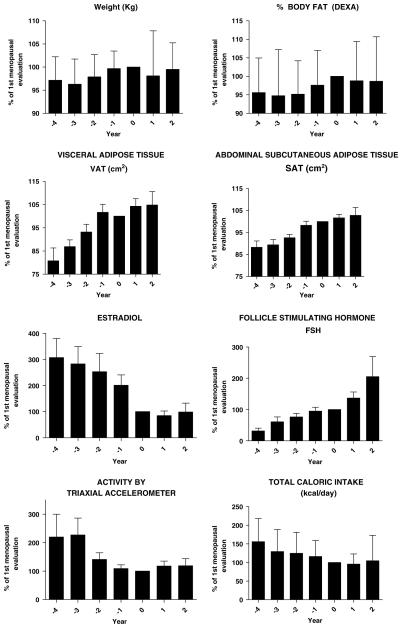
Results: Body fat and weight increased significantly over time only in those women who became postmenopausal by year 4 (n=51). All women gained SAT over time; however, only those who became postmenopausal had a significant increase in VAT. The postmenopausal group also exhibited a significant decrease in serum estradiol. Physical activity decreased significantly 2 years before menopause and remained low. Dietary energy, protein, carbohydrate and fiber intake were significantly higher 3-4 years before the onset of menopause compared with menopause onset. Twenty-four hour EE and sleeping EE decreased significantly with age; however, the decrease in sleeping EE was 1.5-fold greater in women who became postmenopausal compared with premenopausal controls (-7.9 vs -5.3%). Fat oxidation decreased by 32% in women who became postmenopausal (P<0.05), but did not change in those who remained premenopausal.
Conclusion: Middle-aged women gained SAT with age, whereas menopause per se was associated with an increase in total body fat and VAT. Menopause onset is associated with decreased EE and fat oxidation that can predispose to obesity if lifestyle changes are not made.
Trial registration: ClinicalTrials.gov NCT00412269.
Figures
References
-
- WHO . Report of a WHO Consultation. World Health Organization; Geneva: 2000. Obesity: preventing and managing the global epidemic. WHO Technical Report Series 894. - PubMed
-
- Ogden CL, Carroll MD, Curtin LR, McDowell MA, Tabak CJ, Flegal KM. Prevalence of overweight and obesity in the United States, 1999-2004. JAMA. 2006;295:1549–1555. - PubMed
-
- Wing RR, Matthews KA, Kuller LH, Meilahn EN, Plantinga PL. Weight gain at the time of menopause. Arch Intern Med. 1991;151:97–102. - PubMed
-
- Matthews KA, Abrams B, Crawford S, Miles T, Neer R, Powell LH, et al. Body mass index in mid-life women: relative influence of menopause, hormone use, and ethnicity. Int J Obes Relat Metab Disord. 2001;25:863–873. - PubMed
Publication types
MeSH terms
Substances
Associated data
Grants and funding
LinkOut - more resources
Full Text Sources
Medical
Research Materials
