


Plaque complement activation and cognitive loss in Alzheimer's disease
- PMID: 18334032
- PMCID: PMC2292690
- DOI: 10.1186/1742-2094-5-9
Plaque complement activation and cognitive loss in Alzheimer's disease
Abstract
Background: Complement activation is increased in Alzheimer's disease (AD), but its significance is unclear. The objective of this study was to determine the relationship between complement activation and cognition during the development of AD.
Methods: iC3b, C9, Bielschowsky, and Gallyas staining was performed on aged normal (n = 17), mild cognitively impaired (n = 12), and AD (n = 17-18) inferior temporal gyrus specimens. Plaques were counted in 10x fields with high numbers of Bielschowsky-stained plaques. One-way ANOVA was used to determine between-group differences for plaque counts and measures of cognitive function, and linear regression was used to evaluate global cognition as a function of Bielschowsky-stained plaques. Terms for iC3b- and C9-stained plaques were then added sequentially as additional predictors in a "mediation analysis" model.
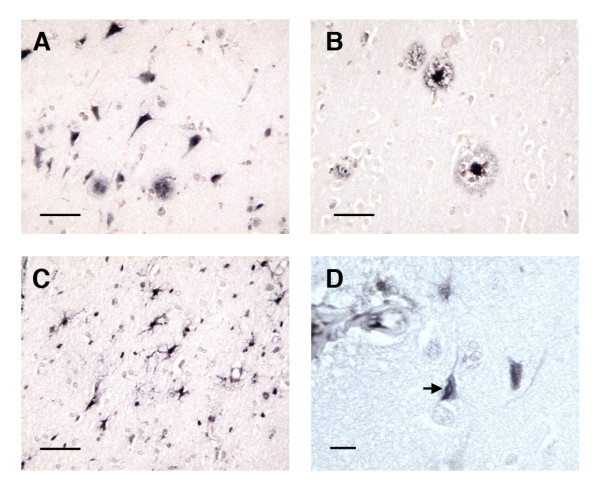
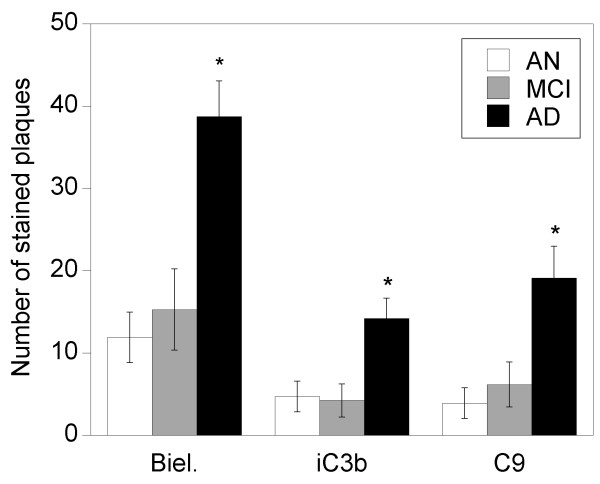
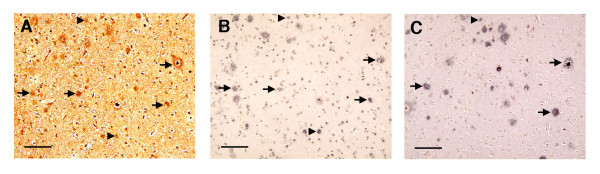
Results: Complement was detected on plaques in all groups, and on neurofibrillary tangles only in AD specimens. iC3b, C9, and Bielschowsky-stained plaque counts increased 2.5- to 3-fold in AD vs. other groups (all p < or = 0.01). C9 staining was present on some diffuse plaques, as well as on neuritic plaques. Bielschowsky-stained and complement-stained plaque counts were highly correlated, and were negatively correlated with cognitive measures. When the Bielschowsky plaque count was used as a predictor, its correlations with cognitive measures were statistically significant, but when iC3b and C9 plaque counts were added as additional predictors, these correlations were no longer significant. This loss of significance was attributed to multicollinearity, i.e., high correlations between Bielschowsky-stained and complement-stained plaque counts.
Conclusion: Both early-stage (iC3b) and late-stage (C9) complement activation occurs on neocortical plaques in subjects across the cognitive spectrum; contrary to previous reports, C9 is present on some diffuse plaques. Because of high correlations between complement-stained and Bielschowsky-stained plaque counts, quantitative assessment of the extent to which complement activation may mediate the relationship between plaques and cognitive function could not be performed. Additional studies with animal models of AD (if late-stage complement activation can be demonstrated), or possibly a trial in AD patients with an inhibitor of late-stage complement activation, may be necessary to determine the significance of this process in AD.
Figures
References
Publication types
MeSH terms
Substances
Grants and funding
LinkOut - more resources
Full Text Sources
Medical
Research Materials
Miscellaneous
