Review
. 2008 Jan 31:14:224-33.

Oxygen and blood flow: players in the pathogenesis of glaucoma

Affiliations
Review

Oxygen and blood flow: players in the pathogenesis of glaucoma

Maneli Mozaffarieh et al. Mol Vis. .

Abstract

The increase of IOP in POAG is due an increased resistance of aqueous outflow through the trabecular meshwork (TM). The exact mechanisms leading to the corresponding changes in the TM are not yet known. We know, however, that all risk factors for arteriosclerosis are also risk factors for an increase in IOP.

Results: The association between IOP increase and these factors is relatively weak but nevertheless significant. Similar to the pathogenesis of arteriosclerosis, oxidative stress plays a role in the development of TM damage. Even less is known about the pathogenesis of glaucomatous optic neuropathy (GON). Obviously the risk factors for arteriosclerosis play a role via increasing the IOP. When corrected for IOP, however, these factors only play a minor role. In contrast, factors associated with disturbed autoregulation, in particular a systemic primary vascular dysregulation (PVD), increase the risk for GON. This is best observed in normal tension glaucoma patients. An insufficient autoregulation increases the chance for an unstable ocular perfusion and thereby an unstable oxygen supply. This, in turn, leads to oxidative stress. The concentration of superoxide (O(2)(-)) within the axons of the optic nerve head increases. If neighboring astrocytes are activated, either by mechanical or by ischemic stress, in excess produced nitric oxide (NO) molecules diffuse also into the axons and fuse with oxygen. The resulting peroxynitrat (ONOO(-)) diffuses within the axons towards the retina and the lateral geniculate nucleus and induces apoptosis.


Figures
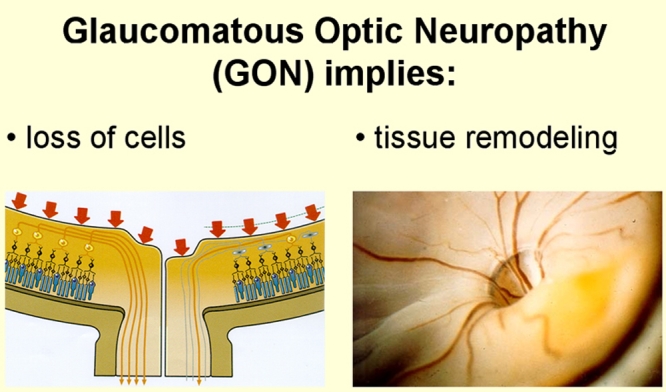
Figure 1
Figure 1
Phenomenology of glaucomatous optic neuropathy. Glaucoma, a progressive optic neuropathy, is characterized by the loss of retinal ganglions cells and their axons and tissue remodelling involving both the optic nerve head and the retina. This leads clinically to a visible cupping of the disc and measurable thinning of the nerve fiber layer of the retina. This figure is reprinted from Flammer J. Glaucoma, Glaucoma A Guide for Patients. An Introduction for Care-Providers. A Quick Reference. 3rd ed. Cambridge: Hogrefe & Huber; 2006. Figure S1.54; p 235.
Figure 2
Figure 2
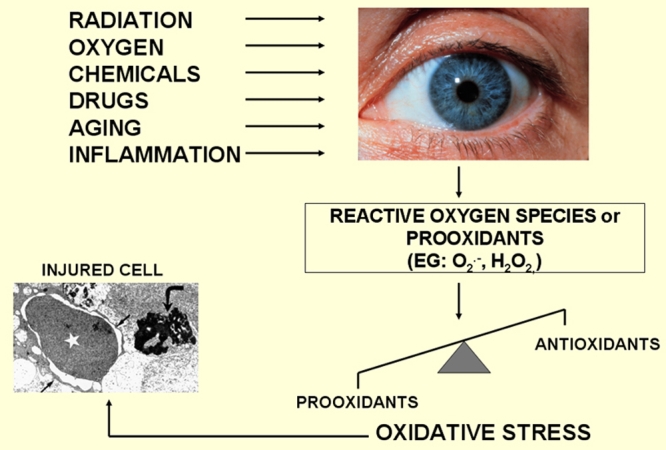
Risks and consequences of oxidative stress. The eye is an organ that is predisposed to great levels of oxidative stress. The eye is constantly exposed to factors such as radiation, chemicals, oxygen, drugs, which induce the formation of reactive oxygen species (ROS) that can ultimately damage cells. This figure is modified from Flammer J. Glaucoma, Glaucoma A Guide for Patients. An Introduction for Care-Providers. A Quick Reference. 3rd ed. Cambridge: Hogrefe & Huber; 2006. Figure S1.29; p 222.
Figure 3
Figure 3
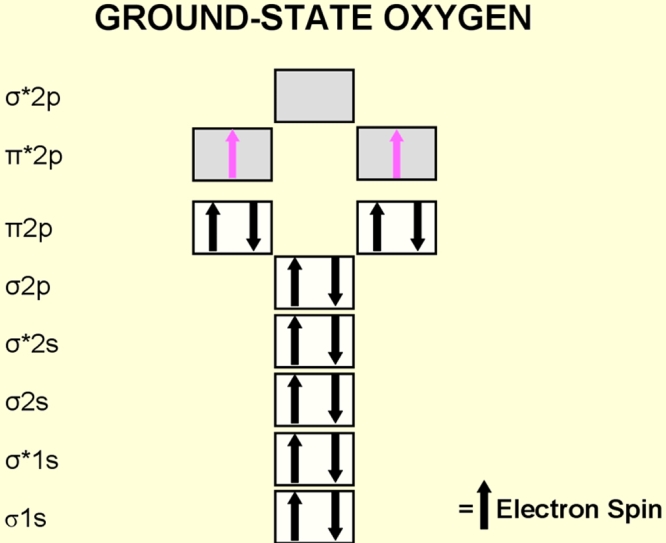
Electron configuration of the diatomic oxygen molecule. Atomic oxygen (atomic number 8) has a total of eight electrons. The oxygen molecule (O2) has 16 electrons. In ground state (the most stable state of oxygen), the last two electrons of the oxygen molecule are located in a different π* antibonding orbital. These two unpaired electrons have the same quantum spin number (they have parallel spins) and qualify ground state oxygen to be a di radical.
Figure 4
Figure 4
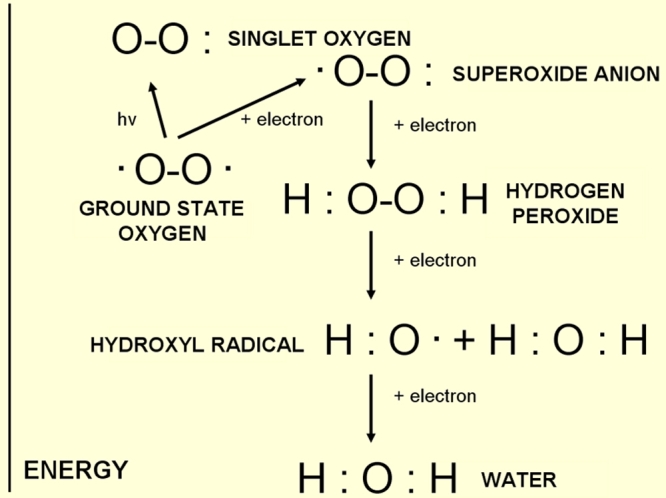
Different energy levels of oxygen and oxygen compounds. Activation of oxygen occurs either through absorption of sufficient energy or through monovalent reduction.
Figure 5
Figure 5
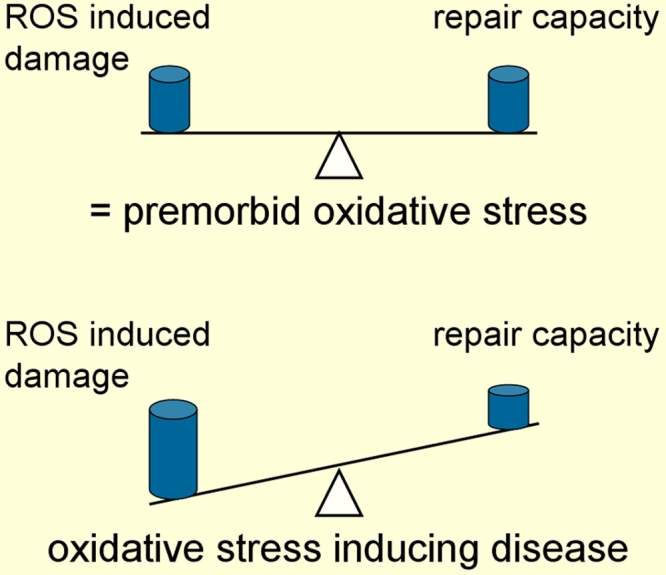
Oxidative stress and disease. In the physiological state, the production of prooxidants is approximately balanced by the antioxidant defence system. The term oxidative stress is referred to when the intensity of prooxidants exceed the antioxidant capacity.
Figure 6
Figure 6
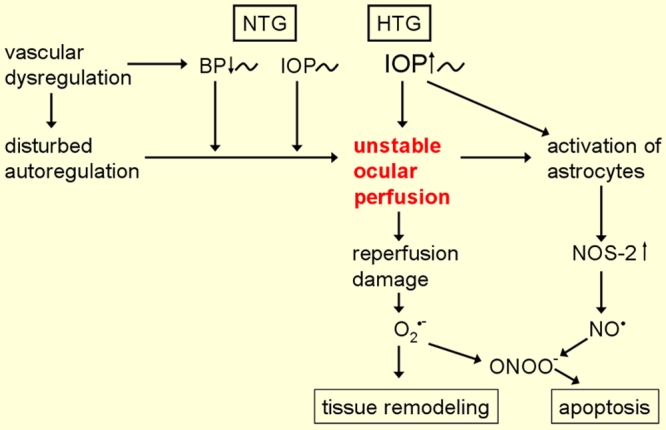
The pathogenetic concept of glaucomatous optic neuropathy. Oxidative stress results from unstable ocular blood flow (OBF). OBF is unstable both in patients with either high IOP or very low blood pressure (BP) exceeding the capacity of autoregulation, as well as in patients with a normal or mildly increased IOP or normal or mildly decreased blood pressure if subjects suffer from disturbed autoregulation. This figure is reprinted from Flammer J. Glaucoma, Glaucoma A Guide for Patients. An Introduction for Care-Providers. A Quick Reference. 3rd ed. Cambridge: Hogrefe & Huber; 2006. Figure 5.12; p 104.
Figure 7
Figure 7
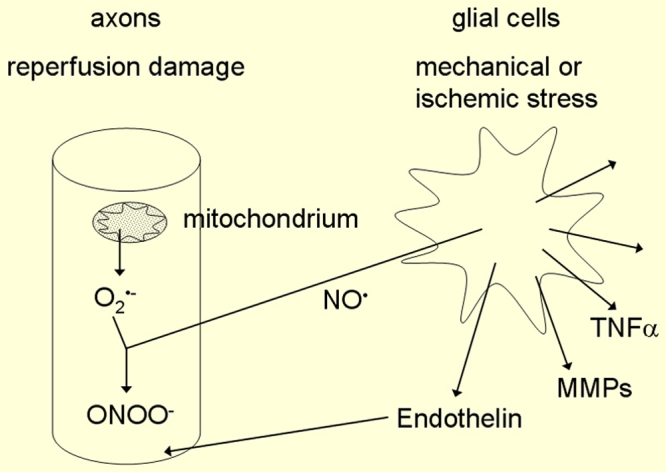
Production of peroxynitrite. The simultaneous production of the readily diffusible nitric oxide (NO) in glial cells and the superoxide anion (O2-) in the axons of the retinal ganglion cells leads to the production of peroxynitrite (ONOO-). This figure is reprinted from Flammer J. Glaucoma, Glaucoma A Guide for Patients. An Introduction for Care-Providers. A Quick Reference. 3rd ed. Cambridge: Hogrefe & Huber; 2006. Figure 5.13; p 105.
Figure 8
Figure 8
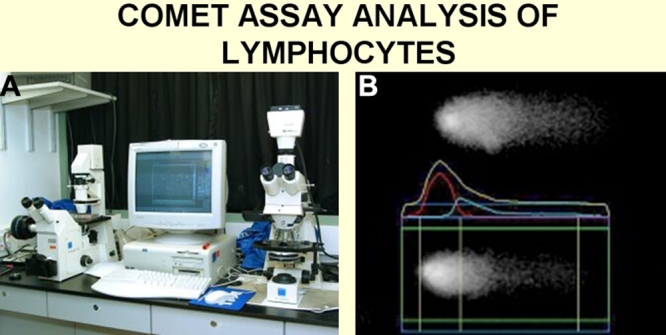
Comet assay analysis of lymphocytes. A: Photograph of the present equipment used. B: a typical picture of the DNA of a lymphocyte analyzed by the system. The greater the amount of DNA breaks, the larger the comet tail.

References

    1. Flammer J, Drance SM. Correlation between color vision scores and quantitative perimetry in suspected glaucoma. Arch Ophthalmol. 1984;102:38–9. - PubMed
    1. Flammer J, Orgul S, Costa VP, Orzalesi N, Krieglstein GK, Serra LM, Renard JP, Stefansson E. The impact of ocular blood flow in glaucoma. Prog Retin Eye Res. 2002;21:359–93. - PubMed
    1. Izzotti A, Bagnis A, Sacca SC. The role of oxidative stress in glaucoma. Mutat Res. 2006;612:105–14. - PubMed
    1. Halliwell B. Reactive oxygen species in living systems: source, biochemistry, and role in human disease. Am J Med. 1991;91:14S–22S. - PubMed
    1. Freeman BA, Crapo JD. Biology of disease: free radicals and tissue injury. Lab Invest. 1982;47:412–26. - PubMed

LinkOut - more resources