


HLA-associated susceptibility to childhood B-cell precursor ALL: definition and role of HLA-DPB1 supertypes
- PMID: 18334973
- PMCID: PMC2275491
- DOI: 10.1038/sj.bjc.6604257
HLA-associated susceptibility to childhood B-cell precursor ALL: definition and role of HLA-DPB1 supertypes
Abstract
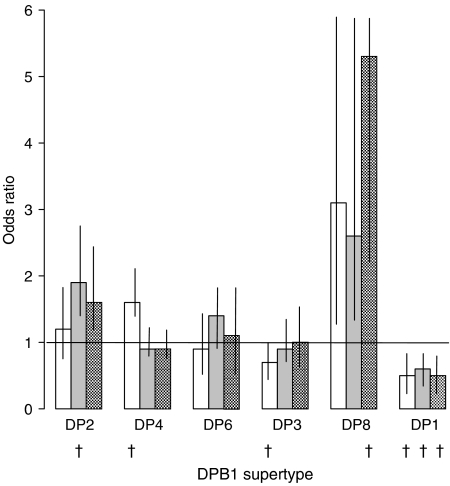
Childhood B-cell precursor (BCP) ALL is thought to be caused by a delayed immune response to an unidentified postnatal infection. An association between BCP ALL and HLA class II (DR, DQ, DP) alleles could provide further clues to the identity of the infection, since HLA molecules exhibit allotype-restricted binding of infection-derived antigenic peptides. We clustered >30 HLA-DPB1 alleles into six predicted peptide-binding supertypes (DP1, 2, 3, 4, 6, and 8), based on amino acid di-morphisms at positions 11 (G/L), 69 (E/K), and 84 (G/D) of the DPbeta(1) domain. We found that the DPbeta11-69-84 supertype GEG (DP2), was 70% more frequent in BCP ALL (n=687; P<10(-4)), and 98% more frequent in cases diagnosed between 3 and 6 years (P<10(-4)), but not <3 or >6 years, than in controls. Only one of 21 possible DPB1 supergenotypes, GEG/GKG (DP2/DP4) was significantly more frequent in BCP ALL (P=0.00004) than controls. These results suggest that susceptibility to BCP ALL is associated with the DP2 supertype, which is predicted to bind peptides with positively charged, nonpolar aromatic residues at the P4 position, and hydrophobic residues at the P1 and P6 positions. Studies of peptide binding by DP2 alleles could help to identify infection(s) carrying these peptides.
Figures
References
-
- Arroyo J, Álvarez AM, Nombela C, Sánchez-Pérez M (1995) The role of HLA-DPβ residue 69 in the definition of antibody-binding epitopes. Human Immunology 43: 219–226 - PubMed
-
- Begovich AB, McClure GR, Suraj VC, Helmuth RC, Fildes N, Bugawan TL, Erlich HA, Klitz W (1992) Polymorphism, recombination, and linkage disequilibrium within the HLA class II region. J Immunol 148: 249–258 - PubMed
-
- Berretta F, Butler RH, Diaz G, Sanarico N, Arroyo J, Fraziano M, Aichinger G, Wucherpfennig KW, Colizzi V, Saltini C, Amicosante M (2003) Detailed analysis of the effects of Glu/Lys human leukocyte antigen-DP polymorphism on peptide-binding specificity. Tissue Antigens 62: 459–471 - PubMed
-
- Buckley JD, Buckley CM, Ruccione K, Sather HN, Waskerwitz MJ, Woods WG, Robison LL, For The Children's Cancer Group (1994) Epidemiological characteristics of childhood acute lymphocytic leukemia. Analysis by immunophenotype. Leukemia 8: 856–864 - PubMed
-
- Bugawan TL, Horn GT, Long CM, Mickelson E, Hansen JA, Ferrara GB, Angelini G, Erlich HA (1988) Analysis of HLA-DP allelic sequence polymorphism using the in vitro enzymatic DNA amplification of DP-α and DP-β loci. J Immunol 141: 4024–4030 - PubMed
Publication types
MeSH terms
Substances
Grants and funding
LinkOut - more resources
Full Text Sources
Research Materials
