. 2008 Apr;41(2):336-47.
doi: 10.1111/j.1365-2184.2008.00519.x.

Stromal cell-derived factor-1 promotes bone marrow-derived cells differentiation to cardiomyocyte phenotypes in vitro

Affiliations

Stromal cell-derived factor-1 promotes bone marrow-derived cells differentiation to cardiomyocyte phenotypes in vitro

M Chen et al. Cell Prolif. 2008 Apr.

Abstract

Objective: Recent studies have demonstrated the potential of bone marrow-derived cells (BMDC) to differentiate into cardiomyocytes. Up-regulation of stromal cell-derived factor-1 (SDF-1), a member of the chemokine CXC subfamily, mediating recruitment of BMDC has been documented in infarcted myocardium; however, it remains unknown whether SDF-1 plays a role in cardiomyogenesis of BMDC.

Materials and methods: Adherent BMDCs were cultured with SDF-1, or specific inhibitor for PI3K, CXCR4 or Akt with SDF-1, respectively. After 2 weeks, mRNAs and proteins from BMDCs were examined.

Results: Two weeks after supplementation with SDF-1, either murine or human adherent BMDC cultured in vitro expressed cardiac specific mRNAs (NKX2.5, atrial natriuretic factor and heavy chain beta-myosin) and proteins (troponin I and heavy chain cardiac myosin), and expression levels were partly decreased by combined treatment of CXCR4, PI3K or Akt inhibitor, with SDF-1.

Conclusions: The novel findings suggest that beyond its role in mobilization and homing of BMDC, SDF-1 can promote BMDC to give rise to cardiomyocyte phenotypes in vitro, and the SDF-1/CXCR4/PI3K/Akt pathway may be one of the molecular mechanisms regulating cardiomyogenesis.


Figures

Figure 1
Figure 1
Representative RT‐PCR gene expression profiles of cultured BMDCs. Two weeks after supplemented with SDF‐1, either adherent primary murine (a) or 5th‐passage human (b) BMDCs, expressed cardiac–specific mRNAs encoding NKX2.5, β‐MHC and atrial natriuretic factor (ANF). Four samples were tested for the target mRNA, and three RT‐PCRs were separately performed for each sample. Murine ventricle and human atrial cells were used as positive controls (control (P)) and phosphate‐buffered saline as negative control (control (N)).
Figure 2
Figure 2
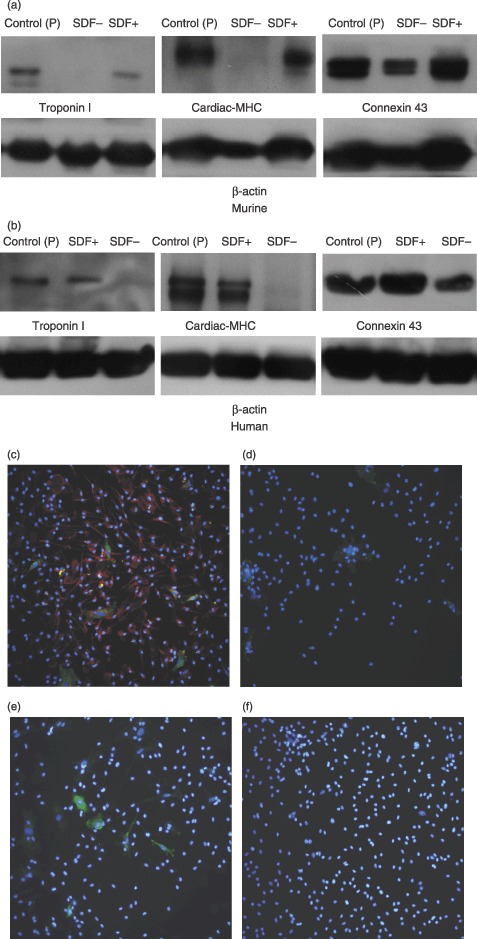
Western blotting and immunostaining study to show cardiomyogenesis of BMDCs. Two weeks after supplementation with SDF‐1, troponin I and cardiac MHC were observed in either adherent primary murine (a) or 5th‐passage human (b) BMDC, via Western blotting. Four samples were tested for the target protein, and three Western blots were separately performed for each sample. Murine ventricle and human atrial cells were used as positive controls (control (P)). (c) Immunostaining study to demonstrate cardiac MHC (red) and connexin 43 (green) with nuclear counterstain (blue) in murine cultured BMDC supplemented with SDF‐1. (d) In murine BMDCs supplemented without SDF‐1, only less connexin 43 (green) was found. (e, f) Compared to without SDF‐1 (f), treatment with SDF‐1 (e) induced murine BMDCs to express troponin I (green) (magnification ×400).
Figure 3
Figure 3
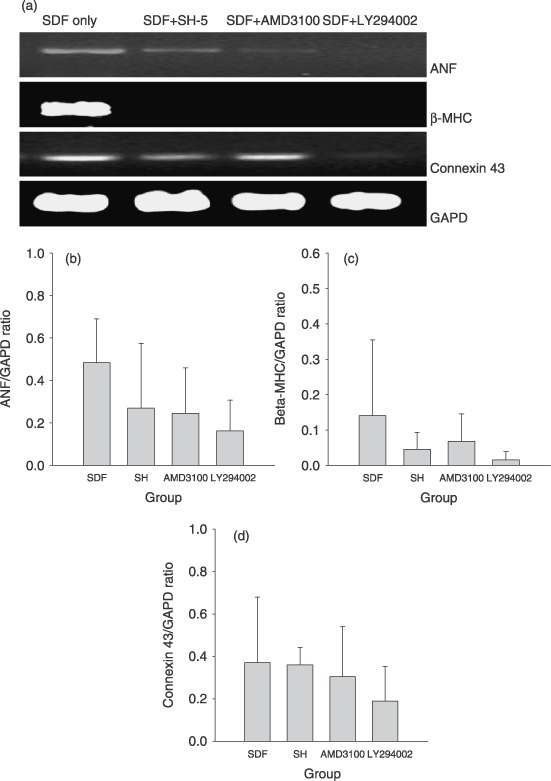
Combined treatment of the inhibitors of CXCR4 (AMD3100), PI3K (LY294002) or Akt (SH‐5), partly antagonized the effective of SDF‐1 on cardiomyogenesis. (a) Representative RT‐PCR gene expression profiles of murine BMDCs supplemented with SDF‐1 or mixture of SDF‐1 and different inhibitors. In the presence of any inhibitor, atrial natriuretic factor (ANF) and β‐MHC were obviously down‐regulated. (b–d) Quantification of density ratio of mRNA encoding ANF (b), β‐MHC (c) and connexin 43 (d) to glyceraldehyde‐3‐phosphate dehydrogenase (GAPD). After treatment with each inhibitor, a trend towards down‐regulation of ANF or β‐MHC mRNA was observed, even though the difference was not statistically significant, whereas no obvious change was found in connexin 43 mRNA. Five samples were tested for the target mRNA, and three RT‐PCRs were separately performed for each sample. Mean density ratio of target mRNA to GAPD in each sample was used for statistical analysis.
Figure 4
Figure 4
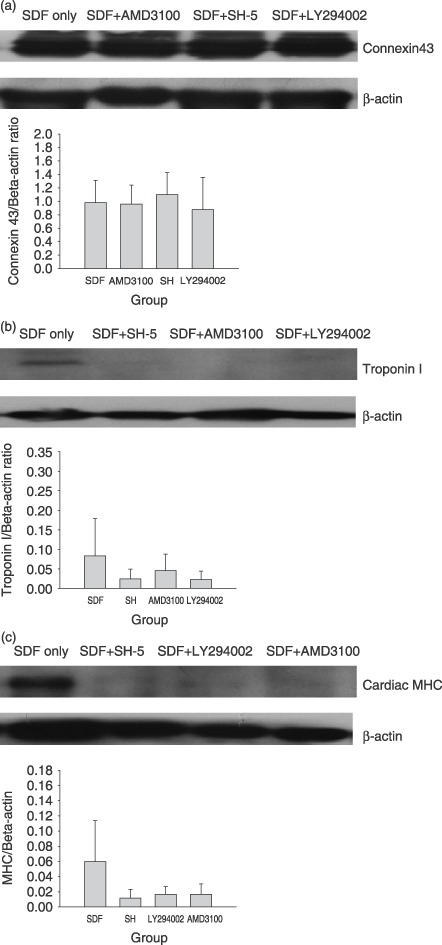
Western blotting and quantification analysis showed the antagonism of CXCR4, PI3K or Akt inhibitor to the effect of SDF‐1 on cardiomyogenesis. (a) No change of connexin 43 expression was found. (b, c) Compared to SDF‐1 alone, each inhibitor tended to decrease the expression of troponin I and cardiac MHC, although the decrease was not statistically significant. Five samples were tested for the target protein, and three Western blots were separately performed for each sample. Mean density ratio of target protein to β‐actin in each sample was used for statistical analysis.
Figure 5
Figure 5
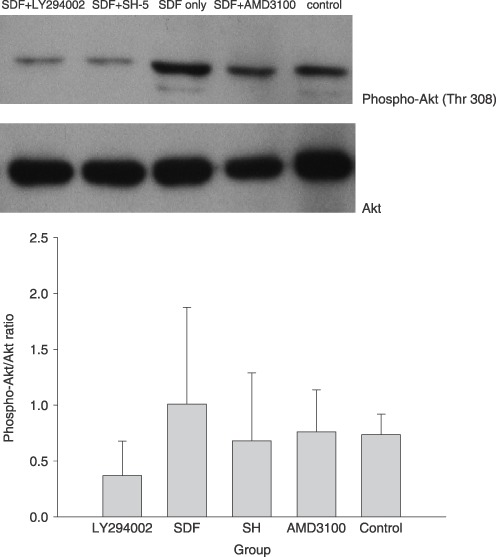
Phosphorylation of Akt was measured by the ratio of phospho‐Akt to total Akt. The phospho‐Akt/Akt ratio was lowered when BMDCs were cultured in medium supplemented with SDF‐1 and LY294002, a specific PI3K inhibitor, or SH‐5, a specific Akt inhibitor. Four samples were tested for phospho‐Akt and total Akt, and three Western blots were separately performed for each sample. Mean density ratio in each sample was used for statistical analysis.

References

    1. Abbott JD, Huang Y, Liu D, Hickey R, Krause DS, Giordano FJ (2004) Stromal cell‐derived factor‐1alpha plays a critical role in stem cell recruitment to the heart after myocardial infarction but is not sufficient to induce homing in the absence of injury. Circulation 110, 3300–3305. - PubMed
    1. Alsayed Y, Ngo H, Runnels J, Leleu X, Singha UK, Pitsillides CM, Spencer JA, Kimlinger T, Ghobrial JM, Jia X, Lu G, Timm M, Kumar A, Cote D, Veilleux I, Hedin KE, Roodman GD, Witzig TE, Kung AL, Hideshima T, Anderson KC, Lin CP, Ghobrial IM (2007) Mechanisms of regulation of CXCR4/SDF‐1 (CXCL12)‐dependent migration and homing in multiple myeloma. Blood 109, 2708–2717. - PMC - PubMed
    1. Assmus B, Honold J, Schächinger V, Britten MB, Fischer‐Rasokat U, Lehmann R, Teupe C, Pistorius K, Martin H, Abolmaali ND, Tonn T, Dimmeler S, Zeiher AM (2006) Transcoronary transplantation of progenitor cells after myocardial infarction. N. Engl. J. Med. 355, 1222–1232. - PubMed
    1. Badorff C, Brandes RP, Popp R, Rupp S, Urbich C, Aicher A, Fleming I, Busse R, Zeiher AM, Dimmeler S (2003) Transdifferentiation of blood‐derived human adult endothelial progenitor cells into functionally active cardiomyocytes. Circulation 107, 1024–1032. - PubMed
    1. Burns JM, Summers BC, Wang Y, Melikian A, Berahovich R, Miao Z, Penfold MET, Sunshine MJ, Littman DR, Kuo CJ, Wei K, McMaster BE, Wright K, Howard MC, Schall TJ (2006) A novel chemokine receptor for SDF‐1 and I‐TAC involved in cell survival, cell adhesion, and tumor development. J. Exp. Med. 203, 2201–2213. - PMC - PubMed

Publication types

MeSH terms