


Secular trends in the lifetime prevalence of alcohol dependence in the United States: a re-evaluation
- PMID: 18336633
- PMCID: PMC2443101
- DOI: 10.1111/j.1530-0277.2008.00635.x
Secular trends in the lifetime prevalence of alcohol dependence in the United States: a re-evaluation
Abstract
Background: U.S. epidemiologic surveys have consistently found higher lifetime prevalence of alcohol dependence among younger subjects than among older groups. Because lifetime prevalence is cumulative, such patterns are suggestive of strong secular trends; i.e., more-recently born subjects have developed more disease in a shorter period of time than their elders. However, it remains unclear whether such patterns truly reflect secular trends or are confounded by age-dependent factors such as differential recall, differential mortality, and other effects.
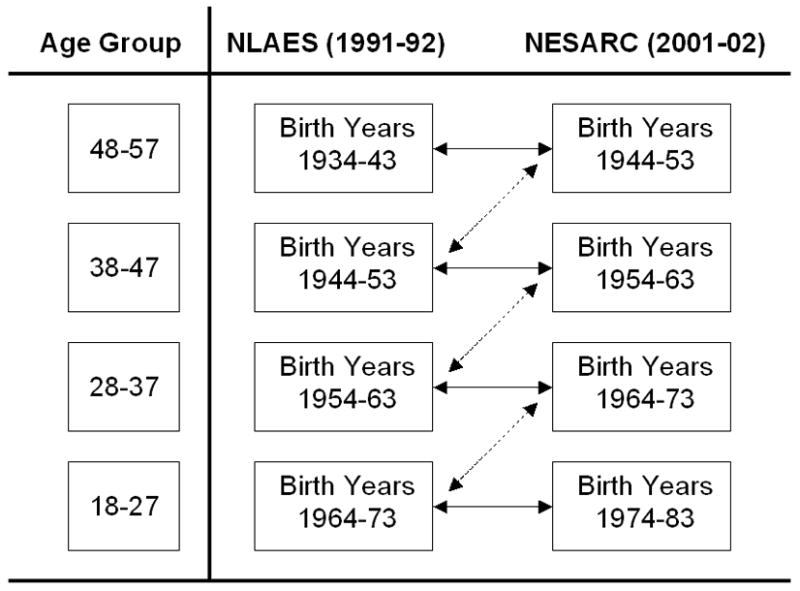
Methods: Using data from 2 large, national epidemiological surveys, a repeated cross-sectional analysis was conducted to compare lifetime prevalence of alcohol dependence across temporally adjacent birth cohorts surveyed at the same age, thus enabling estimates of cross-cohort differences while controlling for age-related factors.
Results: In contrast with results from single cross-sectional analyses, there were few significant cross-cohort differences among groups of men compared at similar ages. On the other hand, women born between 1954 and 1963 were at 1.2-fold higher odds for lifetime drinking, and those who drank were at 1.5-fold higher odds for lifetime alcohol dependence, compared with the immediately preceding birth cohort (1944 to 1953). The 1944 to 1953 cohort was also at elevated odds for lifetime drinking compared with their predecessors (1934 to 1943). These results were largely due to changes among White and Hispanic women.
Conclusions: These results suggest that there have been substantial secular increases in drinking and alcohol dependence among women, but not men. Analyses of single cross-sectional studies may tend to over-estimate secular trends by failing to account for age-dependent effects. Nonetheless, secular increases in drinking and alcohol dependence among women are evident after taking age-related factors into account.
Figures
References
-
- Ames GM, Rebhun LA. Women, alcohol and work: interactions of gender, ethnicity and occupational culture. Soc Sci Med. 1996;43(11):1649–63. - PubMed
-
- Aschengrau A, Seage GR. Essentials of Epidemiology for Public Health. Jones & Bartlett; Boston, MA: 2003.
-
- Becker GS, Murphy KM. A Theory of Rational Addiction. The economics of corruption and illegal markets Volume 3. The economics of illegal markets and organized crime. 1999:401–26.
-
- Bender R, Lange S. Adjusting for multiple testing--when and how? J Clin Epidemiol. 2001;54(4):343–9. - PubMed
Publication types
MeSH terms
Grants and funding
LinkOut - more resources
Full Text Sources
Other Literature Sources
Medical
