. 2008 May;82(10):4731-41.
doi: 10.1128/JVI.00002-08. Epub 2008 Mar 12.

Role of nonstructural protein NS2A in flavivirus assembly

Affiliations

Role of nonstructural protein NS2A in flavivirus assembly

Jason Y Leung et al. J Virol. 2008 May.

Abstract

Flavivirus nonstructural (NS) proteins are involved in RNA replication and modulation of the host antiviral response; however, evidence is mounting that some NS proteins also have essential roles in virus assembly. Kunjin virus (KUN) NS2A is a small, hydrophobic, transmembrane protein that is part of the replication complex and inhibits interferon induction. Previously, we have shown that an isoleucine (I)-to-asparagine (N) substitution at position 59 of the NS2A protein blocked the production of secreted virus particles in cells electroporated with viral RNA carrying this mutation. We now show that prolonged incubation of mutant KUN NS2A-I59N replicon RNA, in an inducible BHK-derived packaging cell line (expressing KUN structural proteins C, prM, and E), generated escape mutants that rescued the secretion of infectious virus-like particles. Sequencing identified three groups of revertants that included (i) reversions to wild-type, hydrophobic Ile, (ii) pseudorevertants to more hydrophobic residues (Ser, Thr, and Tyr) at codon 59, and (iii) pseudorevertants retaining Asn at NS2A codon 59 but containing a compensatory mutation (Thr-to-Pro) at NS2A codon 149. Engineering hydrophobic residues at NS2A position 59 or the compensatory T149P mutation into NS2A-I59N replicon RNA restored the assembly of secreted virus-like particles in packaging cells. T149P mutation also rescued virus production when introduced into the full-length KUN RNA containing an NS2A-I59N mutation. Immunofluorescence and electron microscopy analyses of NS2A-I59N replicon-expressing cells showed a distinct lack of virus-induced membranes normally present in cells expressing wild-type replicon RNA. The compensatory mutation NS2A-T149P restored the induction of membrane structures to a level similar to those observed during wild-type replication. The results further confirm the role of NS2A in virus assembly, demonstrate the importance of hydrophobic residues at codon 59 in this process, implicate the involvement of NS2A in the biogenesis of virus-induced membranes, and suggest a vital role for the virus-induced membranes in virus assembly.


Figures
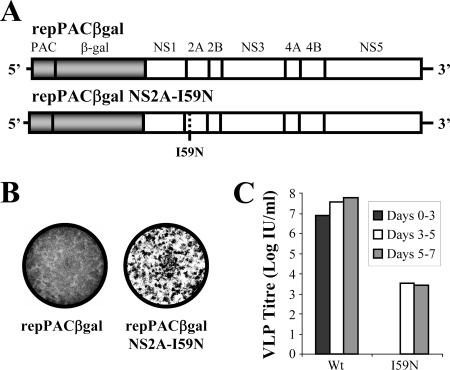
FIG. 1.
FIG. 1.
Production of virus-like particles in tetKUNCprME-packaging BHK21 cells transfected with repPACβgal replicon RNA containing NS2A-I59N mutation after extended incubation. (A) Schematic representation of puromycin (PAC)-selectable and β-Gal-expressing KUN replicon constructs used for electroporation into tetKUNCprME-packaging BHK-21 cells. Heterologous gene inserts are gray, and the KUN nonstructural genes (as indicated) are colored white. NS2A-I59N mutation is shown by a broken line. (B) Detection of β-Gal expression in tetKUNCprME-packaging BHK-21 cells electroporated with KUN replicon RNAs (A) at 7 days posttransfection by using X-Gal staining after fixation with 4% formaldehyde. (C) Infectious VLP titers in culture fluids of tetKUNCprME-packaging BHK-21 cells electroporated with WT and NS2A-I59N mutant RNAs 3, 5, and 7 days postelectroporation. The titers were determined by infectivity assay on fresh VERO cells as described in Materials and Methods.
FIG. 2.
FIG. 2.
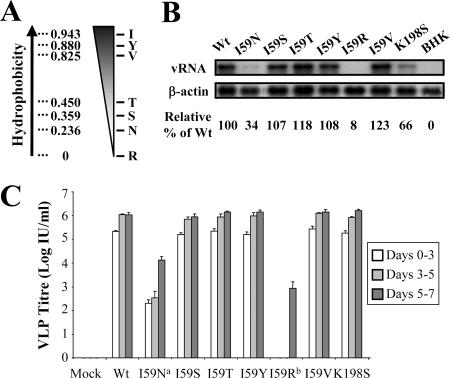
Replication and packaging of NS2A 59 pseudorevertants. (A) Hydrophobicity plot of amino acid residues found in pseudorevertants and cloned into NS2A codon 59 of repPACβgal cDNA. (B) Northern blot analysis of total cellular RNA from BHK-21 cells 2 days postelectroporation with various mutant KUN replicon RNAs. The probes were 32P-labeled cDNA fragments specific for the KUN 3′ UTR and for β-actin. Efficiencies of replication are expressed as percentages of accumulated viral RNAs relative to WT and normalized to β-actin (shown under the blots). (C) Infectious titers of VLPs in culture fluids of tetKUNCprME-packaging BHK-21 cells electroporated with mutant repPACβgal RNAs and harvested at 3, 5, and 7 days postelectroporation. The titers were determined by infectivity assay on VERO cells as described in Materials and Methods. Error bars indicate standard deviations. a, RT-PCR and sequencing on culture fluids revealed (pseudo)reversions to Ile and Tyr at NS2A codon 59; b, RT-PCR and sequencing on culture fluids revealed (pseudo)reversions to Ile and Val at NS2A codon 59.
FIG. 3.
FIG. 3.
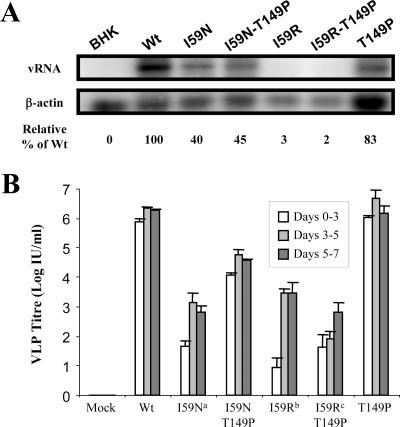
Ability of Thr-to-Pro mutation at NS2A codon 149 to rescue packaging defects of two different I59 mutants. (A) Replication efficiencies of mutant RNAs in transfected BHK-21 cells. Total cellular RNA was purified 48 h postelectroporation, and accumulated viral RNAs were detected by Northern blotting using 32P-labeled probes specific for the KUN 3′ UTR and β-actin. The efficiencies of RNA replication are expressed as percentages relative to the WT and normalized to β-actin. (B) Infectious titers of VLPs in culture fluids of tetKUNCprME-packaging BHK-21 cells electroporated with mutant repPACβgal RNAs and harvested at 3, 5, and 7 days postelectroporation. The titers were determined by infectivity assay on fresh VERO cells as described in Materials and Methods. Error bars indicate standard deviations. a, RT-PCR and sequencing on culture fluids revealed (pseudo)reversions to Tyr at NS2A codon 59; b, RT-PCR and sequencing on culture fluids revealed (pseudo)reversions to Ile NS2A codon 59; c, RT-PCR and sequencing on culture fluids revealed (pseudo)reversions to Trp NS2A codon 59.
FIG. 4.
FIG. 4.
Characterization of KUN virus containing a Thr-to-Pro compensatory mutation at codon 149 that rescues the packaging defect caused by NS2A-I59N mutation. (A) Plaque morphology of WT and mutant viruses. BHK21 and VERO cells were infected with the viruses at a multiplicity of infection of 0.1 PFU/cell and stained with crystal violet at 4 and 5 days postinfection, respectively. (B and C) Growth kinetics of the WT and mutant viruses on BHK21 and VERO cells, respectively. Culture fluids from infected cells were collected every 12 h for 3 days, and viral titers were determined by plaque assay as described in Materials and Methods.
FIG. 5.
FIG. 5.
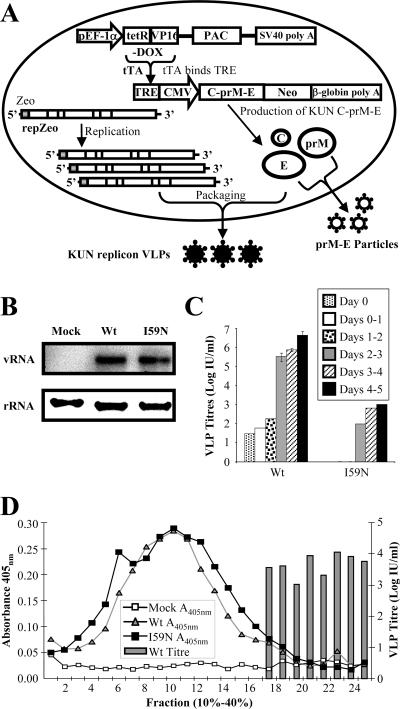
Secretion of prM-E particles is not affected by NS2A-I59N mutation in a cell line stably expressing both a structural gene cassette and replicon RNA. (A) Schematic representation of production of secreted prM-E particles and replicon RNA-containing VLPs in tetKUNCprMErepZeo cells. Stably expressing cells were generated as described in Materials and Methods. (B) Northern blot analysis of RNA replication in tetKUNCprME-packaging BHK-21 cells stably expressing WT and NS2A-I59N-mutated repZeo replicon RNAs using 32P-labeled probes specific for the KUN 3′ UTR and β-actin. CMV, cytomegalovirus; DOX, doxycycline; PAC, puromycin; SV40, simian virus 40; TRE, tetracycline-responsive element. (C) Production of VLPs containing repZeo RNAs in culture fluids harvested every 24 h for 5 days after induction of structural protein expression. VLP titers were determined by infectivity assay on VERO cells using immunofluorescence staining with anti-NS1 antibodies, as described in Materials and Methods. Error bars indicate standard deviations. (D) Sucrose gradient separation of prM-E particles and VLPs. Culture fluids were collected from tetKUNCprME-packaging BHK-21 cells stably expressing WT or NS2A-I59N-mutated repZeo RNAs 3 days postinduction of structural proteins, concentrated, and placed on a 10 to 40% continuous sucrose gradient. Fractions were taken from the top to the bottom of the gradient and analyzed by E capture ELISA. The detection of infectious VLPs in gradient fractions was performed by an infectivity assay of VERO cells using immunofluorescence staining with anti-NS1 antibodies.
FIG. 6.
FIG. 6.
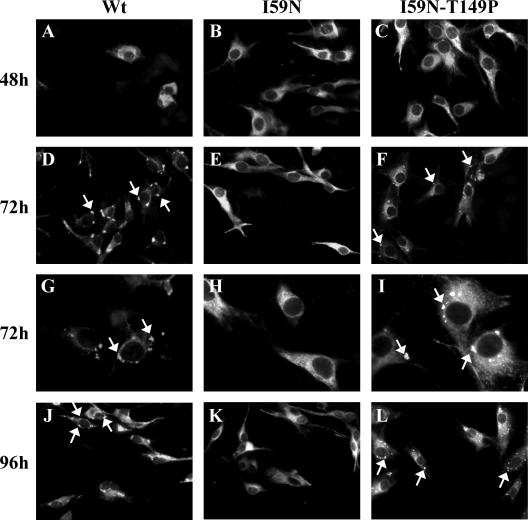
Lack of characteristic virus-induced membranes in BHK21 cells transfected with mutant NS2A-I59N replicon RNA. (A) BHK-21 cells were electroporated with WT and mutant repPACβgal RNAs, fixed with 4% paraformaldehyde at 48 h, 72 h, and 96 h posttransfection, and stained with anti-NS3 antibodies, as described Materials and Methods. Virus-induced foci are highlighted by arrows. All images are taken at ×300 magnification except those for panels G to I, which were taken at ×680 magnification.
FIG. 7.
FIG. 7.
Ultrastructure of BHK21 cells containing NS2A-I59N mutant replicon RNA. Cells were resin embedded at 72 h postelectroporation as described in Materials and Methods. Arrows indicate vesicle packets. Abbreviations: CM, convoluted membranes; PC, paracrystalline arrays; Nuc, nucleus. Bars, 500 nm.
FIG. 8.
FIG. 8.
Sequence alignment of the flavivirus NS2A protein. The same residues are indicated as dots within the alignment, while different residues are shown. Dashes represent deletions. The KUN amino acid residues 59, 149, and 198 and corresponding amino acids in other flaviviruses at this position are indicated by boxes.

References

    1. Agirre, A., A. Barco, L. Carrasco, and J. L. Nieva. 2002. Viroporin-mediated membrane permeabilization. Pore formation by nonstructural poliovirus 2B protein. J. Biol. Chem. 27740434-40441. - PubMed
    1. Chambers, T. J., D. W. McCourt, and C. M. Rice. 1989. Yellow fever virus proteins NS2A, NS2B and NS4B: identification and partial N-terminal amino acid sequence analysis. Virology 169100-109. - PubMed
    1. Chang, Y. S., C. L. Liao, C. H. Tsao, M. C. Chen, C. I. Liu, L. K. Chen, and Y. L. Lin. 1999. Membrane permeabilization by small hydrophobic nonstructural proteins of Japanese encephalitis virus. J. Virol. 736257-6264. - PMC - PubMed
    1. Coia, G., M. D. Parker, G. Speight, M. E. Byrne, and E. G. Westaway. 1988. Nucleotide and complete amino acid sequences of Kunjin virus: definitive gene order and characteristics of the virus-specified proteins. J. Gen. Virol. 691-21. - PubMed
    1. Gehrke, R., M. Ecker, S. W. Aberle, S. L. Allison, F. X. Heinz, and C. W. Mandl. 2003. Incorporation of tick-borne encephalitis virus replicons into virus-like particles by a packaging cell line. J. Virol. 778924-8933. - PMC - PubMed

Publication types

MeSH terms

Substances

LinkOut - more resources