


Modeling repeated time-to-event health conditions with discontinuous risk intervals. An example of a longitudinal study of functional disability among older persons
- PMID: 18338081
- PMCID: PMC2735569
Modeling repeated time-to-event health conditions with discontinuous risk intervals. An example of a longitudinal study of functional disability among older persons
Abstract
Objectives: Researchers have often used rather simple approaches to analyze repeated time-to-event health conditions that either examine time to the first event or treat multiple events as independent. More sophisticated models have been developed, although previous applications have focused largely on such outcomes having continuous risk intervals. Limitations of applying these models include their difficulty in implementation without careful attention to forming the data structures.
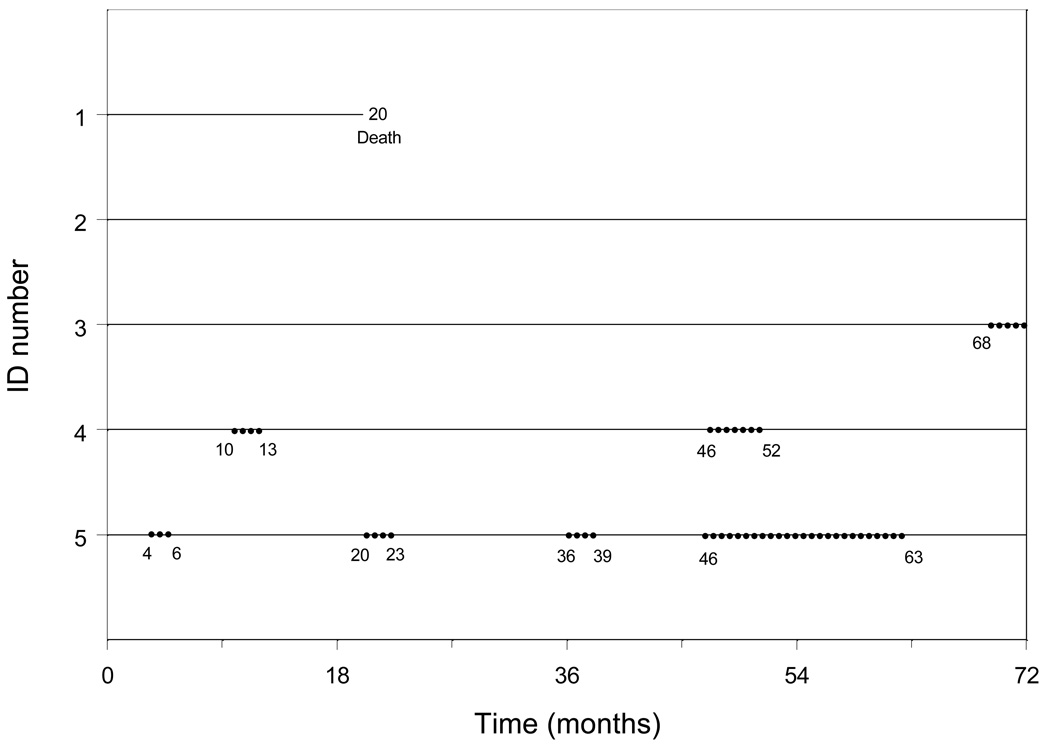
Methods: We first review time-to-event models for repeated events that are extensions of the Cox model and frailty models. Next, we develop a way to efficiently set up the data structures with discontinuous risk intervals for such models, which are more appropriate for many applications than the continuous alternatives. Finally, we apply these models to a real dataset to investigate the effect of gender on functional disability in a cohort of older persons. For comparison, we demonstrate modeling time to the first event.
Results: The GEE Poisson, the Cox counting process, and the frailty models provided similar parameter estimates of gender effect on functional disability, that is, women had increased risk of bathing disability and other disability (disability in walking, dressing, or transferring) as compared to men. These results, especially for other disabilities, were quite different from those provided by an analysis of the first-event outcomes. However, the effect of gender was no longer significant in the counting process model fully adjusted for covariates.
Conclusion: Modeling time to only the first event may not be adequate. After properly setting up the data structures, repeated event models that account for the correlation between multiple events within subjects can be easily implemented with common statistical software packages.
Figures
References
-
- Therneau TM, Grambsch PM. New York: Springer; 2000. Modeling survival data: extending the Cox model.
-
- Wei LJ, Glidden DV. An overview of statistical methods for multiple failure time data in clinical trials. Stat Med. 1997;16:833–839. - PubMed
-
- Therneau TM, Hamilton SA. rhDNaseasan example of recurrent event analysis. Stat Med. 1997;16:2029–2047. - PubMed
-
- Aalen OO, Husebye E. Statistical analysis of repeated events forming renewal processes. Stat Med. 1991;10:1227–1240. - PubMed
Publication types
MeSH terms
Grants and funding
LinkOut - more resources
Full Text Sources