


Evaluation of the new advanced 15-loci MIRU-VNTR genotyping tool in Mycobacterium tuberculosis molecular epidemiology studies
- PMID: 18339198
- PMCID: PMC2291470
- DOI: 10.1186/1471-2180-8-34
Evaluation of the new advanced 15-loci MIRU-VNTR genotyping tool in Mycobacterium tuberculosis molecular epidemiology studies
Abstract
Background: During the last few years, PCR-based methods have been developed to simplify and reduce the time required for genotyping Mycobacterium tuberculosis (MTB) by standard approaches based on IS6110-Restriction Fragment Length Polymorphism (RFLP). Of these, MIRU-12-VNTR (Mycobacterial interspersed repetitive units- variable number of tandem repeats) (MIRU-12) has been considered a good alternative. Nevertheless, some limitations and discrepancies with RFLP, which are minimized if the technique is complemented with spoligotyping, have been found. Recently, a new version of MIRU-VNTR targeting 15 loci (MIRU-15) has been proposed to improve the MIRU-12 format.
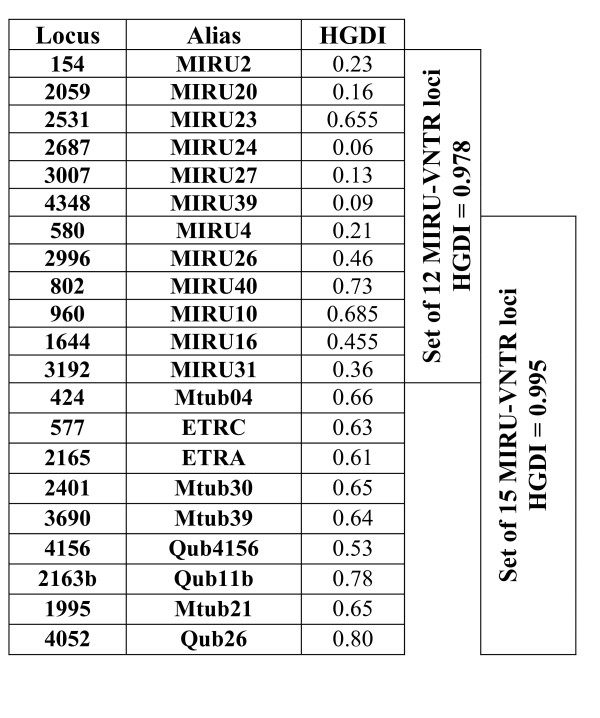
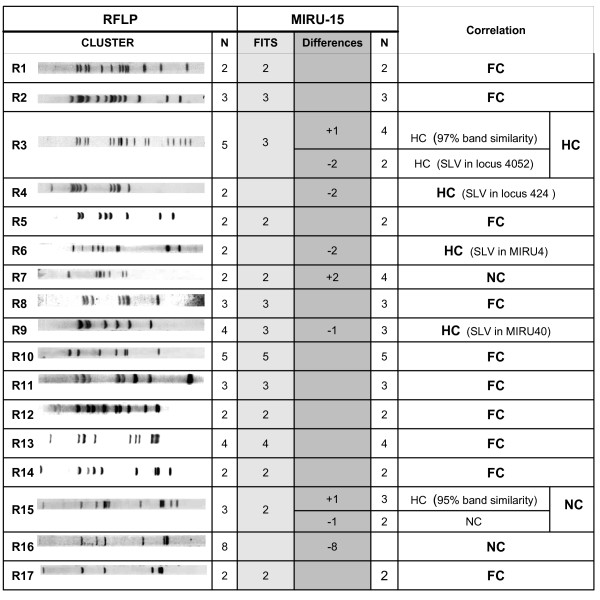
Results: We evaluated the new MIRU-15 tool in two different samples. First, we analyzed the same convenience sample that had been used to evaluate MIRU-12 in a previous study, and the new 15-loci version offered higher discriminatory power (Hunter-Gaston discriminatory index [HGDI]: 0.995 vs 0.978; 34.4% of clustered cases vs 57.5%) and better correlation (full or high correlation with RFLP for 82% of the clusters vs 47%). Second, we evaluated MIRU-15 on a population-based sample and, once again, good correlation with the RFLP clustering data was observed (for 83% of the RFLP clusters). To understand the meaning of the discrepancies still found between MIRU-15 and RFLP, we analyzed the epidemiological data for the clustered patients. In most cases, splitting of RFLP-clustered patients by MIRU-15 occurred for those without epidemiological links, and RFLP-clustered patients with epidemiological links were also clustered by MIRU-15, suggesting a good epidemiological background for clustering defined by MIRU-15.
Conclusion: The data obtained by MIRU-15 suggest that the new design is very efficient at assigning clusters confirmed by epidemiological data. If we add this to the speed with which it provides results, MIRU-15 could be considered a suitable tool for real-time genotyping.
Figures


References
-
- Frothingham R, Meeker-O'Connell WA. Genetic diversity in the Mycobacterium tuberculosis complex based on variable numbers of tandem DNA repeats. Microbiology (Reading, England) 1998;144 ( Pt 5):1189–1196. - PubMed
-
- Mazars E, Lesjean S, Banuls AL, Gilbert M, Vincent V, Gicquel B, Tibayrenc M, Locht C, Supply P. High-resolution minisatellite-based typing as a portable approach to global analysis of Mycobacterium tuberculosis molecular epidemiology. Proceedings of the National Academy of Sciences of the United States of America. 2001;98:1901–1906. doi: 10.1073/pnas.98.4.1901. - DOI - PMC - PubMed
