Review
. 2007 Dec;17(6):704-11.
doi: 10.1016/j.conb.2008.01.006. Epub 2008 Mar 12.

Leech locomotion: swimming, crawling, and decisions

Affiliations
Review

Leech locomotion: swimming, crawling, and decisions

W Otto Friesen et al. Curr Opin Neurobiol. 2007 Dec.

Abstract

Research on the neuronal control of locomotion in leeches spans almost four decades. Recent advances reviewed here include discoveries that: (1) interactions between multiple hormones modulate initiation of swimming; (2) stretch receptors associated with longitudinal muscles interact with the central oscillator circuit via electrical junctions; (3) intersegmental interactions, according to theoretical analyses, must be relatively weak compared to oscillator interactions within ganglia; and (4) multiple interacting neurons control the expression of alternative modes of locomotion. The innovative techniques that facilitated these advances include optical recording of membrane potential changes, simultaneous intracellular injection of high and low molecular weight fluorescent dyes, and detailed modeling via an input-output systems engineering approach.


Figures
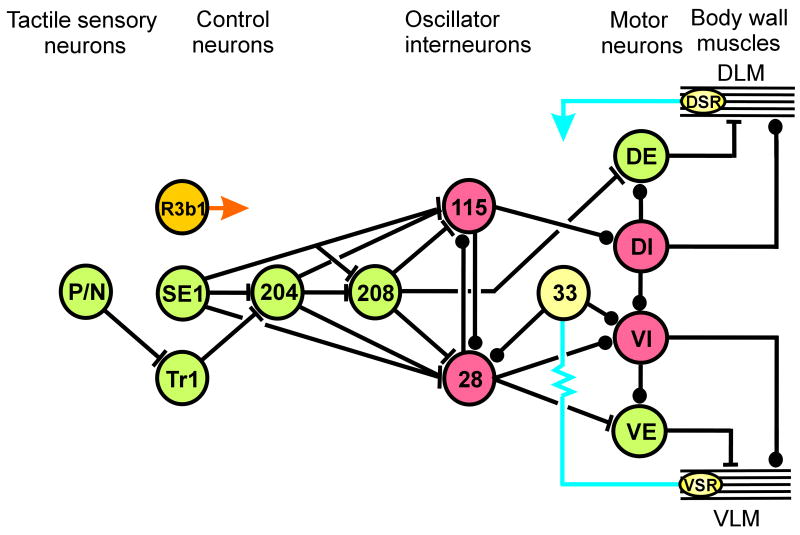
Figure 1
Figure 1
Neurons and circuits. Subset of the neuronal circuits that control and generate leech locomotion. The cascade from left to right begins with swim-initiating sensory neurons, which are found in each segment. The somata of control neurons R3bi, SE1, and Tr1 are found in the subesophageal ganglion, but their axons project to the posterior end of the nerve cord. The somata of swim-gating cell 204 are restricted to segmental ganglia 10 - 16, whereas those of oscillator interneurons, are found in most, if not all, segmental ganglia. These cells all have extensive intersegmental projections. Finally, motor neurons and the stretch receptors (VSR and DSR) are local, with processes restricted to individual segments. Abbreviations and symbols: P - pressure-sensitive neuron; N - nociceptive neuron; R3b1 - decision neuron, SE1 - swim excitor neuron; Tr1 - trigger neuron; 204 - swim-gating neuron; 208, 33, 115, 28, and 33 - subset of the central oscillator neurons; DE - dorsal excitor; DI - dorsal inhibitor; VI - ventral inhibitor; VE - ventral excitor; DSR - dorsal stretch receptor; VSR - ventral stretch receptor; DLM - dorsal longitudinal muscle; VLM - ventral longitudinal muscle; filled circles - inhibitory synapses, bars - excitatory synapses; and resistor - non-rectifying electrical interaction. Green denotes excitatory, and red denotes inhibitory neurons. The direct targets of R3b1 and DSR are not identified. For the sake of simplicity some identified neurons and many synaptic interactions are not depicted in this diagram.
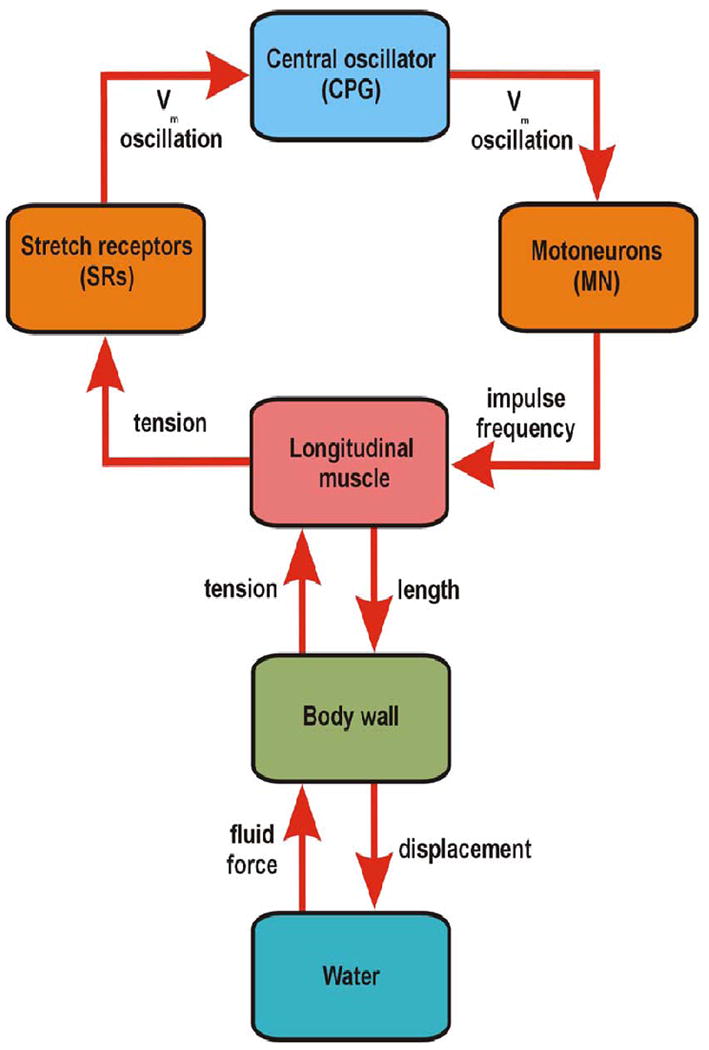
Figure 2
Figure 2
Systems overview. The system that generates and executes swimming locomotion in leeches comprises many complex subsystems. The central oscillator (central pattern generator – CPG) includes mostly inhibitory intersegmental interneurons that drive inhibitory and excitatory segmental motor neurons. These command, or countermand local, antiphasic contractions of segmental dorsal and ventral longitudinal muscles. Muscle contractions, which are phase-delayed along the body, cast the body wall into a rearward traveling body wave of about length wavelength. Movement of the body against the water medium generates forces (fluid force) that are essential elements in the realization of the sinusoidal swimming undulations and in turn, critically affect the tension in longitudinal muscles. These tensions are transduced by peripheral stretch receptors (SRs) associated with the longitudinal muscles. Giant, non-spiking axons convey graded rhythmic membrane potentials to the central oscillator through strong non-rectifying electrical interactions with at least one interneuron, thereby completing a loop of interactions. Both motor neuron impulse frequencies and muscle lengths, strongly influenced by fluid-body wall interactions, determine muscle tensions during each sector of the swim cycle.
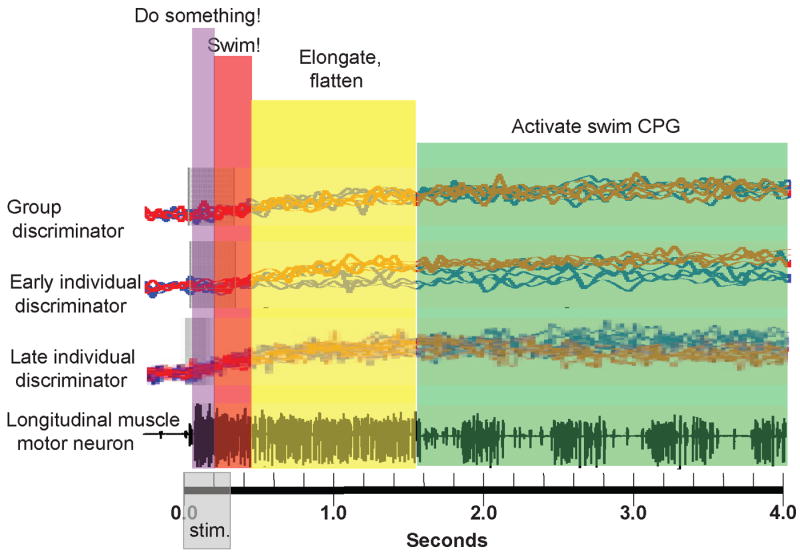
Figure 3
Figure 3
Hypothesized series of choices made by a leech nervous system in deciding to swim. The bottom trace is an extracellular recording from a nerve in the middle of an isolated leech nervous system; the largest spikes are from a motor neuron (DE-3) that excites dorsal longitudinal muscles. A burst of electrical pulses during the time indicated by “stim.,” delivered to another nerve, activated DE-3 for about 1.5 seconds, followed by the swim motor program, indicated by a series of four-spike bursts. The top traces (“Group discriminator”) are 9 overlain optical trajectories from one neuron when the stimulation led to swimming (blue traces) or crawling (red traces). The traces from this neuron did not, by themselves, discriminate swimming from crawling, but taken together with several other neurons, they did predict which behavior would occur during the time period marked by the red vertical stripe. Other neurons, typified by the second set of traces (“Early individual discriminator”) did predict which behavior would occur, but only at later times, marked by the yellow vertical stripe. These neurons are likely to be involved in the elongation and flattening movements made by the leech as it prepares to swim. Still other neurons (“Late individual discriminator”) became active during the production of the motor pattern (green vertical stripe); these are likely to be the neurons responsible for generating the swim motor program. It should be noted that the DE-3 motor neuron began to fire even earlier than the earliest discriminators (violet stripe), which is thought to mean that there were decision-making neurons active before the swimming/crawling decision was made, readying the nervous system for either behavior. The time after the delivery of the stimulus, therefore, is thought to consist of four kinds of decisions: (1) “do something;” (2) “swim or crawl” (swim, in the nerve recording shown); (3) “prepare the body,” by elongating and flattening it; and, finally, (4) make the appropriate motor pattern. Examples of all but the first kind of interneuron have been identified. (This figure is based upon data from references and .)

References

    1. Marder E, Calabrese RL. Principles of rhythmic motor pattern generation. Physiol Rev. 1996;763:687–717. - PubMed
    1. Kristan WB, Jr, Calabrese R, Friesen WO. Neuronal control of leech behavior. Prog in Neurobiol. 2005;76:279–327. - PubMed
    2. **A review of what is known about behaviorally relevant neuronal circuits in the leech central nervous system.

    1. Hooper SL, DiCaprio RA. Crustacean motor pattern generator networks. Neurosignals. 2004;13:50–69. - PubMed
    1. Rossignol S, Dubuc R, Gossard JP. Dynamic sensorimotor interactions in locomotion. Physiol Rev. 2006;86:89–154. - PubMed
    1. Büschges A. Sensory control and organization of neural networks mediating coordination of multisegmental organs for locomotion. J Neurophysiology. 2005;93:1127–1135. - PubMed

Publication types