. 2008 May 16;283(20):14092-9.
doi: 10.1074/jbc.M709161200. Epub 2008 Mar 13.

A proposed role for the Azotobacter vinelandii NfuA protein as an intermediate iron-sulfur cluster carrier

Affiliations

A proposed role for the Azotobacter vinelandii NfuA protein as an intermediate iron-sulfur cluster carrier

Sibali Bandyopadhyay et al. J Biol Chem. .

Abstract

Iron-sulfur clusters ([Fe-S] clusters) are assembled on molecular scaffolds and subsequently used for maturation of proteins that require [Fe-S] clusters for their functions. Previous studies have shown that Azotobacter vinelandii produces at least two [Fe-S] cluster assembly scaffolds: NifU, required for the maturation of nitrogenase, and IscU, required for the general maturation of other [Fe-S] proteins. A. vinelandii also encodes a protein designated NfuA, which shares amino acid sequence similarity with the C-terminal region of NifU. The activity of aconitase, a [4Fe-4S] cluster-containing enzyme, is markedly diminished in a strain containing an inactivated nfuA gene. This inactivation also results in a null-growth phenotype when the strain is cultivated under elevated oxygen concentrations. NifU has a limited ability to serve the function of NfuA, as its expression at high levels corrects the defect of the nfuA-disrupted strain. Spectroscopic and analytical studies indicate that one [4Fe-4S] cluster can be assembled in vitro within a dimeric form of NfuA. The resultant [4Fe-4S] cluster-loaded form of NfuA is competent for rapid in vitro activation of apo-aconitase. Based on these results a model is proposed where NfuA could represent a class of intermediate [Fe-S] cluster carriers involved in [Fe-S] protein maturation.


Figures
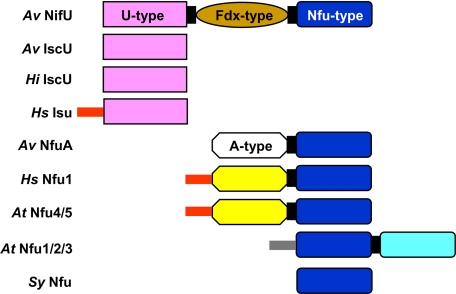
FIGURE 1.
FIGURE 1.
Schematic representation of domain structures of IscU/NifU/Nfu proteins from bacteria (A. vinelandii Av IscU, Av NifU, Av NfuA, and Haemophilus influenzae Hi IscU), mitochondria (human Hs Isu, Hs Nfu1, and Arabidopsis thaliana At Nfu4/5), plant chloroplast (A. thaliana At Nfu1/2/3) and cyanobacteria (Synechocystis sp. Sy Nfu). The pink boxes represent U-type domains, and the brown box represents a Fdx-like domain. Nfu-type domains with a CXXC motif are colored deep blue and those without the CXXC motif are colored light blue. The white box represents the N-terminal A-type domain (without the conserved cysteine residues) that is present in bacterial Nfu-type proteins. The yellow boxes represent the N-terminal domain of mitochondrial Nfu-type proteins. The red and gray sticks represent mitochondrial and plastid targeting sequences, respectively.
FIGURE 2.
FIGURE 2.
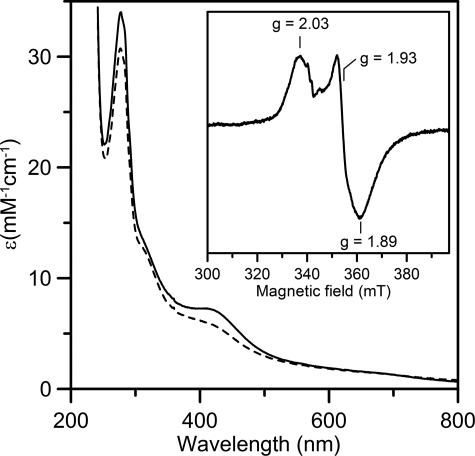
UV-visible absorption spectra of reconstituted A. vinelandii NfuA as prepared (solid line) and after anaerobic reduction with one reducing equivalent of dithionite (dashed line). Molar extinction coefficients are expressed per NfuA monomer. The inset shows the X-band EPR spectrum of the sample reduced with one reducing equivalent of dithionite. EPR conditions: microwave frequency, 9.60 GHz; microwave power, 10 milliwatt; modulation amplitude, 0.63 mT; temperature, 10 K.
FIGURE 3.
FIGURE 3.
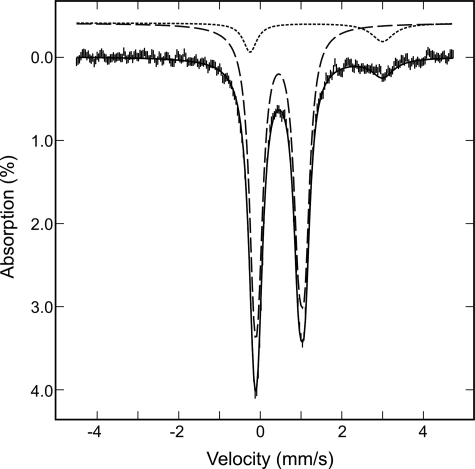
Mössbauer spectrum of 57Fe-reconstituted A. vinelandii NfuA recorded at 4.2 K with a field of 50 mT applied parallel to the γ-radiation. The solid black line is the composite spectrum including the simulated spectrum of a [4Fe-4S]2+ cluster (dashed line), scaled to 90% of the total iron absorption, and the simulated spectrum of a Fe2+ species (dotted line), accounting for 10% of the iron absorption. The parameters used for the simulations are provided in the text.
FIGURE 4.
FIGURE 4.
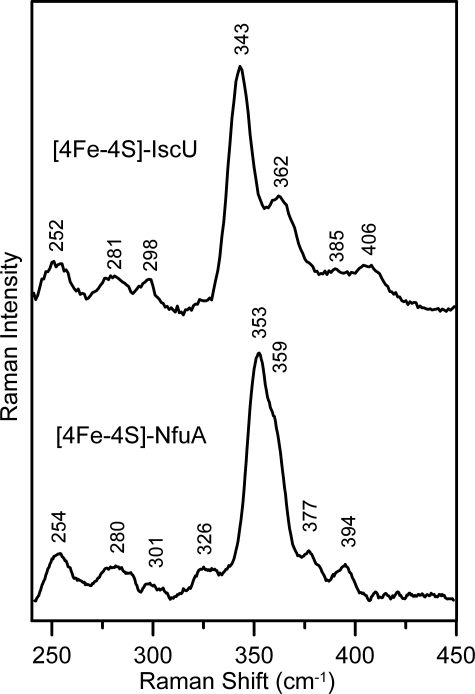
Comparison of the resonance Raman spectra for [4Fe-4S] 2+ cluster-loaded forms of A. vinelandii IscU and NfuA. The samples (∼3 mm in [4Fe-4S] clusters) were in the form of frozen droplets at 17 K. The spectra were recorded using 457-nm excitation with 100 milliwatts of laser power at the sample. Each spectrum is the sum of 100 scans, with each scan involving photon counting for 1 s at 1-cm-1 increments with 7-cm-1 resolution. Bands due to lattice modes of the frozen buffer solution have been subtracted from both spectra.
FIGURE 5.
FIGURE 5.
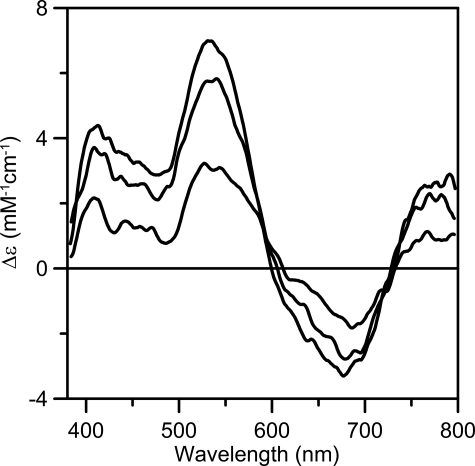
VTMCD spectra of dithionite-reduced reconstituted A. vinelandii NfuA. Reconstituted NfuA (0.25 mm in [4Fe-4S] clusters) was reduced with one reducing equivalent of dithionite after addition of 55% (v/v) ethylene glycol. MCD spectra recorded in a 1-mm cell with a magnetic field of 6 T at 1.7, 4.2, and 15 K. All bands increased in intensity with decreasing temperature, and Δε values are expressed per NfuA monomer.
FIGURE 6.
FIGURE 6.
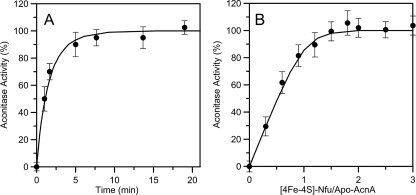
Activation of apo-AcnA activity using [4Fe-4S] cluster-loaded NfuA. A, apo-AcnA (4 μm) was incubated with [4Fe-4S] cluster-loaded NfuA (12 μm in [4Fe-4S]2+ clusters) at room temperature under anaerobic conditions. Aliquots containing 4 μm AcnA were withdrawn after 100, 460, 820, 1140, 1480, and 1800 s, and AcnA activity was immediately measured. The solid line is the best fit to second order kinetics based on the initial concentrations of [4Fe-4S]2+ clusters on NfuA and apo-AcnA, and corresponds to a rate constant of 6.0 × 10⁴ m-1 min-1. B, apo-AcnA activation as a function of the concentration of NfuA-ligated [4Fe-4S]2+ clusters. The concentration of apo-AcnA was kept constant at 4 μm, and the concentration of NfuA-ligated [4Fe-4S]2+ clusters was varied as indicated on the x-axis. After 20 min, aliquots were withdrawn and assayed for AcnA activity. The solid line is theoretical data computed for [4Fe-4S] cluster transfer from NfuA to apo-AcnA occurring with a 1:1 stoichiometry and with a rate constant of 6.0 × 10⁴ m-1 min-1 after 20 min of reaction. The data points in A and B correspond to the average values of three independent measurements, and the error bars represent the standard deviation.
FIGURE 7.
FIGURE 7.
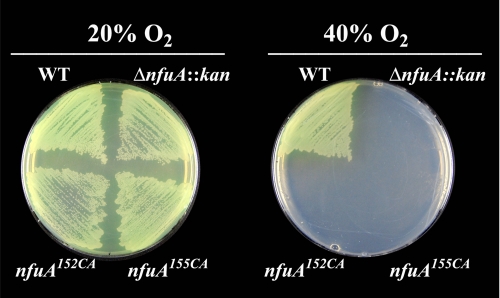
Inactivation of nfuA and its conserved cysteines results in a null-growth phenotype under elevated oxygen conditions. Strains were cultured in Burk's medium supplemented with 13 mm ammonium acetate under ambient (∼20%) O2 or 40% O2 for 3 days. The standard laboratory strain designated as DJ was used as a wild-type control (WT). Strain DJ1707 has a deletion and kanamycin gene cartridge insertion within the nfuA gene (ΔnfuA::kan). Strains DJ1759 and DJ1769 have, respectively, NfuA Cys152 and NfuA Cys155 substituted by alanine.
FIGURE 8.
FIGURE 8.
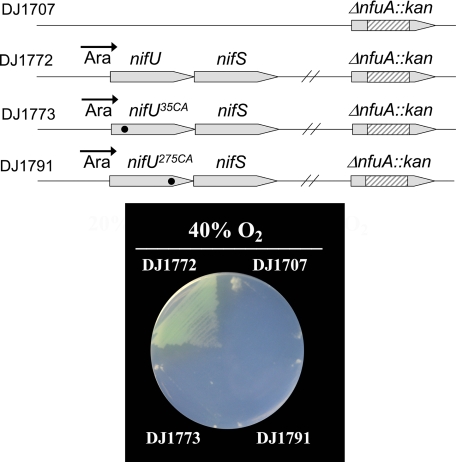
Rescue of the null-growth phenotype associated with the functional loss of NfuA by elevated ara-directed expression of NifUS. Top, schematic representation of the genetic organizations of DJ1707, DJ1772, DJ1773, and DJ1791. Bottom, growth of strains when cultured in Burk's medium supplemented with 13 mm ammonium acetate and 20 mm arabinose and cultured under a 40% O2 atmosphere. NifU and NifS expression are under the control of the ara-regulatory elements, resulting in accumulation of high levels when arabinose is added to the growth medium.

References

    1. Johnson, D. C., Dean, D. R., Smith, A. D., and Johnson, M. K. (2005) Annu. Rev. Biochem. 74 247-281 - PubMed
    1. Zheng, L., Cash, V. L., Flint, D. H., and Dean, D. R. (1998) J. Biol. Chem. 273 13264-13272 - PubMed
    1. Johnson, D. C., Unciuleac, M. C., and Dean, D. R. (2006) J. Bacteriol. 188 7551-7561 - PMC - PubMed
    1. Johnson, D. C., Dos Santos, P. C., and Dean, D. R. (2005) Biochem. Soc. Trans. 33 90-93 - PubMed
    1. Dos Santos, P. C., Johnson, D. C., Ragle, B. E., Unciuleac, M. C., and Dean, D. R. (2007) J. Bacteriol. 189 2854-2862 - PMC - PubMed

Publication types

LinkOut - more resources