


Haemodynamic responses to exercise, ATP infusion and thigh compression in humans: insight into the role of muscle mechanisms on cardiovascular function
- PMID: 18339690
- PMCID: PMC2479567
- DOI: 10.1113/jphysiol.2008.152058
Haemodynamic responses to exercise, ATP infusion and thigh compression in humans: insight into the role of muscle mechanisms on cardiovascular function
Abstract
The muscle pump and muscle vasodilatory mechanism are thought to play important roles in increasing and maintaining muscle perfusion and cardiac output ((.)Q) during exercise, but their actual contributions remain uncertain. To evaluate the role of the skeletal muscle pump and vasodilatation on cardiovascular function during exercise, we determined leg and systemic haemodynamic responses in healthy men during (1) incremental one-legged knee-extensor exercise, (2) step-wise femoral artery ATP infusion at rest, (3) passive exercise (n=10), (4)femoral vein or artery ATP infusion (n=6), and (5) cyclic thigh compressions at rest and during passive and voluntary exercise (n=7). Incremental exercise resulted in progressive increases in leg blood flow (DeltaLBF 7.4 +/- 0.7 l min(-1)), cardiac output (Delta (.)Q 8.7 +/- 0.7 l min(-1)), mean arterial pressure (DeltaMAP 51 +/- 5 mmHg), and leg and systemic oxygen delivery and (.)VO2 . Arterial ATP infusion resulted in similar increases in (.)Q , LBF, and systemic and leg oxygen delivery, but central venous pressure and muscle metabolism remained unchanged and MAP was reduced. In contrast,femoral vein ATP infusion did not alter LBF, (.)Q or MAP. Passive exercise also increased blood flow (DeltaLBF 0.7 +/- 0.1 l min(-1)), yet the increase in muscle and systemic perfusion, unrelated to elevations in aerobic metabolism, accounted only for approximately 5% of peak exercise hyperaemia.Likewise, thigh compressions alone or in combination with passive exercise increased blood flow (DeltaLBF 0.5-0.7 l min(-1)) without altering (.)Q, MAP or (.)VO2. These findings suggest that the skeletal muscle pump is not obligatory for sustaining venous return, central venous pressure,stroke volume and (.)Q or maintaining muscle blood flow during one-legged exercise in humans.Further, its contribution to muscle and systemic peak exercise hyperaemia appears to be minimal in comparison to the effects of muscle vasodilatation.
Figures
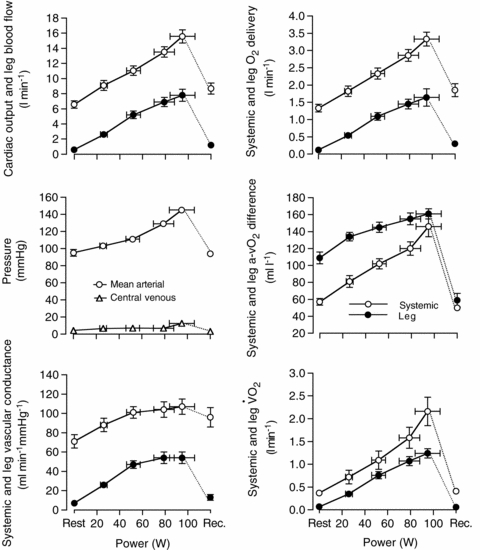
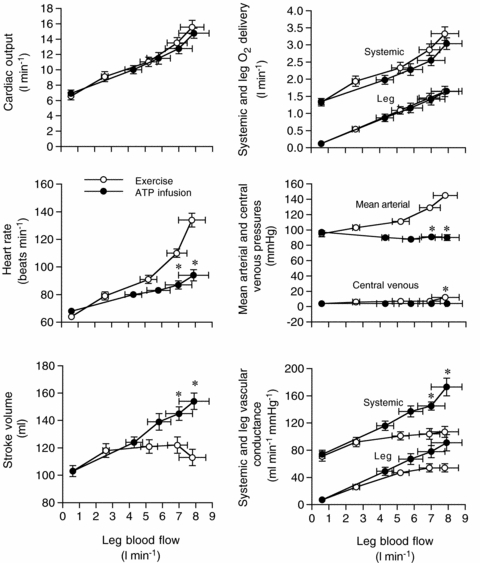
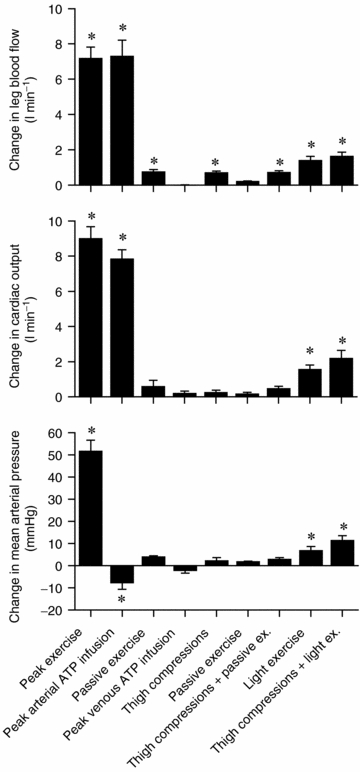
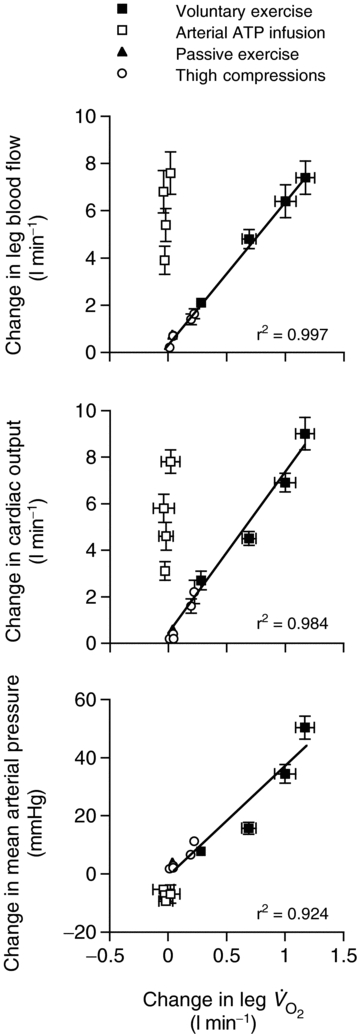
 during the exercise and thigh compressions protocols, but the dissociation in these responses during arterial ATP infusion.
Comment in
-
Cardiovascular function in humans during exercise: role of the muscle pump.J Physiol. 2008 Nov 1;586(21):5045-6. doi: 10.1113/jphysiol.2008.162123. Epub 2008 Sep 18. J Physiol. 2008. PMID: 18801838 Free PMC article. No abstract available.
References
-
- Åstrand PO, Cuddy TE, Saltin B, Stenberg J. Cardiac output during submaximal and maximal work. J Appl Physiol. 1964;19:268–274. - PubMed
-
- Bevegård S, Lodin A. Postural circulatory changes at rest and during exercise in five patients with congenital absence of valves in the deep veins of the legs. Acta Med Scand. 1962;172:21–29. - PubMed
-
- Bogert LW, van Lieshout JJ. Non-invasive pulsatile arterial pressure and stroke volume changes from the human finger. Exp Physiol. 2005;90:437–446. - PubMed
-
- Brengelmann GL. Counterpoint: the classical Guyton view that mean systemic pressure, right atrial pressure, and venous resistance govern venous return is not correct. J Appl Physiol. 2005;101:1525–1526. - PubMed
Publication types
MeSH terms
Substances
LinkOut - more resources
Full Text Sources
Other Literature Sources
Miscellaneous
