Quantitative differentiation between healthy and disordered brain matter in patients with neurofibromatosis type I using diffusion tensor imaging
- PMID: 18339726
- PMCID: PMC7978201
- DOI: 10.3174/ajnr.A0921
Quantitative differentiation between healthy and disordered brain matter in patients with neurofibromatosis type I using diffusion tensor imaging
Abstract
Background and purpose: Hyperintensities on T2-weighted images are seen in the brains of most patients with neurofibromatosis type I (NF-1), but the origin of these unidentified bright objects (UBOs) remains obscure. In the current study, we examined the diffusion characteristics of brain tissue in children with NF-1 to test the hypothesis that a microstructural abnormality is present in NF-1.
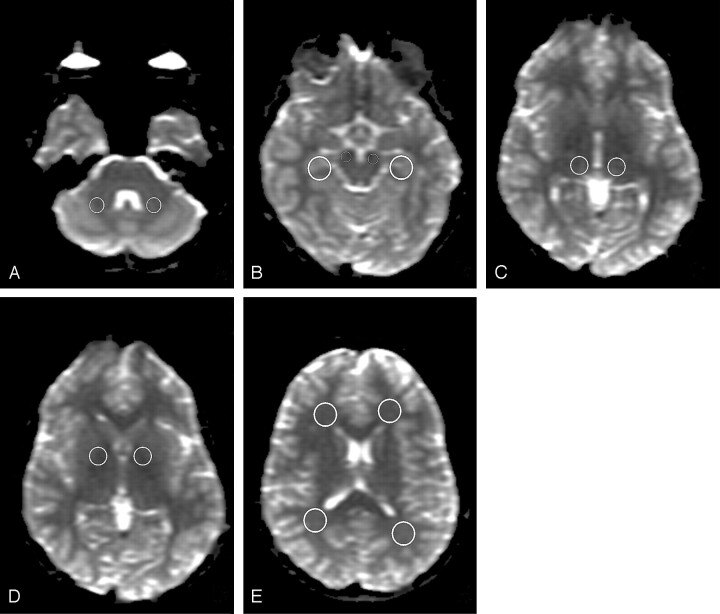
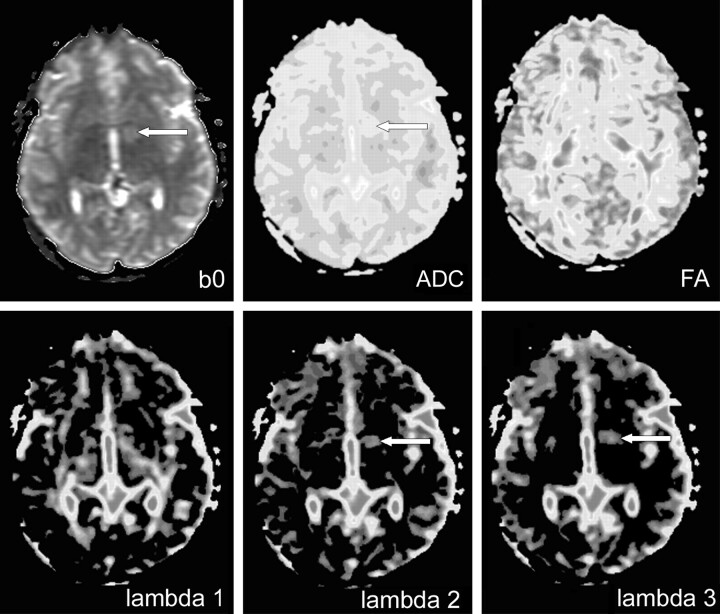
Materials and methods: Diffusion tensor imaging (DTI) was performed in 50 children with NF-1 and 8 controls. Circular regions of interest were manually placed in 7 standardized locations in both hemispheres, including UBO sites. Apparent diffusion coefficients (ADC), fractional anisotropy (FA), and axial anisotropy (A(m)) were used to differentiate quantitatively between healthy and disordered brain matter. Differences in eigenvalues (lambda(1), lambda(2), lambda(3)) were determined to examine parenchymal integrity.
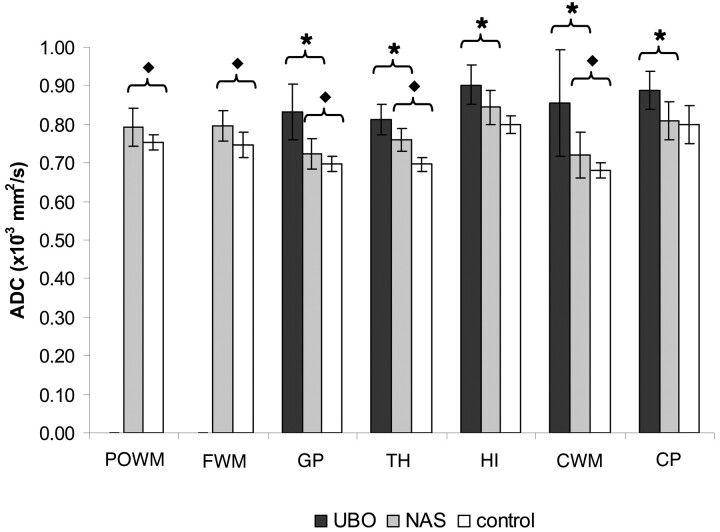
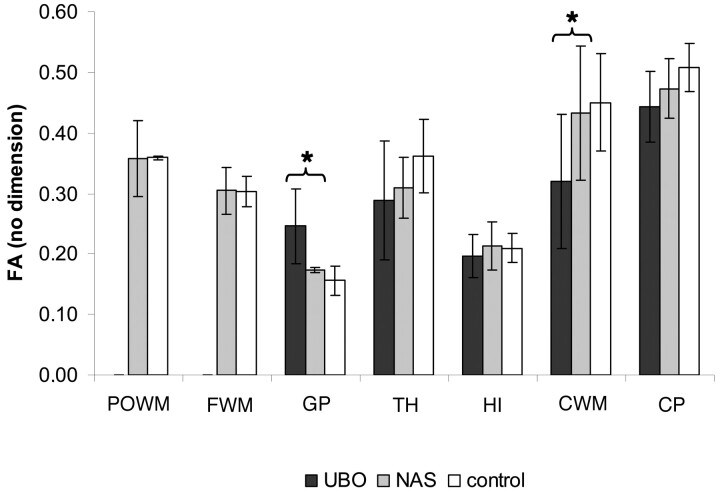
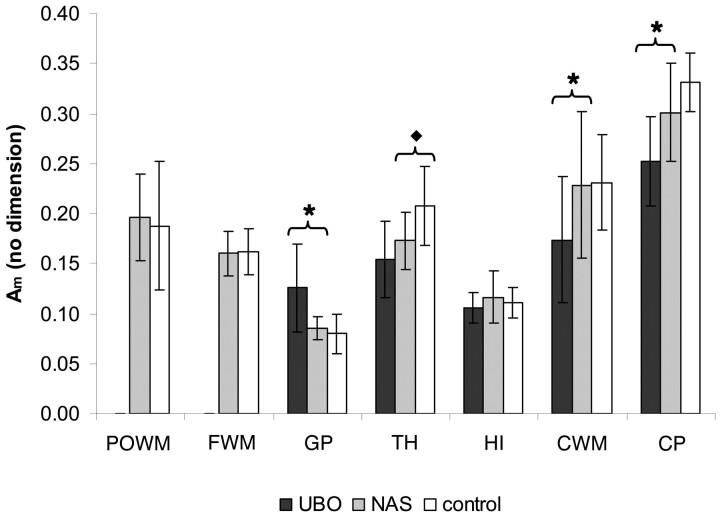
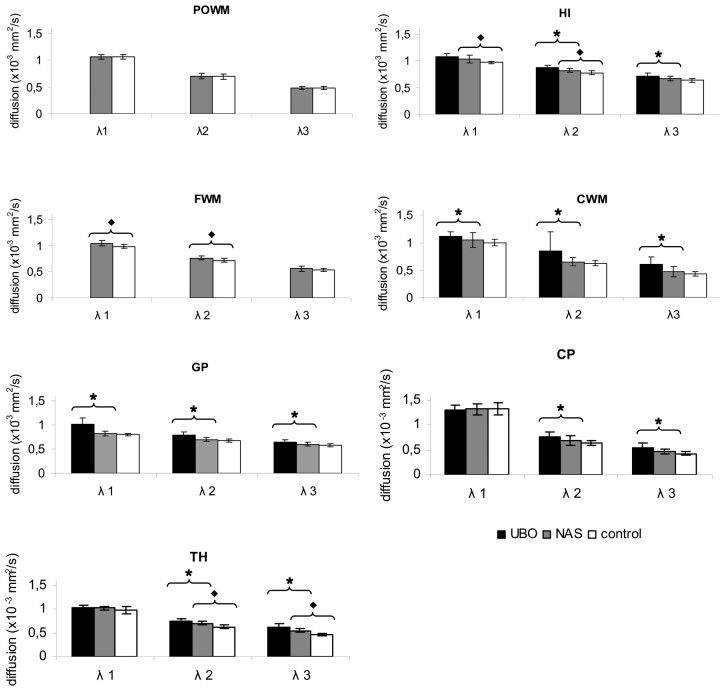
Results: We found higher ADC values for UBOs than for normal-appearing sites (P < .01) and higher ADC values for normal-appearing sites than for controls (P < .04 in 5 of 7 regions). In most regions, we found no differences in FA or A(m). Eigenvalues lambda(2) and lambda(3) were higher at UBO sites than in normal-appearing sites (P < .04).
Conclusion: With ADC, it was possible to differentiate quantitatively between normal- and abnormal-appearing brain matter in NF-1 and also between normal-appearing brain matter in NF-1 and healthy brain matter in controls, indicating subtle pathologic damage disrupting the tissue microstructure in the NF-1 brain. Higher diffusivity for lambda(1), lambda(2), and lambda(3) indicates that this disturbance of microstructure is caused by accumulation of fluid or vacuolation.
Figures
References
-
- Aoki S, Barkovich AJ, Nishimura K, et al. Neurofibromatosis types 1 and 2: cranial MR findings. Radiology 1989;172:527–34 - PubMed
-
- North K. Neurofibromatosis type 1. Am J Med Genet 2000;97:119–27 - PubMed
-
- Menor F, Marti-Bonmati L, Mulas F, et al. Imaging considerations of central nervous system manifestations in pediatric patients with neurofibromatosis type 1. Pediatr Radiol 1991;21:389–94 - PubMed
-
- DiPaolo DP, Zimmerman RA, Rorke LB, et al. Neurofibromatosis type I: pathologic substrate of high-signal-intensity foci in the brain. Radiology 1995;195:721–24 - PubMed
Publication types
MeSH terms
LinkOut - more resources
Full Text Sources
Research Materials
Miscellaneous