


Femtosecond spectroscopy of native and carotenoidless purple-bacterial LH2 clarifies functions of carotenoids
- PMID: 18339744
- PMCID: PMC2397352
- DOI: 10.1529/biophysj.107.121681
Femtosecond spectroscopy of native and carotenoidless purple-bacterial LH2 clarifies functions of carotenoids
Abstract
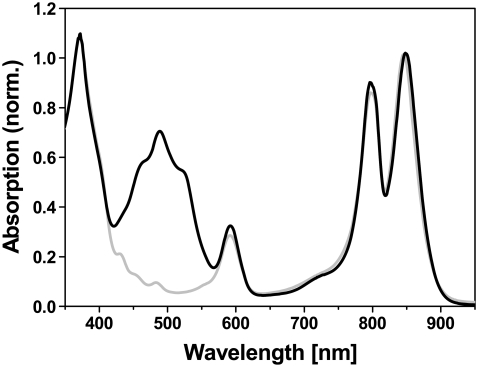
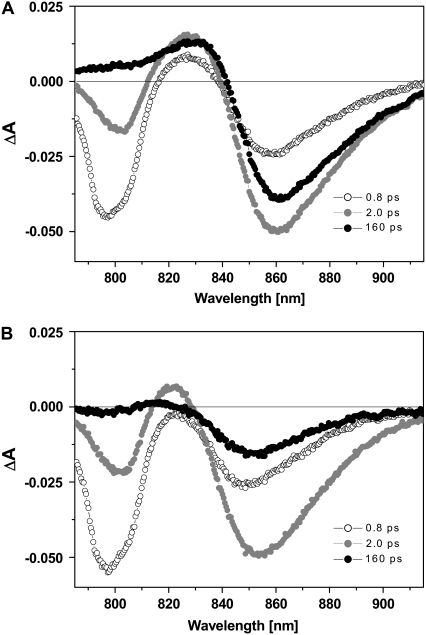
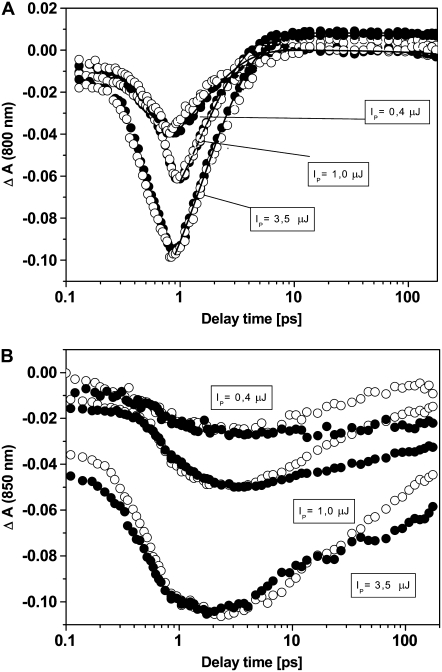
EET between the two circular bacteriochlorophyll compartments B800 and B850 in native (containing the carotenoid rhodopin) and carotenoidless LH2 isolated from the photosynthetic purple sulfur bacterium Allochromatium minutissimum was investigated by femtosecond time-resolved transient absorption spectroscopy. Both samples were excited with 120-fs laser pulses at 800 nm, and spectral evolution was followed in the 720-955 nm range at different delay times. No dependence of transient absorption in the B800 band on the presence of the carotenoid rhodopin was found. Together with the likewise virtually unchanged absorption spectra in the bacteriochlorophyll Q(y) region, these observations suggest that absence of rhodopin does not significantly alter the structure of the pigment-protein complex including interactions between bacteriochlorophylls. Apparently, rhodopin does also not accelerate B800 to B850 EET in LH2, contrary to what has been suggested previously. Moreover, "carotenoid-catalyzed internal conversion" can also be excluded for the bacteriochlorophylls in LH2 of A. minutissimum. Together with previous results obtained with two-photon fluorescence excitation spectroscopy, it can also be concluded that there is neither EET from rhodopin to B800 nor (back-)EET from B800 to rhodopin.
Figures
References
-
- Scholes, G. D., and G. R. Fleming. 2000. On the mechanism of light harvesting in photosynthetic purple bacteria: B800 to B850 energy transfer. J. Phys. Chem. B. 104:1854–1868.
-
- Razi Naqvi, K. 1998. Carotenoid-induced electronic relaxation of the first excited state of antenna chlorophylls. In Photosynthesis: Mechanisms and Effects, Vol. 1. G. Garab, editor. Kluwer Academic Publisher, Dordrecht. 265–270.
-
- Frank, H. A. 2001. Spectroscopic studies of the low-lying singlet excited states and photochemical properties of carotenoids. Arch. Biochem. Biophys. 385:53–60. - PubMed
-
- Ritz, T., A. Damjanovic, K. Schulten, J.-P. Zhang, and Y. Koyama. 2000. Efficient light harvesting through carotenoids. Photosynth. Res. 66:125–144. - PubMed
-
- Fraser, N. J., H. Hashimoto, and R. J. Cogdell. 2001. Carotenoids and bacterial photosynthesis: The story so far.. Photosynth. Res. 70:249–256. - PubMed
Publication types
MeSH terms
Substances
LinkOut - more resources
Full Text Sources
