. 2008 Apr 8;47(14):4317-28.
doi: 10.1021/bi702409t. Epub 2008 Mar 15.

Anionic phospholipids affect the rate and extent of flux through the mechanosensitive channel of large conductance MscL

Affiliations

Anionic phospholipids affect the rate and extent of flux through the mechanosensitive channel of large conductance MscL

Andrew M Powl et al. Biochemistry. .

Abstract

The mechanosensitive channel of large conductance MscL from Escherichia coli has been reconstituted into sealed vesicles, and the effects of lipid structure on the flux of the fluorescent molecule calcein through the open channel have been studied. The channel was opened by reaction of the G22C mutant of MscL with the reagent [2-(triethylammonium)ethyl]methanethiosulfonate (MTSET) which introduces five positive charges within the pore constriction. Flux through the channel was small when the lipid was phosphatidylcholine, but addition of the anionic lipids phosphatidylglycerol, phosphatidic acid, or cardiolipin up to 50 mol % resulted in increases in the amplitudes and rates of release of calcein. Similar effects were seen when either wild-type MscL or the G22C mutant was opened by osmotic pressure difference; rates of release of calcein were very slow in the absence of anionic lipid but increased with increasing concentrations of phosphatidylglycerol to 50 mol %. The observed partial release of trapped calcein following activation of MscL was attributed to the formation of a long-lived subconductance state of MscL following channel opening. Effects of anionic lipid were attributed to an increase in the rate of the transition from closed to fully open state and to a decrease in the rate of the transition from the fully open state to the subconductance state. Higher concentrations of anionic lipid led to a decrease in the rate and amplitude of release of calcein, possibly due to a decreased rate of flux through the open channel. In mixtures with anionic lipids, phosphatidylethanolamine resulted in lower rates and amplitude of release than phosphatidylcholine.


Figures
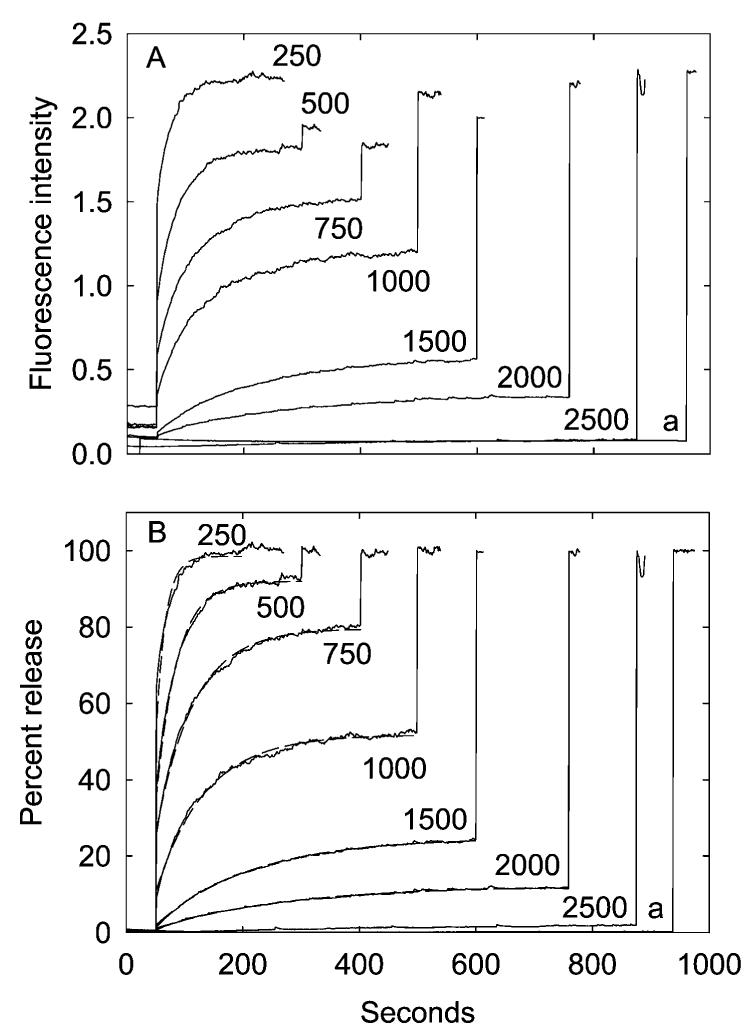
Figure 1
Figure 1
Effect of channel concentration on the efflux of calcein from reconstituted vesicles. The G22C mutant of E. coli MscL was reconstituted into calcein-containing vesicles containing a 1:1 molar ratio of DOPG:DOPC at the given molar ratios of total lipid to MscL. Samples were diluted into buffer, and a fluorescence baseline was recorded for 50 s, followed by the addition of 1 mM MTSET. Finally, 200 μMC12E8 was added to burst the vesicles and establish a value for the fluorescence intensity when all of the trapped calcein had been released. The amount of lipid was kept constant at 6.7 μmol. The trace labeled a shows an experiment for vesicles containing a 1:1 molar ratio of DOPG:DOPC in the absence of MscL. In (A), results are expressed as changes in absolute fluorescence intensities. In (B), results are expressed as a fraction of the observed change in fluorescence intensity between the initial value and that observed in the presence of 200 μM C12E8. The broken lines in (B) show best fits to a single exponential process.
Figure 2
Figure 2
Rates (○) and amplitudes (△) of the fluorescence response following reaction with MTSET for MscL reconstituted in vesicles of a 1:1 molar ratio of DOPG:DOPC. The data were obtained by fitting the data in Figure 1 to single exponentials. The line shows a best fit of the rate data (○) to a straight line.
Figure 3
Figure 3
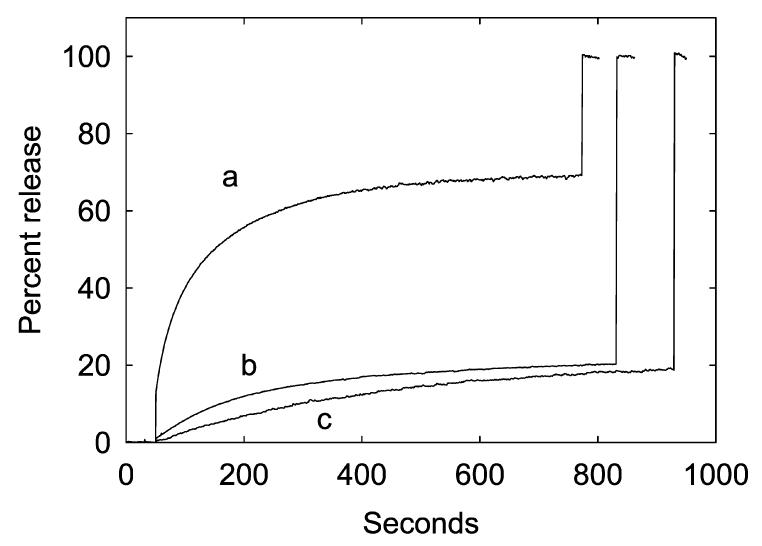
Effect of anionic lipid on calcein flux through MscL. The G22C mutant of E. coli MscL was reconstituted into lipid vesicles containing DOPC and the given mole percent anionic lipid: (A) DOPG, (B) DOPA, and (C) CL. After 50 s, 1 mM MTSET was added, followed finally by 200 μMC12E8 to burst the vesicles. The broken lines show best fits to a single exponential process. In (C), mole fractions of CL are calculated on a fatty acyl chain basis to account for the fact that CL contains four chains whereas DOPC contains two.
Figure 4
Figure 4
Analysis of MTSET labeling of MscL by electrospray mass spectrometry. The G22C mutant of E. coli MscL was reconstituted into lipid vesicles containing DOPC and reacted with MTSET as described under Materials and Methods. (A) and (B) show electrospray mass spectra for MscL unreacted (A) and after reaction with MTSET (B). In (A) the peaks at molecular masses 16492 and 16361 correspond to MscL and MscL lacking the N-terminal Met residue, respectively. In (B) the peaks at molecular masses 16611 and 16480 correspond to labeled MscL and labeled MscL lacking the N-terminal Met residue, respectively, and the peaks at 16627 and 16496 correspond to single Met oxidations of MscL (MscL is Met-rich). No unlabeled MscL is observed in spectrum B.
Figure 5
Figure 5
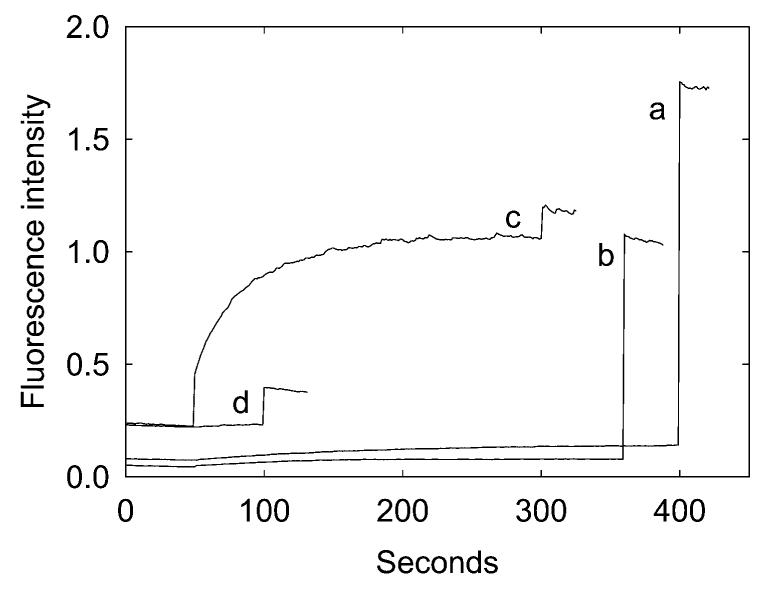
Effect of labeling MTSET before reconstitution. MscL was labeled with MTSET either before or after reconstitution into lipid vesicles. (a) DOPC vesicles were reconstituted with unlabeled MscL. Addition of 1 mM MTSET after 50 s had little effect, so that addition of 200 μM C12E8 after 400 s resulted in a large release of calcein. (b) MscL was labeled with 1 mM MTSET in OG micelles prior to reconstitution and then reconstituted with DOPC. As shown by the large release of calcein observed on addition of C12E8 after 350 s, the vesicles retained a large concentration of calcein. The experiments were repeated for vesicles containing a 1:1 molar ratio of DOPG:DOPC (c, d). When unlabeled MscL was reconstituted into a 1:1 mixture of DOPG:DOPC, addition of MTSET after 50 s resulted in a large release of calcein, so that subsequent addition of C12E8 resulted in only a small release (c). When labeled MscL was reconstituted into vesicles containing a 1:1 molar ratio of DOPG:DOPC, the vesicles retained only a small amount of calcein, as shown by the small response on addition of C12E8 after 100 s (d).
Figure 6
Figure 6
Effect of phosphatidylethanolamine on calcein flux through MscL. The G22C mutant of E. coli MscL was reconstituted into lipid vesicles containing 1:1 molar ratios of the following lipids: (a) DOPC:DOPA, (b) DOPE:DOPA, (c) DOPC:DOPG, (d) DOPE:DOPG, (e) DOPC:CL, and (f) DOPE:CL. After 50 s, 1 mM MTSET was added, followed finally by 200 μM C12E8 to burst the vesicles.
Figure 7
Figure 7
Effect of lipid mixtures on calcein flux through MscL. The G22C mutant of E. coli MscL was reconstituted into lipid vesicles containing the following lipid mixtures: (a) DOPC:DOPG: CL (70:25:5 mol %), (b) DOPE:DOPG:CL (70:25:5 mol %), and (c) azolectin. After 50 s, 1 mM MTSET was added, followed finally by 200 μM C12E8 to burst the vesicles.
Figure 8
Figure 8
Calcein flux following reaction of MscL with MTSES. The G22C mutant of E. coli MscL was reconstituted into lipid vesicles containing DOPC and the given mole percent DOPG. After 50 s, 1 mM MTSES was added, followed finally by 200 μM C12E8 to burst the vesicles.
Figure 9
Figure 9
Sidedness of MscL reconstituted into lipid vesicles. L69C-TbMscL (A) and Y94C-TbMscL (B) with Cys residues located on the periplasmic and cytoplasmic sides of the channel, respectively, were reconstituted into vesicles of DOPC (solid line) or DOPG: DOPC (molar ratio, 1:1; dashed line). Cys residues were then reacted with 7 μM N-(1-pyrenyl)maleimide. Vesicles were burst by the addition of 200 μM C12E8.
Figure 10
Figure 10
Effect of osmotic pressure on release of calcein. (A) Vesicles of a 1:1 mixture of DOPA:DOPC containing 50 mM calcein were diluted into buffer containing 100 mM KCl (a) or 100 mM KCl plus 0.5 M sucrose (b). At the time shown by the arrows the vesicles were burst by the addition of 200 μM C12E8. (B) Vesicles of a 1:1 mixture of DOPA:DOPC with the G22C mutant of MscL containing 50 mM calcein were diluted into buffer containing 100 mM KCl plus 0.5 M sucrose and either burst with 200 μM C12E8 at 800 s (a) or first reacted with MTSET at 50 s and then burst with 200 μM C12E8 at 800 s (c). The same preparation of vesicles was also diluted into buffer containing 100 mM KCl and no sucrose, followed by addition of MTSET after 400 s, and then burst with 200 μM C12E8 at 800 s (b).
Figure 11
Figure 11
The osmotic pressure difference required to open MscL. The G22C mutant of E. coli MscL was reconstituted into vesicles of a 1:1 mixture of DOPA:DOPC containing 50 mM calcein and diluted into buffer containing 100 mM KCl and the following concentrations of sucrose: (a) 0.5 M; (b) 0.45 M; (c) 0.4 M; (d) 0.2 M; (e) 0 M. After 150–250 s, 200 μM C12E8 was added to burst the vesicles.
Figure 12
Figure 12
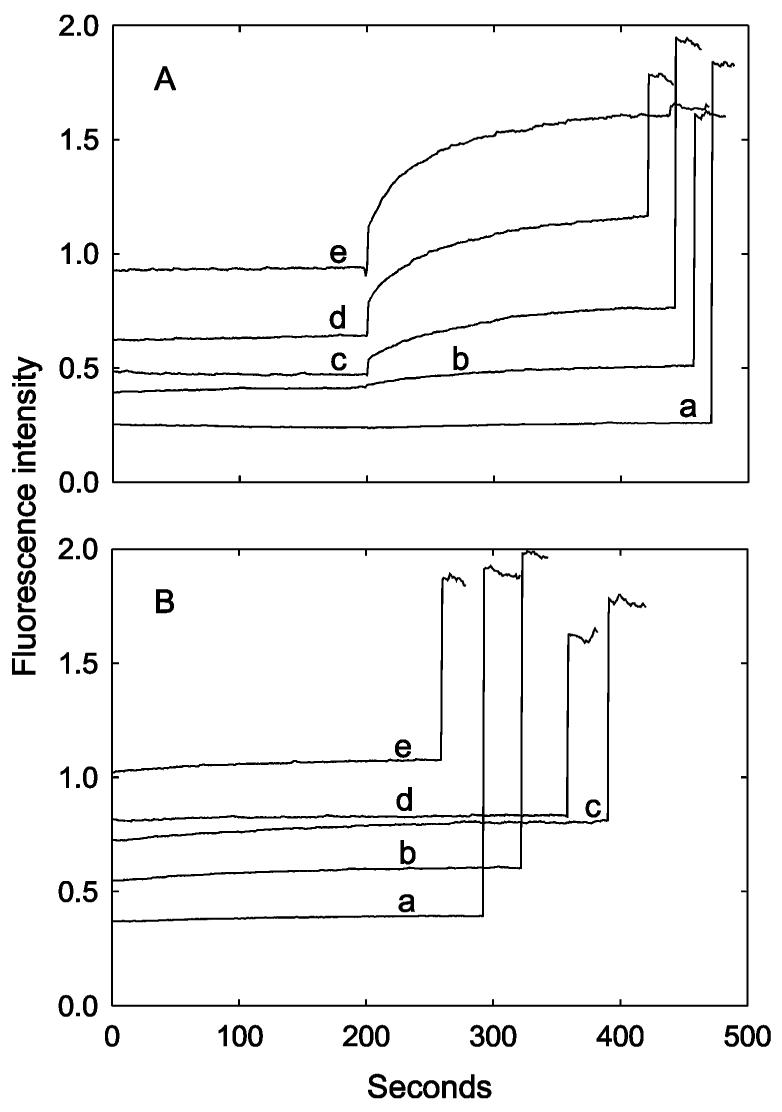
Effect of anionic lipid on osmotic sensitivity. The G22C mutant of E. coli MscL (A) or wild-type E. coli MscL (B) was reconstituted into vesicles containing mixtures of DOPG and DOPC with 50 mM calcein and diluted into buffer containing 100 mM KCl. In (A), 1 mM MTSET was added after 200 s, followed by 200 μM C12E8 to burst the vesicles at about 500 s. In (B), 200 μM C12E8 was added to burst the vesicles after about 300 s. The mole percent of DOPG in the vesicles was as follows: (a) 0; (b) 20%; (c) 30%; (d) 40%; (e) 50%.

References

    1. Sukharev SI, Sigurdson WJ, Kung C, Sachs F. Energetic and spatial parameters for gating of the bacterial large conductance mechanosensitive channel, MscL. J. Gen. Physiol. 1999;113:525–539. - PMC - PubMed
    1. Hamill OP, Martinac B. Molecular basis of mechanotransduction in living cells. Physiol. Rev. 2001;81:685–740. - PubMed
    1. Blount P, Iscla I, Moe PC, Li Y. MscL: the bacterial mechanosensitive channel of large conductance. Curr. Top. Membr. 2007;58:201–233.
    1. Lee AG. Lipid-protein interactions in biological membranes: a structural perspective. Biochim. Biophys. Acta. 2003;1612:1–40. - PubMed
    1. Lee AG. Lipid interactions with ion channels. Future Lipidol. 2006;1:103–113.

Publication types

MeSH terms

LinkOut - more resources