


Comparison of cannabis and tobacco withdrawal: severity and contribution to relapse
- PMID: 18342479
- PMCID: PMC4345250
- DOI: 10.1016/j.jsat.2008.01.002
Comparison of cannabis and tobacco withdrawal: severity and contribution to relapse
Abstract
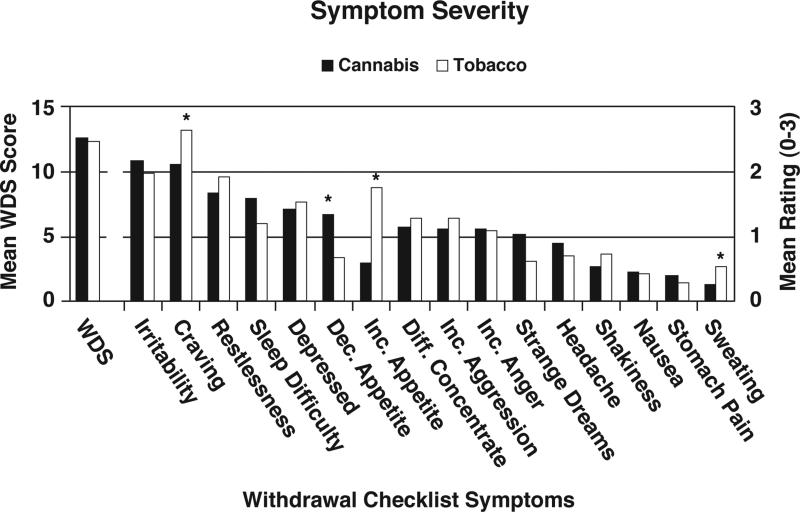
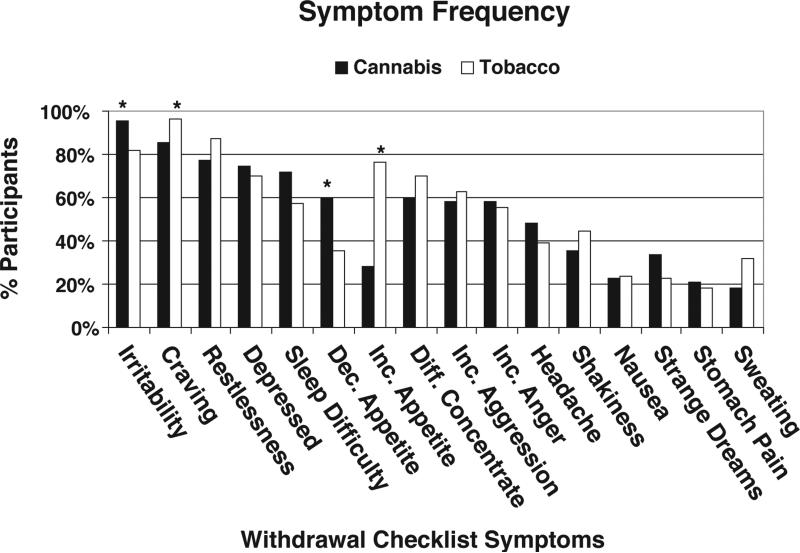
This naturalistic telephone survey study compared perceptions of withdrawal severity in 67 daily cannabis users and 54 daily tobacco cigarette smokers who made quit attempts during the prior 30 days. A Withdrawal Symptom Checklist assessed the severity of abstinence symptoms and a Likert scale assessed perceived relations between abstinence symptoms and relapse. A composite Withdrawal Discomfort Score did not differ significantly between groups (M = 13.0 for cannabis, vs. M = 13.2 for tobacco). Individual symptom severity ratings were also of similar magnitude, except craving and sweating were slightly higher for tobacco. Both groups reported that withdrawal contributed substantially to relapse, and the strength of these ratings was similar across groups. The diverse convenience sample examined in this study adds external validity and generalizability to prior studies that included only users not planning to quit or excluded many common types of cannabis users. The comparable withdrawal experience from these heterogeneous cannabis and tobacco users supports previous findings from controlled laboratory studies and indicates that real-world, frequent cannabis users perceive that withdrawal symptoms negatively affect their desire and ability to quit.
Figures
References
-
- American Psychiatric Association . Diagnostic and statistical manual of mental disorders (IV-TR ed.) American Psychiatric Association; Washington, DC: 2000.
-
- Budney AJ. Are specific dependence criteria necessary for different substances: how can research on cannabis inform this issue? Addiction. 2006;101(Suppl. 1):125–133. - PubMed
-
- Budney AJ, Hughes JR, Moore BA, Vandrey RG. The time course and significance of cannabis withdrawal. Journal of Abnormal Psychology. 2003;112:393–402. - PubMed
-
- Budney AJ, Novy P, Hughes JR. Marijuana withdrawal among adults seeking treatment for marijuana dependence. Addiction. 1999;94:1311–1322. - PubMed
-
- Budney AJ, Radonovich KJ, Higgins ST, Wong CJ. Adults seeking treatment for marijuana dependence: A comparison to cocaine-dependent treatment seekers. Experimental and Clinical Psychopharmacology. 1998;6(4):419–426. - PubMed
Publication types
MeSH terms
Grants and funding
LinkOut - more resources
Full Text Sources
Medical
