


Risk prediction with procalcitonin and clinical rules in community-acquired pneumonia
- PMID: 18342993
- PMCID: PMC2775454
- DOI: 10.1016/j.annemergmed.2008.01.003
Risk prediction with procalcitonin and clinical rules in community-acquired pneumonia
Abstract
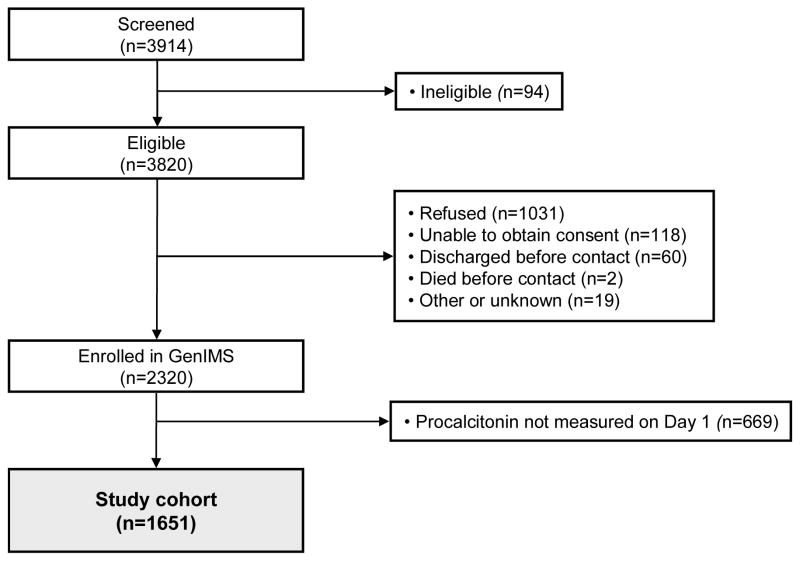
Study objective: The Pneumonia Severity Index and CURB-65 predict outcomes in community-acquired pneumonia but have limitations. Procalcitonin, a biomarker of bacterial infection, may provide prognostic information in community-acquired pneumonia. Our objective is to describe the pattern of procalcitonin in community-acquired pneumonia and determine whether procalcitonin provides prognostic information beyond the Pneumonia Severity Index and CURB-65.
Methods: We conducted a multicenter prospective cohort study in 28 community and teaching emergency departments. Patients presenting with a clinical and radiographic diagnosis of community-acquired pneumonia were enrolled. We stratified procalcitonin levels a priori into 4 tiers: I: less than 0.1; II: greater than 0.1 to less than 0.25; III: greater than 0.25 to less than 0.5; and IV: greater than 0.5 ng/mL. Primary outcome was 30-day mortality.
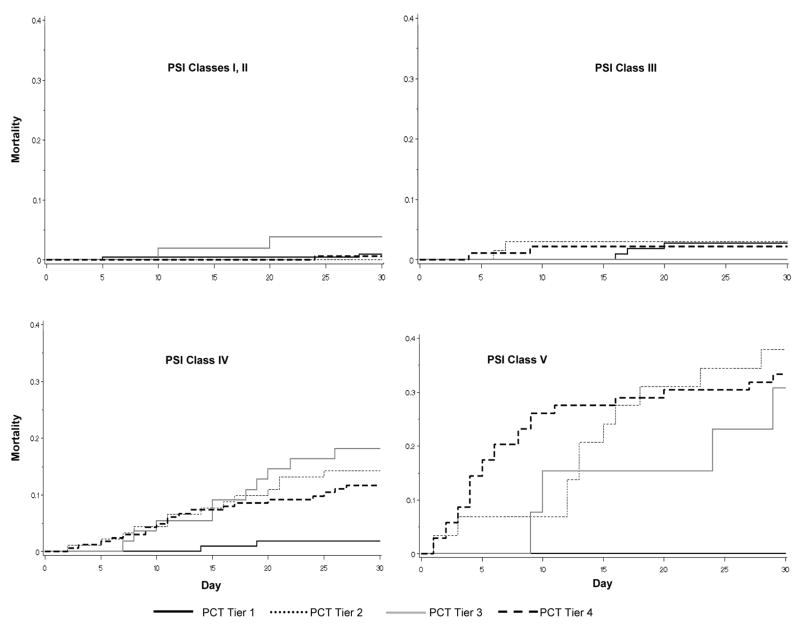
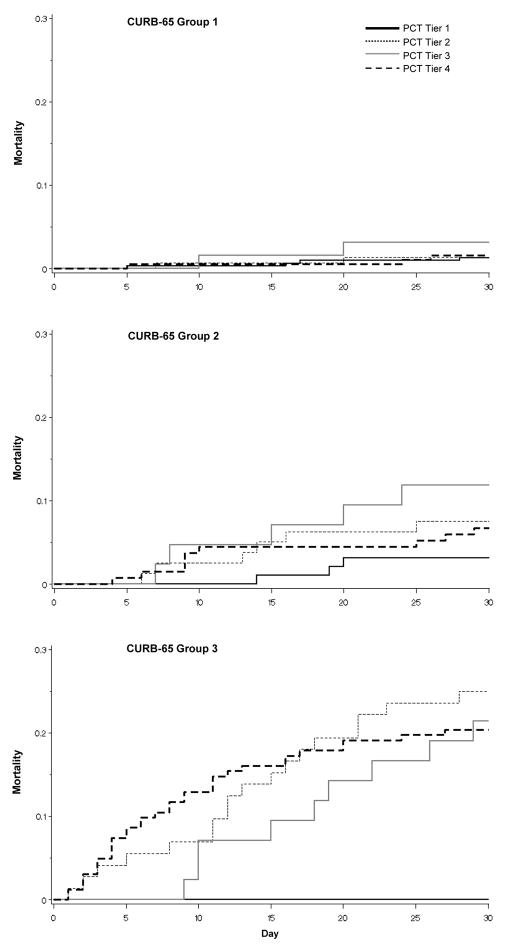
Results: One thousand six hundred fifty-one patients formed the study cohort. Procalcitonin levels were broadly spread across tiers: 32.8% (I), 21.6% (II), 10.2% (III), and 35.4% (IV). Used alone, procalcitonin had modest test characteristics: specificity (35%), sensitivity (92%), positive likelihood ratio (1.41), and negative likelihood ratio (0.22). Adding procalcitonin to the Pneumonia Severity Index in all subjects minimally improved performance. Adding procalcitonin to low-risk Pneumonia Severity Index subjects (classes I to III) provided no additional information. However, subjects in procalcitonin tier I had low 30-day mortality, regardless of clinical risk, including those in higher risk classes (1.5% versus 1.6% for those in Pneumonia Severity Index classes I to III versus classes IV/V). Among high-risk Pneumonia Severity Index subjects (classes IV/V), one quarter (126/546) were in procalcitonin tier I, and the negative likelihood ratio of procalcitonin tier I was 0.09. Procalcitonin tier I was also associated with lower burden of other adverse outcomes. Similar results were observed with CURB-65 stratification.
Conclusion: Selective use of procalcitonin as an adjunct to existing rules may offer additional prognostic information in high-risk patients.
Figures
Comment in
-
Risk stratification of community-acquired pneumonia: what does all of this mean?Ann Emerg Med. 2008 Jul;52(1):61-2. doi: 10.1016/j.annemergmed.2008.02.018. Epub 2008 Apr 3. Ann Emerg Med. 2008. PMID: 18387703 No abstract available.
-
Annals of Emergency Medicine Journal Club. Risk prediction with procalcitonin and clinical rules in community-acquired pneumonia.Ann Emerg Med. 2008 Jul;52(1):59-60. doi: 10.1016/j.annemergmed.2008.05.033. Ann Emerg Med. 2008. PMID: 18565380
-
Annals of Emergency Medicine Journal Club. Risk prediction with procalcitonin and clinical rules in community-acquired pneumonia answers to the July 2008 Journal Club questions.Ann Emerg Med. 2008 Dec;52(6):754-63. doi: 10.1016/j.annemergmed.2008.07.010. Ann Emerg Med. 2008. PMID: 19027500 No abstract available.
References
-
- DeFrances CJ, Podgornik MN. 2004 National Hospital Discharge Survey. Adv Data. 2006;(371):1–19. - PubMed
-
- Niederman MS, McCombs JS, Unger AN, et al. The cost of treating community-acquired pneumonia. Clinical Therapeutics. 1998;20(4):820–837. - PubMed
-
- Angus DC, Linde-Zwirble WT, Lidicker J, et al. Epidemiology of severe sepsis in the United States: Analysis of incidence, outcome, and associated costs of care. Crit Care Med. 2001;29(7):1303–1310. - PubMed
-
- Kaplan V, Angus DC, Griffin MF, et al. Hospitalized community-acquired pneumonia in the elderly: Age- and sex-related patterns of care and outcome in the United States. Am J Respir Crit Care Med. 2002;165(6):766–772. - PubMed
-
- Fine MJ, Auble TE, Yealy DM, et al. A prediction rule to identify low-risk patients with community-acquired pneumonia. N Engl J Med. 1997;336(4):243–250. - PubMed
