


The color appearance of stimuli detected via short-wavelength-sensitive cones: comparisons with visual adaptation and visual field data for peri- or post-menopausal women under 70 years of age
- PMID: 18343478
- PMCID: PMC2653205
- DOI: 10.1016/j.visres.2008.01.029
The color appearance of stimuli detected via short-wavelength-sensitive cones: comparisons with visual adaptation and visual field data for peri- or post-menopausal women under 70 years of age
Abstract
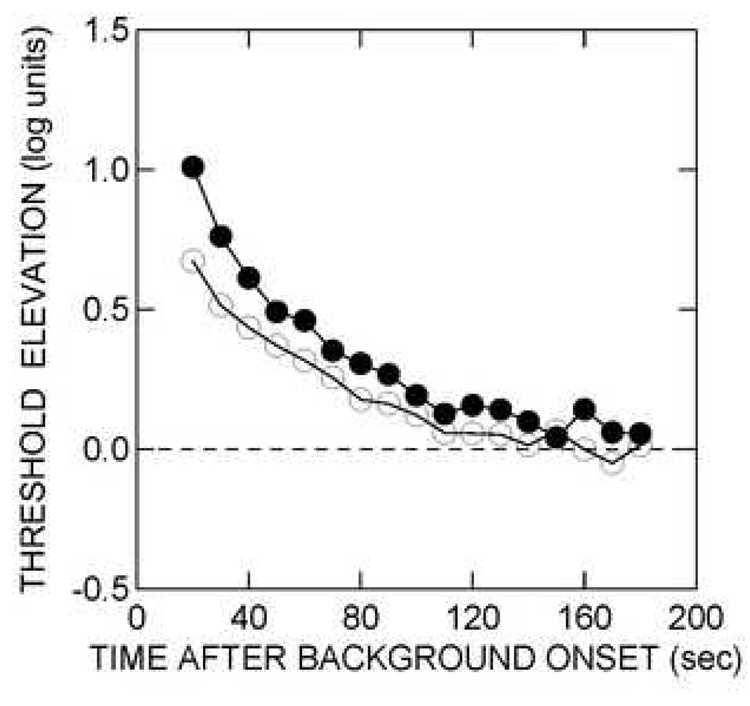
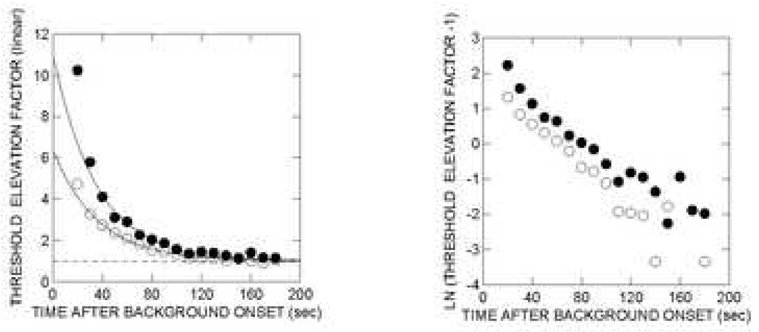
Dynamics of foveal light adaptation for vision mediated via short-wavelength-sensitive (SWS) cones were compared for two groups of healthy amenorrheic (peri- or post-menopausal) women not using hormonal medication. Each subject was assigned to a group based on the color name-"lavender" ( approximately 2/3 of all subjects) or "white" (approximately 1/3 of all subjects)-chosen in a forced-response paradigm to best describe a threshold-level 440-nm test presented on a larger 3.6 log td 580-nm background that had been viewed for approximately 5 min. During the first 20-30s after this 3.6 log td background abruptly replaced a much dimmer background, the threshold elevations (relative to the steady-state levels measured at approximately 5 min) were significantly greater for the lavender-naming subjects than for the white-naming subjects. However, exponential rates of recovery were indistinguishable for the two groups. A viable interpretation is that the gain of the visual response at background onset is greater for lavender-naming subjects than for white-naming subjects at or distal to a site where responses from middle-wavelength-sensitive and long-wavelength-sensitive (MWS and LWS) cones oppose responses from SWS cones. In addition, the color names derived from foveal testing were related systematically to extrafoveal sensitivities measured with Short Wavelength Automated Perimetry (SWAP), in a manner suggesting that response gain and/or response speed may be greater for lavender-naming subjects in the direction of increased SWS response also. Evidence from other subject populations suggests that the choice of color name and the dynamics of visual response each can be affected by alterations (particularly reductions) of estrogen synthesis and response.
Figures


References
-
- Brule J, Lavoie MP, Casanova C, Lachapelle P, Hebert M. Evidence of a possible impact of the menstrual cycle on the reproducibility of scotopic ERGs in women. Documenta Ophthalmologica. 2007;114:125–134. - PubMed
-
- Chichilinsky EJ, Wandell BA. Photoreceptor sensitivity changes explain color appearance shifts induced by large uniform backgrounds in dichoptic matching. Vision Research. 1995;35:239–254. - PubMed
-
- Cicerone CM, Krantz DH, Larimer J. Opponent-process additivity--III. Effect of moderate chromatic adaptation. Vision Research. 1975;15:1125–1135. - PubMed
-
- Dacey DM. Parallel pathways for spectral coding in primate retina. Annual Review of Neuroscience. 2000;23:743–775. - PubMed
-
- Davies SE, Faivre IA, Werner JS. Transient processing in chromatic induction. Vision Research. 1983;23:707–712. - PubMed
Publication types
MeSH terms
Grants and funding
LinkOut - more resources
Full Text Sources
