


Cytochrome bc1-cy fusion complexes reveal the distance constraints for functional electron transfer between photosynthesis components
- PMID: 18343816
- PMCID: PMC2376229
- DOI: 10.1074/jbc.M800091200
Cytochrome bc1-cy fusion complexes reveal the distance constraints for functional electron transfer between photosynthesis components
Abstract
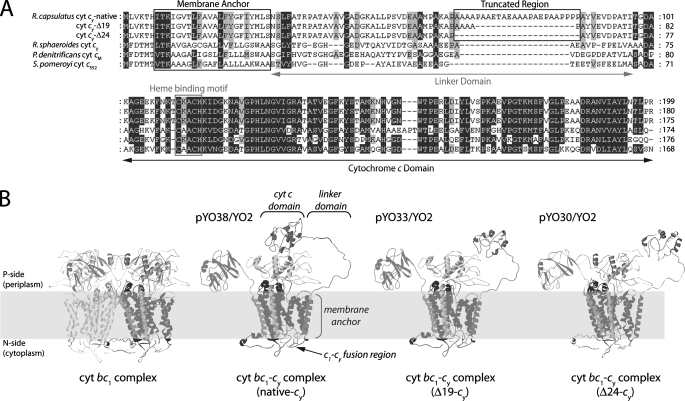
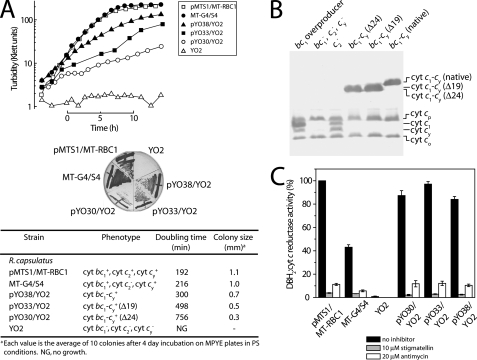
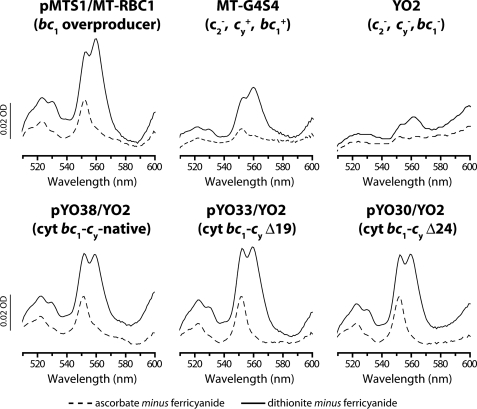
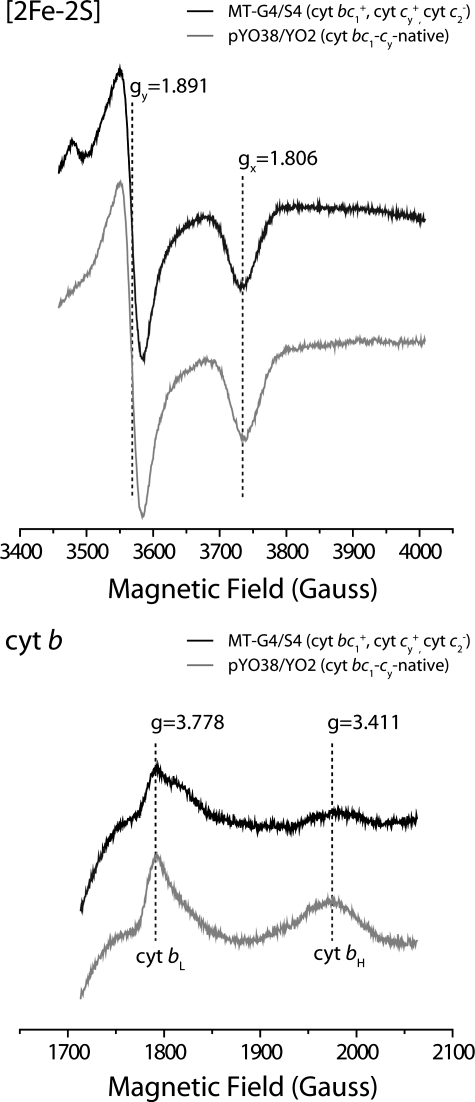
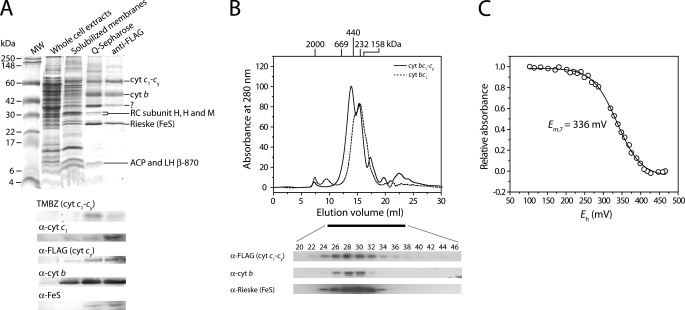
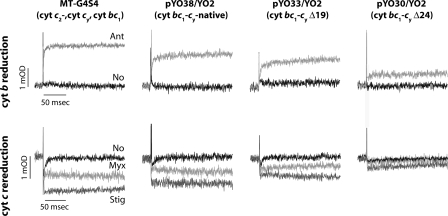
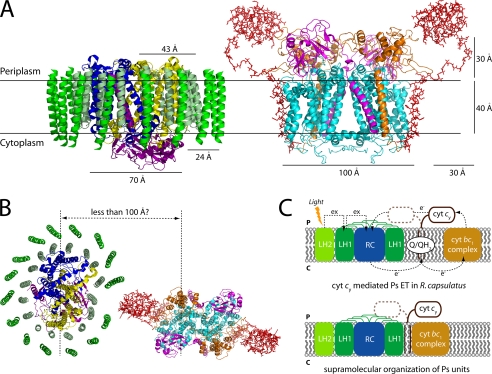
Photosynthetic (Ps) growth of purple non-sulfur bacteria such as Rhodobacter capsulatus depends on the cyclic electron transfer (ET) between the ubihydroquinone (QH2): cytochrome (cyt) c oxidoreductases (cyt bc1 complex), and the photochemical reaction centers (RC), mediated by either a membrane-bound (cyt c(y)) or a freely diffusible (cyt c2) electron carrier. Previously, we constructed a functional cyt bc1-c(y) fusion complex that supported Ps growth solely relying on membrane-confined ET ( Lee, D.-W., Ozturk, Y., Mamedova, A., Osyczka, A., Cooley, J. W., and Daldal, F. (2006) Biochim. Biophys. Acta 1757, 346-352 ). In this work, we further characterized this cyt bc1-c(y) fusion complex, and used its derivatives with shorter cyt c(y) linkers as "molecular rulers" to probe the distances separating the Ps components. Comparison of the physicochemical properties of both membrane-embedded and purified cyt bc1-c(y) fusion complexes established that these enzymes were matured and assembled properly. Light-activated, time-resolved kinetic spectroscopy analyses revealed that their variants with shorter cyt c(y) linkers exhibited fast, native-like ET rates to the RC via the cyt bc1. However, shortening the length of the cyt c(y) linker decreased drastically this electronic coupling between the cyt bc1-c(y) fusion complexes and the RC, thereby limiting Ps growth. The shortest and still functional cyt c(y) linker was about 45 amino acids long, showing that the minimal distance allowed between the cyt bc1-c(y) fusion complexes and the RC and their surrounding light harvesting proteins was very short. These findings support the notion that membrane-bound Ps components form large, active structural complexes that are "hardwired" for cyclic ET.
Figures
References
-
- Berry, E. A., Guergova-Kuras, M., Huang, L. S., and Crofts, A. R. (2000) Annu. Rev. Biochem. 691005 -1075 - PubMed
-
- Darrouzet, E., Cooley, J. W., and Daldal, F. (2004) Photosynth. Res. 7925 -44 - PubMed
-
- Crofts, A. R., and Meinhardt, S. W. (1982) Biochem. Soc. Trans. 10201 -203 - PubMed
-
- Gennis, R. B., Barquera, B., Hacker, B., Van Doren, S. R., Arnaud, S., Crofts, A. R., Davidson, E., Gray, K. A., and Daldal, F. (1993) J. Bioenerg. Biomembr. 25 195-209 - PubMed
Publication types
MeSH terms
Substances
Grants and funding
LinkOut - more resources
Full Text Sources
Other Literature Sources
Miscellaneous
