. 2008 Jul 10;27(30):4249-54.
doi: 10.1038/onc.2008.53. Epub 2008 Mar 17.

Oncolytic herpes virus with defective ICP6 specifically replicates in quiescent cells with homozygous genetic mutations in p16

Affiliations

Oncolytic herpes virus with defective ICP6 specifically replicates in quiescent cells with homozygous genetic mutations in p16

M Aghi et al. Oncogene. .

Abstract

Oncolytic herpes simplex viruses (HSVs), in clinical trials for the treatment of malignant gliomas, are assumed to be selective for tumor cells because their replication is strongly attenuated in quiescent cells, but not in cycling cells. Oncolytic selectivity is thought to occur because mutations in viral ICP6 (encoding a viral ribonucleotide reductase function) and/or gamma34.5 function are respectively complemented by mammalian ribonucleotide reductase and GADD34, whose genes are expressed in cycling cells. However, it is estimated that only 5-15% of malignant glioma cells are in mitosis at any one time. Therefore, effective replication of HSV oncolytic viruses might be limited to a subpopulation of tumor cells, since at any one time the majority of tumor cells would not be cycling. However, we report that an HSV with defective ICP6 function replicates in quiescent cultured murine embryonic fibroblasts obtained from mice with homozygous p16 deletions. Furthermore, intracranial inoculation of this virus into the brains of p16-/- mice provides evidence of viral replication that does not occur when the virus is injected into the brains of wild-type mice. These approaches provide in vitro and in vivo evidence that ICP6-negative HSVs are 'molecularly targeted,' because they replicate in quiescent tumor cells carrying specific oncogene deletions, independent of cell cycle status.


Figures

Figure 1
Figure 1
hrR3 replication is greater in arrested p16-deleted cells than in arrested p16-expressing cells. (a) Recovery in plaque forming units (pfu) ml−1 of infectious KOS-derived vRR(ICP6, UL39)LacZ+ hrR3 (from S Weller, University of Connecticut, Farmington, CT, USA) (Goldstein and Weller, 1988) 48 h after infecting (multiplicity of infection (MOI)=1.5) cultured human (U87 glioma, HF (human fibroblasts), T98 glioma, U373 glioma and U373-mRR cells; all obtained from American Type Culture Collection/ATCC, Manassas, VA, USA) and murine (MEFs (murine embryonic fibroblasts), obtained from R DePinho, Dan Farber Cancer Institute, Boston, MA, USA) cells that were either cycling or in G0/G1 (isolated by flow cytometry). Cells were maintained in Dulbecco's modified Eagle's medium (DMEM) supplemented with 10% fetal calf serum, 2 mM glutamine, 100 U ml−1 of penicillin, and 100 μg ml−1 of streptomycin at 37 °C and 5% CO2. U373-mRR were generated by lipofectamine (Invitrogen, Carlsbad, CA, USA) transfection of U373 with the neomycin resistance gene-containing plasmid pCDNA3.1 (Invitrogen), with the cDNA for the M2 subunit of mRR subcloned into the plasmid. The M2 subunit of mRR cDNA was generated by RT–PCR of mRNAs obtained from U373 cells using a 5′ primer from positions 189 to 211 of the M2 subunit coding sequence including the AUG site (5′-ATCCGGATCCACTATGCTCTCCCTCCGTGT-3′) and the 3′ primer from positions 1346 to 1368 including the UAA site (5′-GCTTAAGCTTATTTAGAAGTCAGCATCCAAG-3′), with the resulting PCR product first cloned into the TA cloning vector (Invitrogen). MEFs were isolated as described (Sharpless et al., 2001). For FACS analysis, 106 cells were trypsinized, centrifuged at 1000 g for 5 min, fixed by gradual addition of ice cold 70% ethanol (30 min at 4 °C) and washed with phosphate buffered saline (PBS). Cells were then treated with RNase (10 μg ml−1) for 30 min at 37 °C, washed once with PBS, resuspended and stained in 1 ml of 69 μM propidium iodide in 38 mM sodium citrate for 30 min at room temperature. The cell cycle phase distribution was determined by analytical DNA flow cytometry as described (Gray-Bablin et al., 1997). Alternatively, to isolate G0/G1 cells by DNA content, 109 cells were trypsinized, resuspended in PBS, and fluorescence activated cell sorting (FACS)-sorted. To measure viral yield, 105 cells were plated into 12-well plates in DMEM plus 10% fetal calf serum. The next day, cells were infected with hrR3 (MOI=1.5) for 48 h. Infected cells were scraped into the medium and subjected to three freeze-thaw cycles. Virus titers were determined by plaque assays on Vero cells. Standard deviations are shown. (b) Ratio of viral yield in cycling cells to viral yield in G0/G1 cells for the six different cell lines analysed in (a). The p16+/+ expressing cells (HF, MEF, p53 MEF, U373) exhibited significantly greater ratios than their p16−/− deleted counterparts (U87/T98 for HF, p16−/− MEF for MEF and for p53−/− MEF) or U373-mRR (P<0.05). Similar results (not shown) were obtained with murine fetal astrocytes of all p16/p53 phenotypes (obtained from R DePinho) and cells in G1 obtained by treating with 40 μM lovastatin (Merck, Rathway, NJ, USA) for 36 h, with lovastatin converted to its active form as described previously (Gray-Bablin et al., 1997).
Figure 2
Figure 2
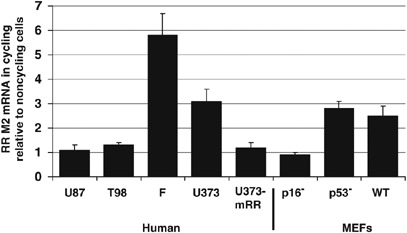
Ribonucleotide reductase expression is elevated in noncycling cells with p16 deletions. Reverse transcription (RT)–PCR shows the ratio of M2 subunit of mammalian ribonucleotide reductase (mRR) mRNA in cycling relative to noncycling cells was 0.9–1.3 in p16-deleted cells (U87, T98, and p16−/− MEFs). However, in p16-expressing cells (that is, wild-type MEFs, human fibroblasts, p53−/− MEFs and U373), this ratio was much higher (2.5–5.8). A high capacity cDNA archive kit (Applied Biosystems, Foster City, CA, USA) was used to generate cDNA from RNA isolated from cells using Trizol (Invitrogen) per protocol. Real-time RT–PCR was performed on an ABI Prism 7000 (Applied Biosystems) machine using human primer-probe combinations for RR subunit M2 (Applied Biosystems part nos. Hs00357247_g1 and Hs00168784_m1) and 18S rRNA (Applied Biosystems part no. 4308329) combined with TaqMan Master Mix (Applied Biosystems). Relative quantification was performed using 18S rRNA as an endogenous control. All reactions began with 10 min at 95 °C for AmpliTaq Gold activation, followed by 40 cycles at 95 °C for 15 s for denaturation and then 60 °C for 1 min for annealing/extension. Abbreviations used: F, fibroblasts; WT, wild-type; U373-mRR, U373 clone selected after stable transfection with plasmid constitutively expressing the M2 subunit of mammalian ribonucleotide reductase.
Figure 3
Figure 3
hrR3 exhibits greater replication in brains of p16−/− transgenic mice than in brains of wild-type mice. (a) Plaque forming units (pfu) per gram brain tissue recovered 5 days after intracranial inoculation of wild-type FVB (Jackson Laboratories; Bar Harbor, ME, USA) and FVB-derived p16−/− mice (provided by R DePinho) with wild-type KOS (obtained from D Knipe, Harvard Medical School, Boston, MA, USA) and hrR3 viruses. Viral recovery was nearly 30-fold lower when hrR3 was inoculated into the brains of FVB mice than in the other three experimental groups (P<0.05 by Student's t-test). Mice (n=10 per treatment group) were anesthetized with ketamine/xylazine (75/15 mg kg−1 intraperitoneally) and immobilized in a stereotactic apparatus. Through a midline sagittal incision, a 1 mm skull burr hole was drilled l 1 mm anterior to and 2.5 mm right of the bregma. KOS and hrR3 virus (105–1010 pfu) in 2 μl virus buffer (150 mM NaCl, 20 mM Tris pH 7.5) were injected 4.5 mm below dura using Hamilton syringes. Mice were euthanized when they became lethargic, anorexic, dehydrated or distressed. Brains were cut in small pieces, suspended in a volume of PBS twice the tumor volume, homogenized manually, sonicated and centrifuged at 16 110 × g for 5 min at 4 °C. The supernatant was isolated and freeze thawed three times, and viral yield was determined by plaque assays on Vero cells as described above. Standard deviations are shown. (b) LD50, the viral dose in pfu required for death of 50% of mice 14 days after intracranial inoculation, was nearly 3-log higher when hrR3 was inoculated into FVB mice than in the other three experimental groups. The LD50 for each virus/mouse strain combination was calculated as follows: (1) the portion of 10 mice who survived 14 days after inoculating 4 viral doses in FVB or p16−/− mice (105, 107, 109, and 1010 pfu) was calculated; and (2) Finney's probit analysis method was used to calculate LD50 from these four data points (Finney, 1971). (c) hrR3 positivity in neurons, as determined by staining for the marker gene β-galactosidase, was far greater with significant associated necrosis and surrounding inflammatory infiltrate in the brains of p16−/− mice (upper panel) than in the brains of wild-type FVB mice (lower panel; × 60 magnification). Brains were frozen in liquid nitrogen-cooled N-methylbutane, and sectioned coronally by cryostat to 8 μm thickness. Slides underwent blocking of endogenous peroxidase (DAKO PAP kit, Dako, Copenhagen, Denmark), incubating with goat serum for 30 min at 4 °C to reduce nonspecific background staining, incubation with mouse-anti-β-galactosidase antibody (Promega Biosciences, Madison, WI, USA) overnight at 4 °C, incubation with rabbit anti-mouse peroxidase conjugated secondary antibody (Dako) for 2 h, incubation with 3′,3′-deamino-benzidine tetrahydrochloride per protocol (Dako) and hematoxylin staining. Scale bar represents 100 μm.

References

    1. Aghi M, Martuza RL. Oncolytic viral therapies—the clinical experience. Oncogene. 2005;24:7802–7816. doi: 10.1038/sj.onc.1209037. - DOI - PubMed
    1. Burns KL, Ueki K, Jhung SL, Koh J, Louis DN. Molecular genetic correlates of p16, cdk4, and pRb immunohistochemistry in glioblastomas. J Neuropathol Exp Neurol. 1998;57:122–130. doi: 10.1097/00005072-199802000-00003. - DOI - PubMed
    1. Costello JF, Berger MS, Huang HS, Cavenee WK. Silencing of p16/CDKN2 expression in human gliomas by methylation and chromatin condensation. Cancer Res. 1996;56:2405–2410. - PubMed
    1. Elledge SJ, Zhou Z, Allen JB. Ribonucleotide reductase: regulation, regulation, regulation. Trends Biochem Sci. 1992;17:119–123. doi: 10.1016/0968-0004(92)90249-9. - DOI - PubMed
    1. Farassati F, Yang AD, Lee PW. Oncogenes in Ras signalling pathway dictate host-cell permissiveness to herpes simplex virus 1. Nat Cell Biol. 2001;3:745–750. doi: 10.1038/35087061. - DOI - PubMed

Publication types

Substances