Bilateral medial tibiofemoral joint stiffness in full extension and 20 degrees of knee flexion
- PMID: 18345340
- PMCID: PMC2267334
- DOI: 10.4085/1062-6050-43.2.157
Bilateral medial tibiofemoral joint stiffness in full extension and 20 degrees of knee flexion
Abstract
Context: The valgus stress test is used clinically to assess injury to the medial knee structures in 2 positions: full extension and some degree of flexion. The amount of flexion used to "isolate" the medial collateral ligament is not consistent in the literature, but most studies have shown that stiffness of the ligaments was consistent between the limbs.
Objective: To determine (1) if the stiffness of the medial knee structures was the same bilaterally, and (2) if the stiffness was different in full extension compared with 20 degrees of knee flexion.
Design: Criterion standard, before-after design.
Setting: University research laboratory.
Patients or other participants: Both knees of 45 healthy and active volunteers (26 females, 19 males; age = 23.2 +/- 3.96 years, height = 170.6 +/- 7.75 cm, mass = 74.2 +/- 15.14 kg) were studied.
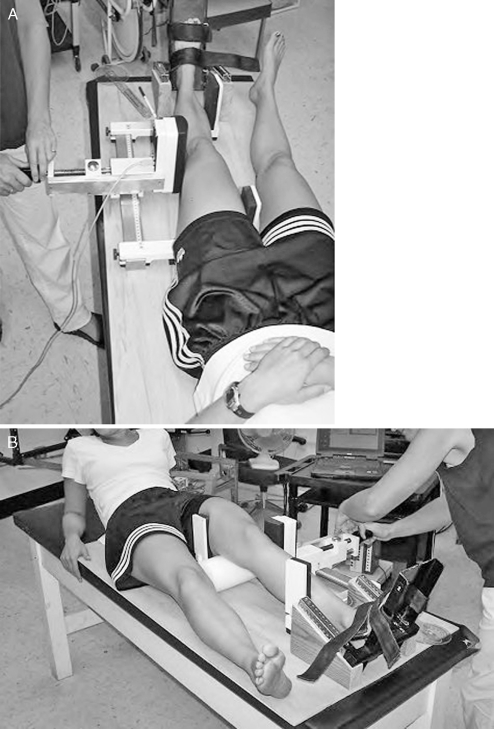
Intervention(s): A valgus force of 60 N was applied to the lateral aspect of both knees in full extension and in 20 degrees of flexion.
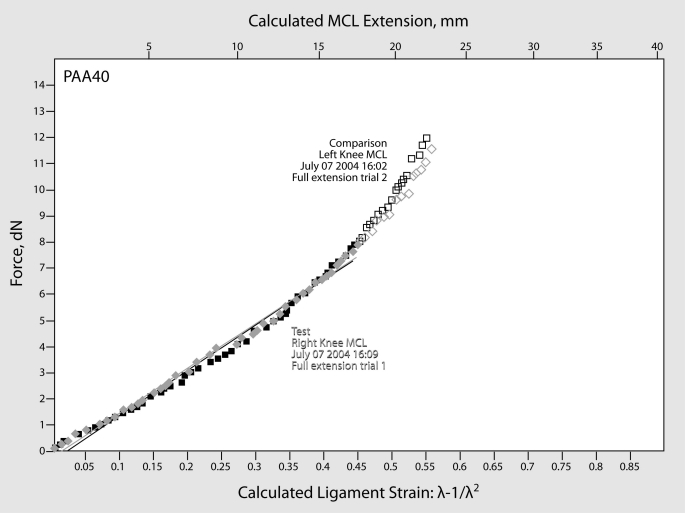
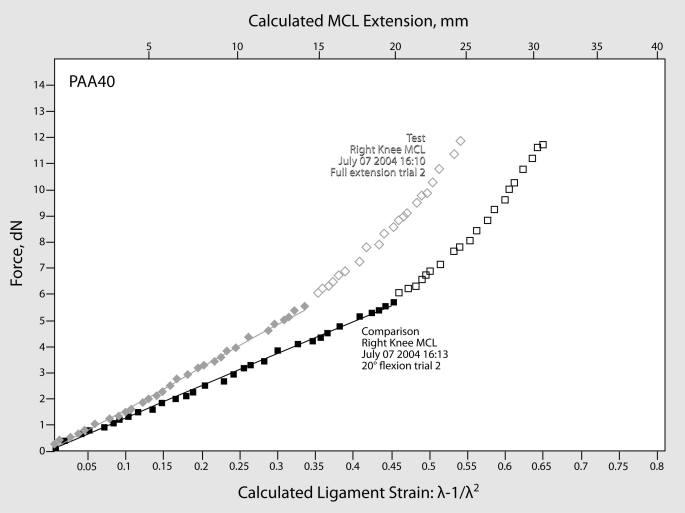
Main outcome measure(s): The slope of the force-strain line of the medial knee during a valgus force was calculated using the LigMaster arthrometer.
Results: Slope means in full extension were 16.1 +/- 3.3 (right knee) and 15.8 +/- 3.1(left knee). Means for 20 degrees of flexion were 12.2 +/- 3.1 (right) and 11.7 +/- 2.8 (left). Stiffness was greater when the knee was in full extension versus 20 degrees of flexion (t(44) = 12.04, P < .001). No difference was noted between the slopes of the 2 knees in extension (t(44) = 0.74, P = .46) or in flexion (t(44) = 1.2, P = .27).
Conclusions: These findings support the use of the contralateral knee as a control. Further, the valgus stress test should be performed in full extension and in some degree of flexion to assess the different restraining structures of the medial tibiofemoral joint.
Keywords: arthrometry; leg dominance; valgus stress.
Figures
References
-
- Hillard-Sembell D, Daniel D.M, Stone M.L, Dobson B.E, Fithian D.C. Combined injuries of the anterior cruciate and medial collateral ligaments of the knee: effect of treatment on stability and function of the joint. J Bone Joint Surg Am. 1996;78(2):169–176. - PubMed
-
- Petersen W, Laprell H. Combined injuries of the medial collateral ligament and the anterior cruciate ligament: early ACL reconstruction versus late ACL reconstruction. Arch Orthop Trauma Surg. 1999;119(5,6):258–262. - PubMed
-
- Markolf K.L, Graff-Radford A, Amstutz H.C. In vivo knee stability: a quantitative assessment using an instrumented clinical testing apparatus. J Bone Joint Surg Am. 1978;60(5):664–674. - PubMed
-
- Anderson A.F, Snyder R.B, Federspiel C.F, Lipscomb A.B. Instrumented evaluation of knee laxity: a comparison of five arthrometers. Am J Sports Med. 1992;20(2):135–140. - PubMed
MeSH terms
LinkOut - more resources
Full Text Sources