


Mutation of the PDK1 PH domain inhibits protein kinase B/Akt, leading to small size and insulin resistance
- PMID: 18347057
- PMCID: PMC2423167
- DOI: 10.1128/MCB.02032-07
Mutation of the PDK1 PH domain inhibits protein kinase B/Akt, leading to small size and insulin resistance
Abstract
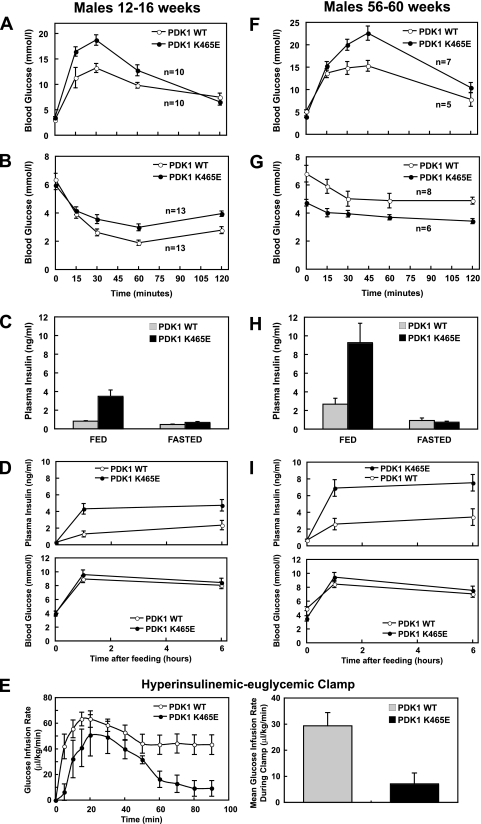
PDK1 activates a group of kinases, including protein kinase B (PKB)/Akt, p70 ribosomal S6 kinase (S6K), and serum and glucocorticoid-induced protein kinase (SGK), that mediate many of the effects of insulin as well as other agonists. PDK1 interacts with phosphoinositides through a pleckstrin homology (PH) domain. To study the role of this interaction, we generated knock-in mice expressing a mutant of PDK1 incapable of binding phosphoinositides. The knock-in mice are significantly small, insulin resistant, and hyperinsulinemic. Activation of PKB is markedly reduced in knock-in mice as a result of lower phosphorylation of PKB at Thr308, the residue phosphorylated by PDK1. This results in the inhibition of the downstream mTOR complex 1 and S6K1 signaling pathways. In contrast, activation of SGK1 or p90 ribosomal S6 kinase or stimulation of S6K1 induced by feeding is unaffected by the PDK1 PH domain mutation. These observations establish the importance of the PDK1-phosphoinositide interaction in enabling PKB to be efficiently activated with an animal model. Our findings reveal how reduced activation of PKB isoforms impinges on downstream signaling pathways, causing diminution of size as well as insulin resistance.
Figures




References
-
- Alessi, D. R., M. Deak, A. Casamayor, F. B. Caudwell, N. Morrice, D. G. Norman, P. Gaffney, C. B. Reese, C. N. MacDougall, D. Harbison, A. Ashworth, and M. Bownes. 1997. 3-Phosphoinositide-dependent protein kinase-1 (PDK1): structural and functional homology with the Drosophila DSTPK61 kinase. Curr. Biol. 7776-789. - PubMed
-
- Alessi, D. R., M. T. Kozlowski, Q. P. Weng, N. Morrice, and J. Avruch. 1998. 3-Phosphoinositide-dependent protein kinase 1 (PDK1) phosphorylates and activates the p70 S6 kinase in vivo and in vitro. Curr. Biol. 869-81. - PubMed
-
- Artunc, F., R. Rexhepaj, H. Volkl, F. Grahammer, C. Remy, D. Sandulache, O. Nasir, C. A. Wagner, D. R. Alessi, and F. Lang. 2006. Impaired intestinal and renal glucose transport in PDK-1 hypomorphic mice. Am. J. Physiol. Regul. Integr. Comp. Physiol. 291R1533-R1538. - PubMed
-
- Balendran, A., A. Casamayor, M. Deak, A. Paterson, P. Gaffney, R. Currie, C. P. Downes, and D. R. Alessi. 1999. PDK1 acquires PDK2 activity in the presence of a synthetic peptide derived from the carboxyl terminus of PRK2. Curr. Biol. 9393-404. - PubMed
-
- Balendran, A., G. R. Hare, A. Kieloch, M. R. Williams, and D. R. Alessi. 2000. Further evidence that 3-phosphoinositide-dependent protein kinase-1 (PDK1) is required for the stability and phosphorylation of protein kinase C (PKC) isoforms. FEBS Lett. 484217-223. - PubMed
Publication types
MeSH terms
Substances
Grants and funding
LinkOut - more resources
Full Text Sources
Other Literature Sources
Molecular Biology Databases
Miscellaneous
